by Dean | Aug 24, 2017 | General

The Nutty Professor (Photo credit: Wikipedia)
The “inner man” Prof. Julius Kelp releases from himself through chemical means is the rude, unspeakably conceited Buddy Love—not a good inner man. Julius, a college chemistry teacher, fails to realize this, and never expects Stella (Stella Stevens) to fall for him. We don’t expect it either; he’s a nutty professor—played with farcical adroitness by Jerry Lewis in the Lewis classic, The Nutty Professor (1963).
However, the movie ends on a dandy note by having Julius and Stella walk off to get married as Stella, unknown to her fiance, bears on her belt two bottles of the weird chemical that turned Julius into masculine Buddy. Sincerely wanting the qualities of Prof. Kelp, she also wants, I would say,—for Julius—some of the qualities of Buddy Love.
Lewis’s film is a sassy, leisurely, corny delight—with “some scenes that can hold their own with the classic silent comedies” (Pauline Kael). One such scene contains a tracking shot of people on the street looking astonished at an unseen, very, very cool Buddy. Another shows, in a flashback, Julius’s darkly, grimly funny parents while goofy baby Julius is in a nearby playpen. . . Stella Stevens fills the bill as the lady-love, and is youthfully beautiful. Del Moore, as the college president, and Howard Morris, as the professor’s father, are successful as well, hilariously right.
In ’63, The Nutty Professor may have been the best American comedy since Pillow Talk.
by Dean | Aug 21, 2017 | General
Unread by me, an A.S. Byatt novel, Possession, became in 2002 a weak film directed and co-written by Neil LaBute. Such LaBute films as Your Friends and Neighbors and Nurse Betty are dismally offputting, while this one is merely poorly written.
In it, two literary researchers in London (Aaron Eckhart and Gwyneth Paltrow) try to solve the mystery of whether an illustrious 19th century poet, Randolph Henry Ash (Jeremy Northam), began an extramarital affair with a fellow poet, the lesbian, or bisexual, Christabel LaMotte (Jennifer Ehle). It so happens he did, and so does Eckhart begin a licit if dullish affair with Paltrow, playing an Englishwoman. The crosscutting between time periods yields on screen the two researchers more often than the two luminaries, which is a shame since Ash and LaMotte are the more interesting couple—and with Northam and Ehle outacting Paltrow.
The script, one of whose writers is the playwright David Henry Hwang, has its people saying things like “I have known incandescence and must decline to sample it further.” To the scenarists’ credit, though, elsewhere the dialogue shines. But characterization matters little here—less, in fact, than dialogue. We wish to know more about Ash, this fictitious poet laureate to Queen Victoria, a man whom Paltrow’s character calls “a soft-core misogynist.” Ostensibly a feminist, Paltrow’s character herself is a zero. Then there’s Blanche (Lena Headey), Christobel LaMotte’s lesbian companion who turns out to be mostly a punching bag.
Possession was not a mature work for LaBute. He may have avoided his usual misanthropy, or whatever it is, but why do it in an adaptation of a book by A.S. Byatt? Generally his directing is not only good but expert, and once again he gets plenty of vitality from Aaron Eckhart. Luciana Arrighi did the spot-on production design, Jean Yves Escoffier the cinematography. Thanks to this pair, the look is modestly painterly—appropriate for a small but artful opus. Alas, a small but artful failure. LaBute is a gifted man with a baffling career.
by Dean | Aug 18, 2017 | General

Two-Lane Blacktop (Photo credit: Wikipedia)
Footage of the rural road in America, with plenty of medium-long shots and no score, dominates the screen in the 1971 Two-Lane Blacktop, directed by Monte Hellman. A flick about two car nuts who routinely race other street drivers for money, it is so low-key it is practically asleep at the wheel. Neither James Taylor (the singer) nor Dennis Wilson (the Beach Boy) is a good actor as they play the Driver and the Mechanic—no names, please—respectively. But Warren Oates is, and Rudolph Wurlitzer‘s screenplay is provocative and amusing.
Oates plays a man who, though proud of his car, is no longer young and has problems. Reduced to mendacious talk, he is a lost soul, while the Driver and the Mechanic are empty souls. As their girl companion (Laurie Bird) observes, their lives are no “better” than those of the noisy, mating cicadas they hear.
Apropos of Bird’s character, simply called the Girl, everything is a letdown. The Driver tries to retain his relationship with her, such as it is, by murmuring, “Figured we’d go on up to Columbus, Ohio. A man got some parts up there he wants to sell cheap.” But what goes on with these car nuts is cheap, and blandly the Girl replies, “No good.”
Two-Lane Blacktop has nothing new to say, but it can be a strange treat of “white trash” naturalism. If you haven’t been on the rural roads in a while, and you actually miss them, this is your film.
by Dean | Aug 15, 2017 | General

Cropped screenshot of Ida Lupino from the trailer for the film The Hard Way Further cropped from Image:Ida Lupino in The Hard Way trailer.jpg (Photo credit: Wikipedia)
The print I saw (on DVD) of Ida Lupino‘s The Young Lovers (1949) is so technically deficient it seems ready to come apart at the seams. The audio, for example, is often lousy. As for the movie, it is a nicely serious love story in which the girl (Sally Forrest), a dancer, contracts polio. The guy (Keefe Brasselle), also a dancer, doesn’t—but he truly loves the girl. He has to eat, though, so he leaves for Las Vegas.
Herself afflicted with polio as a child, Lupino was a genuine creative force. Not only did she direct The Young Lovers, she also produced and, with Collier Young, wrote it. Likewise with other films. The movie in question, however, is pretty pedestrian and sometimes overwrought. But, again, it is nicely serious and thus manages to be watchable.
Also called Never Fear (a crummy title).
by Dean | Aug 14, 2017 | General
The French film The Clockmaker (1973) tells us that France in the Seventies is a country in which a loutish, abusive security officer is allowed to get away with the garbage he does. As the picture opens, the somewhat political son of the tale’s main character, a clockmaker (Philippe Noiret), has murdered the security officer and fled.
The film was directed by Bertrand Tavernier and so is not without artistic merit. Even so, it does not take the murder of the depraved man seriously enough, but more or less excuses it. At heart it is a politically radical film, consistently distrustful of authority. Based on a Georges Simenon novel, it was screenwritten by Jean Aurenche and Pierre Bost, who, in their seventies at the time, should have known better. It is a relatively simple but also foolish work.
Its counterculture attitudes could be appropriated for the sake of present-day people in America who are not exactly bending to the big Ideological Will. Two or three years ago, Wisconsin police illegally raided the homes of certain conservatives (probably Scott Walker supporters) and confiscated their computers. In a case involving the refusal to honor a same-sex marriage, any Christian defendant who did not show up in court would have a warrant sent out for his or her arrest. The current Attorney General wishes to expand the seizure of property, before a trial, of suspected drug traffickers. See what I mean?
by Dean | Aug 10, 2017 | General

Cover of Army of Shadows – Criterion Collection
Jean-Pierre Melville‘s Army of Shadows (1969), adapted from a Joseph Kessel novel, would be a mere adventure story if it were not for its impressive sophistication and excellent execution. It follows the actions of Philippe Gerbier (Lino Ventura) and other French Resistance members in German-occupied Marseille.
The Nazis in the film are scumbags, suspicious and inhumane. The qualms about violence the resisters often exhibit never arise in the hearts of the Germans. But the resisters do kill, for various reasons; yet, alas, the Nazis are able to shockingly push them against the wall. Watch the entire movie and you’ll see what I mean.
Treated unfairly in France—for one thing, it was thought the Resistance ought not to be glorified after the Algerian conflict—Shadows is long and slow-moving but, to me, fascinating and effectual.
(In French with English subtitles)
by Dean | Aug 8, 2017 | General
Dunkirk (2017), written and directed by Christopher Nolan, presents war in Europe within the broadness, or openness, of time—and even within a relatively brief duration of time. Three time periods meet, in all of which men are warring and struggling to survive; all demand endurance.
How credible some of the details in the film are I don’t know, but an enthralling and exciting enterprise this is. Although it contains more heroism than (British) patriotism, patriotism is there. So are great surprises and little mysteries, as when a charitable old man compliments the British soldiers but never makes eye contact with them. And when two of the soldiers quickly haul a wounded grunt on a stretcher a strikingly long way to a seabound ship, where, as it turns out, the grunt is in greater danger than he was before.
Unlike other war movies today, Dunkirk never becomes even slightly boring until, I’d say, the last 15 minutes. But, as well, it is gratifying to see that it bounces back a bit before those minutes are over.
by Dean | Aug 7, 2017 | General
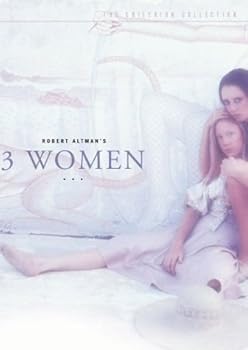
Cover of 3 Women – Criterion Collection
Director Robert Altman had “a succession of dreams” and afterwards based one of his movies—Three Women (1977)—on these dreams. Hence the film, though linear, is profoundly weird.
It is the story of Millie Lammoreaux (Shelley Duvall) and Pinky Rose (Sissy Spacek)—as well as a nonverbal painter named Willie (Janice Rule)—who work at a rehab center with mineral baths for the elderly. Millie is talkative, but very few people listen to her (funny, this); which easily leads us to infer that social interaction in the film amounts to almost nothing. And yet, ironically, the shy Pinky quasi-worships Millie, seeing a certain perfection in her. And there is nothing sexual in this—Pinky, like Millie, likes men—but . . . a question must be asked: Is Pinky a psychotic who actually wants Millie’s personality for herself?
The film never indicates that someone is dreaming this dreamlike story. Is it reality, then? Is it a work of art simply meant to resemble a dream—in other words, a work that is only about itself? Three Women is unceasingly perplexing. There are fine performances from Spacek and Duvall, though. The former is suitably eccentric and beautifully nuanced. With her diffident, little-girl face, the latter is oddly beguiling, improvising nicely. For improvisation is certainly here—but what about a raison d’etre?
by Dean | Jul 30, 2017 | General
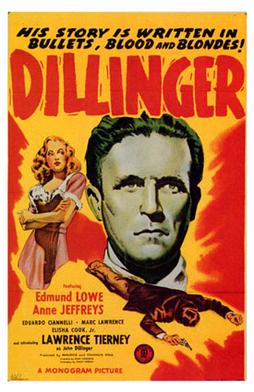
Dillinger (1945 film) (Photo credit: Wikipedia)
There is a useless prelude here in which a movie audience watches newsreel about John Dillinger the gangster before Dillinger’s father shuffles out on the stage to deliver his own information about the man. It actually promises to be boring.
The prelude belongs to the 1945 Dillinger, which isn’t boring, starring a very limited Lawrence Tierney as the ever-active bank robber and murderer. The screenplay by Philip Yordan is intermittently dopey—the movie, in point of fact, is near-trash—but not without heat and punch. Max Nosseck (who?) directed with only modest ability, notwithstanding he gives us a nifty scene where Dillinger, after having a tooth pulled, wakes up from the anesthesia only to be nabbed by waiting police officers.
I’m glad I saw Dillinger, but I can’t value it much. . . Speaking of very limited acting, Anne Jeffreys plays Dillinger’s love interest, and is one of the most beautiful blondes in American cinema.
by Dean | Jul 27, 2017 | General

Cover of The Good Girl
The Good Girl, from 2002, is a flop.
Jennifer Aniston plays Justine Last, a retail store assistant who attempts to escape her hated husband and her hated life by having a no-account affair with a young neurotic (Jake Gyllenhaal). Intelligent people are well aware that the film is dreadfully condescending to small-town Texans, but it is also true that after the condescension finally eases up, scriptwriter Mike White proffers a phony happy ending. We are prompted to ask a few questions: Why, really, does Justine hate her husband (John C. Reilly)? Because he frequently smokes pot? Did she not know what he was like before they got married? Did he have her fooled? No answers are supplied.
White substitutes serious intent for credibility. Eventually Justine’s hubby learns of her unfaithfulness, but, well, he accepts it. He stays married to her. Convincing? No.
Directed by Miguel Arteta, The Good Girl is an unprofound nonentity, the very thing the filmmakers don’t believe it to be. Its cheapness is enough to make it a nonentity. Mike White himself, an actor as well as a screenwriter, plays Corny, a security guard and a Christian, one who turns out to be, in Justine’s words, a “Bible-thumping pervert.” At length he gets beaten up for something he never did, which is, to White, no big deal.