by Dean | Jun 27, 2017 | General

Cover of I Fidanzati – Criterion Collection
Giovanni and Liliana, engaged to be married, are capable of bringing joy to each other, but . . . it might not happen for a long while. Or it will happen only periodically. The couple must be temporarily separated from each other because they cannot afford to marry and Giovanni, much to Liliana’s sadness, has agreed to a welding job in Sicily. The film—Italy’s The Fiances (I Fidanzati, 1963)—then zeroes in on Giovanni’s solitary life in a mundane Sicilian town. I mentioned joy—but the town offers little of it. It can be quite dreary.
The Fiances was scripted and directed by Ermanno Olmi, and it is tempting to think that while making it he was in love with Loredana Detto, the actress in Olmi’s Il Posto, whom he later married, and that this accounts for the film’s eventual romantic feeling. Expressed here, in fact, is the need for the certainty of love (romantic feeling or no). Giovanni and Liliana, we see, are more than the weak and financially poor persons they necessarily know themselves to be. They are fiancés, and to Olmi—a devout Catholic, in fact—this makes all the difference in the world.
Starring Carlo Cabrini and Anna Canzi, the picture is short and artistic, gentle and tasteful. It has more vigor than an early ’60s Antonioni film, but is more restrained and indeed smarter than a Fellini film. Few Italian products nowadays surpass it.
(In Italian with English subtitles)
by Dean | Jun 22, 2017 | General
After her mother’s death, Tristana (Catherine Deneuve) in 1970’s Tristana, becomes the ward of a much older man, Don Lope (Fernando Rey). Innocent because of her youth, Tristana is eventually propositioned by Don Lope, agreeing to go to bed with him. Hereafter she hates the man for his sexual proclivity and decides to take up with a young painter (Franco Neri), living with him for two years. Subsequently Tristana develops a tumor and has to have her leg amputated—and is again in the care of her guardian. Now, however, the woman is plainly bitter and cruel.
On the one hand, in this Luis Bunuel film, there is Don Lupe’s humane, religion-rejecting 1920s leftism (approved by Bunuel?); and on the other, Don Lope’s imperious attitude and unwise behavior because of sex. In light of this and Tristana’s corruption, the opus must be considered basically misanthropic. The themes here, however, have already been explored in Bunuel’s Viridiana, a film with more verve than Tristana. Why did Bunuel want to make the picture?
Deneuve’s part is dubbed in Spanish by another speaker (the film is set in Spain). A beautiful Spanish actress would have been preferable to a beautiful French one.
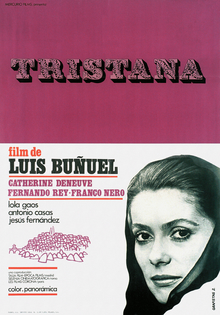
Tristana (Photo credit: Wikipedia)
by Dean | Jun 20, 2017 | General

Shane (film) (Photo credit: Wikipedia)
Directed by George Stevens, Shane (1953) is a Western—interestingly, one in which everything points to America still being a relatively young country. Men try to make a living in a spacious land where deer approach farms and a muddy ground fronts a needed dry goods store-cum-tavern.
Here and there the script by A.B. Guthrie Jr., based on a novel, is laughably weak. (Why does Joe Starrett [Van Heflin] show himself to be naïve about the angry Ryker?) But the film’s violent action—everything from the shooting of Torrey to the final showdown—is sobering and riveting, and there are exquisite epic images in a non-epic movie. I am prompted also to observe that, what with all the doings of Brandon De Wilde‘s Joey, Shane is practically a children’s film.
by Dean | Jun 19, 2017 | General
I’m unable to tell how valuable are the stories of Jamie Quatro that are heavily influenced by the literary avant garde.
But it’s different with a story like “Better to Lose An Eye,” whose conventional narrative shows, I believe, artistic merit. Quatro’s fiction is set in the American South and has its share of Southern Christians. The characters in “Eye” are a young girl, her quadriplegic mother and her grandmother, Nona; and we learn that the mother once lived a pretty fast life until a former boyfriend caused her paralysis by shooting her. The one born-again person in the story, the industrious Nona, nevertheless proves insensitive to the mother’s condition—to me, a rather cheap shot from Quatro. It is an otherwise effective story.
More satisfying is another non-avant garde tale called “The Anointing” (which, like the story above, is found in the 2013 collection, I Want to Show You More). Mitch, the suburban husband of Diane, falls into a deep depression, refusing to leave his bed. Diane is incessantly concerned. It can’t be helped that her Christian faith begins “waning,” yet she freely allows her pastor and five church elders to come to the house and anoint Mitch with oil in the name of the Lord. But there is no healing, and a problem with trust involving one of Diane’s two children crops up as well. A possible truth in the story is that Diane is anointed to love her family, which she does fiercely. Part of the last sentence reads, “She would do anything to save them,” and she loves them even as she suffers. In point of fact, she loves them in a Christ-like manner.
“The Anointing” is a smoothly, unerringly written 12-page gem—and not the only good short story Jamie Quatro has purveyed. Read “Georgia the Whole Time” too.
by Dean | Jun 19, 2017 | General
Reggie (the Audrey Hepburn character): Do you know what’s wrong with you?
The Cary Grant character: What?
Reggie: Absolutely nothing.
But wait. Reggie believes this because she’s infatuated with the Grant character and doesn’t really know him. Doesn’t the charade in Stanley Donen‘s Charade (1963) break down, revealing Grant to be a big-time thief and even a murderer?
A murderer— with the kind of wit he displays?
Later, Reggie falls in love with Grant, but more frequently she adverts to her fear, to how afraid she is. She might be snuffed out by one of the movie’s criminals. Charade has honesty, as well as appealing improbable twists. It is a funny thriller directed with perfect smarts by the careful Donen.
‘Twas a great vehicle for Hepburn too.
by Dean | Jun 15, 2017 | General

Cover via Amazon
In his review of The Discreet Charm of the Bourgeoisie (1972), Charles Thomas Samuels wrote, “Bunuel’s film doesn’t deserve to be called surrealistic because its dislocation of reality isn’t dictated by theme but by narrative opportunism.” Is there a theme in this French-language attempt at surrealism? I think so: the theme that the middle class is blind—to everything.
Bunuel himself was blind. He and co-writer Jean-Claude Carriere produced a script wherein “the dislocation of reality” and frequent satire do not mesh at all. When Bunuel satirizes a clergyman who kills the murderer of his parents, before which he introduces a working-class woman who murmurs, “I do not like Jesus Christ,” he is merely indulging his atheism. Too, fascinated as he is by domestic terrorists, he appears to be a political ignoramus; but, as Samuels indicated, it is only the narrative opportunism and not this political dimension that’s behind the surrealism. Or “surrealism.”
by Dean | Jun 13, 2017 | General

Les Dames du Bois de Boulogne (Photo credit: Wikipedia)
The Frenchman Jean ceases to love Helene, who in turn plots to avenge herself on him. She starts financially supporting Agnes, a destitute cabaret dancer, and Agnes’s mother with the objective of introducing Agnes to Jean, sensing that he will fall for her. He does, but without knowing that Agnes is less than respectable—as ashamed, indeed, as she is cynical.
This is what goes on in Les Dames du Bois de Boulogne (1944), Robert Bresson‘s second film. The tale is lifted from a Diderot novel, though it seems very Henry Jamesian, infused with Bresson’s perennial Catholic morality. With a moving last scene, it’s quite a good love story (between Jean and Agnes), and by no means are the characters two-dimensional. They are intelligently acted by Maria Casares (Helene), a not-miscast Elina Labourdette (Agnes), and Lucienne Bogaert (Agnes’s mother). Paul Bernard, however, is deplorably charmless as Jean.
(In French with English subtitles)
by Dean | Jun 12, 2017 | General
The whole physical package of Gal Gadot—pro-Israel and former Miss Israel—is stunningly gorgeous, and the character she plays, Wonder Woman (or Diana), in Wonder Woman (2017), is truly morally good. Which only adds to her irresistible being.
Directed by Patty Jenkins, the film may prove to be the summer’s best pop feature. Diana is a princess on a splendid all-female island, and when she saves the life of a World War I pilot (Chris Pine), pulling his drenched body to the island’s beach where other Amazon inhabitants join the pair, it is the kind of rich, spectacular sequence Fellini would have enjoyed shooting had the technology been available in his day. Jenkins has an eye for grandeur and wide scopes, and is adeptly served by her team of technicians.
Granted, Wonder Woman is imperfect but certainly watchable, and thrilling. It has beauty and violence but neither is overdone. Moreover, well, it’s a rather confused religious film (three men, by the way, devised the story here). In the final scenes, Wonder Woman begins to represent the ascent of Christ-as-God, of Christianity, and—because she mightily battles Ares, the god of war—the elimination of mean pagan gods. The puzzling thing is that Diana, from that all-female island, was created out of clay by Zeus (!), and he too is ripe for elimination.
Oh, well. I liked the flick more than I do most superhero movies. . . Gee, those Middle Eastern Arabs who refuse to see Wonder Woman because it stars a pro-Israel Jew don’t know what they’re missing. Get a life!
by Dean | Jun 8, 2017 | General

Cover of Twilight
A very fine Paul Newman entertainment of post-studio system film is Butch Cassidy and the Sundance Kid, not the 1998 Twilight. A very fine detective entertainment of post-studio system film is Chinatown, not the 1998 Twilight. In this Robert Benton movie in which Newman plays an aging P.I., many of the details are a load of bull, especially in light of how many shootings take place.
Further, most crime dramas of the Sixties and early Seventies are candid but not vulgar (exception: Dirty Harry); Twilight is both. Floating around is a rumor that Newman’s P.I. had his “pecker” accidentally shot off by a 17-year-old girl. A man acted by James Garner urinates off his elevated terrace instead of in a toilet bowl, nearly hitting the P.I. Part of the bull I mentioned consists in these scenes. About the header on this review, let me say that much of the dialogue alone in the film proves it’s the work of a hack.
by Dean | Jun 6, 2017 | General
In the first-rate Iranian film, The Salesman (2016), by Asghar Farhadi, Emad, the main character, is not a salesman. He is a schoolteacher who plays a salesman—Willy Loman—in a local production of Arthur Miller’s Death of a Salesman, but this is not the only role he is drawn to assume. A second role is that of vengeful husband after he discovers the man who mistook Emad’s wife Rana for a prostitute and may have impulsively abused her. Although he’s a smart man who surely knows how to leave well enough alone, Emad, failing to do this, acts the dishonored avenger; and it ends badly.
Human weakness and fault are all over this downer of a film, but as well people are trying to adjust to, and stay alive in, urban society in general and Iranian society in particular. The old apartment building where Emad and Rana live begins to collapse due to nearby construction work. The former apartment of a prostitute, the couple’s new home, invites some aggression. That the police are never called to investigate the situation has something to do with the fact that, as Anthony Lane puts it, “The woman [in Iran] is the guilty party until proven innocent.”
Life in The Salesman has people limping along day after day, and even those who charge ahead, as Emad does, are limping. What Farhadi’s men believe themselves justified in doing—and they do gain our sympathy—suddenly pushes them and their wives against the wall. Both sexes demonstrate their vulnerability, in a marriage, alas, which may be in jeopardy. Is there a new role to take on that will salvage this?
(In Farsi with English subtitles)