by Dean | Feb 5, 2017 | General
Catchy or not, are the songs in the 2016 movie musical, La La Land, interesting? I would say yes, almost all of them are—and they’re catchy besides. Which means they are pretty good, contrary to what some of the critics think.
Well directed by Damien Chazelle, the movie’s story nevertheless should have been better, not so dull and flimsy. (Why does Mia believe her one-woman show will be a success?) Until the climax, Chazelle stops taking chances with his song-and-dance numbers in order to let this bland story flow. What’s more, I don’t always like the film’s dim lighting. I do like the acting of Ryan Gosling and, especially, Emma Stone, though. Gosling is solid, Stone is marvelously solid.
Go see La La Land for the music and the acting.
by Dean | Feb 2, 2017 | General

Cover of Metropolitan – Criterion Collection
The characters in Whit Stillman‘s first film, Metropolitan (1990), are socially adept preppies (is that redundant?) who prove how much they’ve learned from and delighted in the prodigious world of ideas. Politics, social decline, literature, their own generation—all these are discussed as extensively as the bright boys and girls can manage it. Religion is, too, though not much. Nobody is living religion any more than he or she is living anything else, members of the “untitled aristocracy” as they are, except for Tom, who tries to abide by the moral principles of socialism as he sees them. A certain stagnation prevails.
The social scene is all most of these people have for sustenance. If the world of ideas is having any influence at all, it must be on sensitive Audrey, lover of Jane Austen and Mansfield Park, who may be imitating Mansfield‘s Fanny Price by affectionately longing for socialist Tom the way Fanny affectionately longs for Edmund. And perhaps it is significant that the man Fanny loves is a clergyman whereas the one Audrey loves is in truth not even much good at abiding by socialism’s moral principles.
But at least Audrey wants love for sustenance, as do the other girls in the film, eventually. For all the stagnation, change is as inevitable in these preppies’ lives as it is in The Cherry Orchard, and who knows? Maybe religion is around the corner. Nobody knows just where the language of theology and morality will take a person. In one particularly funny scene, someone calls a handsome chap named Nick a hypocrite for sleeping with a slut (to find out why he is called this, you’ll have to see the film) to which Nick responds, “It’s not hypocrisy . . . it’s sin.” And although the slut, Cynthia by name, immediately and confidently murmurs, “It’s hardly that,” the peculiar statement remains in the air, its weight undeniable. When it isn’t fatuous, language here does have weight, not least because it is witty. And, yes, fatuity gets spoken, as it does by all of us, but intellects here are not fully cultivated, not completely mature. Will they mature? What is this maturity? How likely the members of an untitled aristocracy are to find out I don’t know.
by Dean | Jan 31, 2017 | General
In August of 1939, German SS men attacked one of their country’s radio stations at Gleiwitz on the German-Polish border with the aim of blaming the attack on the targeted Poles. Thus a pretext would exist for declaring war on Poland.
Distributed by a company called Icestorm is a DVD of the 1961 The Gleitwitz Case, a German film by Gerhard Klein having to do with this scandalous plot. Unfairly criticized and neglected in the GDR, the film is unreservedly welcome in the U.S., even on disk. Written by Wolfgang Kohlhaase and Gunther Rucker, it is, according to the DVD case, mostly “based on statements by the [German] commanding officer to British military personnel.” It documents but is not a work of documentary realism; rather it aestheticizes the Gleiwitz case. Klein is an artist, interested in geometric composition, closeups and forceful montage, the last of which evokes heady romanticism at a time of implacable deception and ruthlessness. Although not without filler, the film is compelling and imaginative, boasting a marvelous if occasionally too light score by Kurt Schwaen. Almost everything about The Gleiwitz Case clicks.
by Dean | Jan 29, 2017 | General

Cover of Equus
1977 was a bad year for cinema. Sidney Lumet‘s film version of the Peter Shaffer play, Equus, didn’t make it any better.
In Equus, we witness what amounts to a religious passion, for a nonexistent horse-god, and the morose psychiatrist (in the film, Richard Burton) who cures this passion. But John Simon was right when he complained that the work “falls into that category of worn-out whimsy wherein we are told that insanity is more desirable, admirable, or just saner than sanity.”
The movie is dramatically underwhelming in a way the play, bad as it is, is not. This fits in with how dismal it all is: a nudity-filled, finally bloody piece of balderdash, this. And if Simon was correct that it’s possible to read Equus as “a thinly veiled paean to pederasty,” it does not surprise me. The most important character is a boy, and heterosexuality is not the most fulfilling thing in the world here.
by Dean | Jan 26, 2017 | General

Cover of The Palm Beach Story
Born into a rich family, director Preston Sturges was inspired to supply in The Palm Beach Story (1942) some generous millionaires and billionaires who help a financially pinched married couple, Tom and Gerry Jeffers (Joel McCrea and Claudette Colbert). So pinched are they, in fact, that Gerry sees herself as a financial albatross (and inadequate wife) for Tom and flees to Palm Beach for a divorce. Really, though, the two love each other and so Tom pursues his misguided wife, only to find she now has a rich suitor (Rudy Vallee), led to believe that Tom is Gerry’s brother.
Colbert is charming and grounded in this unusual farce (whereas McCrea is strictly by-the-numbers) wherein Sturges again exhibits his love of slapstick. Not only that: he loves it when amusing lies are conjoined with heartwarming—or amusing—truth-telling. Possibly this is because he knows there is consistent lying in fiction’s representations of romance; The Palm Beach Story is a romantic comedy. What is also clearly true is that Mr. Preston knows how to lie like truth, which he does not do all the time but it is pleasing that he does do it.
by Dean | Jan 24, 2017 | General
Spring Breakdown (2010), by Melody Carlson, is one of the short books in a series, for young adults, about six teenaged girls. As a brief summary inside the book puts it: “The wealthy fashion students in Mrs. Carter’s boardinghouse spend a quiet spring break in Florida until . . .” Well, until spring breakdown hits. Fun time is over.
The girls are typical teenagers except that two or three of them are Christians, among them DJ and Taylor. Like the unsaved girls (and lover-boys), these two have their faults, albeit for Taylor one of them isn’t boozing now that she is a spiritually delivered ex-alcoholic. THIS isn’t ordinary, but all kinds of ordinary incidents roll into this little bailiwick. The only bailiwick the girls know, it is a mixed bag of the mundane and the fleshly. There is a Rockabilly dance. DJ and Taylor do some harmless skinny dipping at night. Two other girls, Eliza and Casey, get drunk after a bumpy photo shoot. There are, however, some spiritual and emotional challenges for DJ (the main character) pushing to the side all the kids-will-be-kids occurrences.
Carlson’s prose is imperfect—for one thing, she keeps misusing “hopefully”—but her narrative is entertaining and her dialogue is serviceable. It’s a Christian book, but not a preachy one. And it’s meant to appeal to a broad audience. I would rather see devout teens reading Spring Breakdown than buying a fundamentally insignificant Adele or Beyoncé CD.
by Dean | Jan 22, 2017 | General

Family Law (film) (Photo credit: Wikipedia)
In Derecho de Familia (2004), a.k.a. Family Law, from Argentina, Perelman Sr. (Arturo Goetz) practices law. His son, Perelman Jr. (Daniel Hendler), teaches legal ethics at a university, although he too practices law as a defense attorney. That filmmaker Daniel Burman presents the vocational spheres of these two men, father and son, is the most agreeable thing about Family Law. Otherwise there is nothing exceptional here. Nothing new is being said, nothing particularly compelling is done. It’s just a well-made film about a family.
What is being said? A message about the burden of transience; the idea that grown sons recognize themselves in their fathers (as daughters do in their mothers); that anguish has a way of sneaking into any given father-son relationship. Again, nothing new. In truth the film is more intelligent than, say, Cronicas but is less challenging, less gripping, than that South American picture. By no means do I wish to discourage anyone from seeing it, but I must wrap it up by asking a question: Does Burman disapprove of Perelman Jr.’s unwillingness to degrade or embarrass himself in certain public activities involving his little son Gaston, e.g., dressing up as a clown? If so, why? Granted, like Perelman Sr. Perelman Jr. is not an ideal father but he isn’t a bad one either. He has a lot to learn but . . . what is Burman getting at?
(In Spanish with English subtitles)
by Dean | Jan 19, 2017 | General
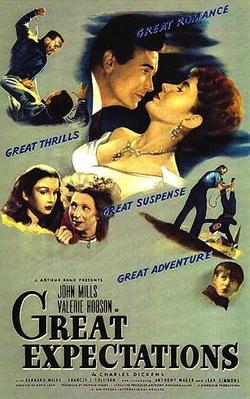
Great Expectations (1946 film) (Photo credit: Wikipedia)
A 1946 British film directed by David Lean, Great Expectations is a civilized and scintillating adaptation, with acting ranging from extraordinary to ordinary—most of it the former. Consider Finlay Currie as Magwitch and Martita Hunt as Miss Havisham. Almost needless to say, GE is visually finer and emotionally deeper than most of the Old Hollywood adaptations of classics, nifty as these can be (e.g. Cukor’s Little Women). Granted, its simple humanitarianism is boring now, but at least the film avoids moralism. And it itself isn’t boring.
by Dean | Jan 17, 2017 | General
I was worried that Martin Scorsese‘s Silence (2016), based on the fine Shusaku Endo novel, was ready to deem Christian apostasy no more unfortunate or dismaying than Christian commitment, but happily it refuses to do so. The honest and truthful content in Endo’s book about tortured and executed Catholic believers in 17th century Japan is properly transferred to the film—making it a soberly Christian film—though perhaps with too little understanding of the inclinations of the faithful.
Two Jesuit priests (Andrew Garfield and Adam Driver) sail to Japan to find a missionary padre (Liam Neeson) said to be “lost” to the Church. This man, Father Ferreira, was a real-life figure driven to apostasy by torture, albeit before his death he supposedly recanted. When Ferreira tells Father Rodrigues (Garfield) that Japanese converts who are martyred die not for Christ but for the ministering priests, it does not ring true at all. Yet there is no one in the film to positively belie this. To me this is a flaw, but at any rate Silence is benignly spiritual and winningly profound. Its concerns must be respected. The inhumanity and suffering are relentless, with one of those concerns being the silence of God while His servants are agonized. The Japanese authorities might as well be ISIS or (possibly) the North Korean government. But, truth to tell, it is Christ Who subtly prevails.
Scorsese’s movie is just as notable a work of art as the novel. Its 165-minute length underscores that time keeps bringing to the Christians the necessity for making hard decisions, for thinking how to stave off further horror. There is, sadly, much to figure out.
by Dean | Jan 15, 2017 | General

Cover of Edmond
Indisputably, people don’t know why they exist. Are they in hell? IS there a hell? Edmond, the anti-hero in Stuart Gordon‘s film Edmond, would like to know. Really, it is David Mamet‘s film too; he authored the script and Edmond is the 2005 screen version of his Eighties play.
His protagonist (William H. Macy) leaves his wife and wanders into an ugly urban environment, one requiring too much money for a prostitute and a measure of furious self-defense. Temporarily losing his mind, Edmond knifes to death a waitress played by Julia Stiles. Along with being intelligent, the film is unspeakably grim and, in the end, grimly perverse. Which is why I don’t like it.
As it happens, hetero Edmond gives in to, and starts an intimate relationship with, an incarcerated black man who threatens to kill Edmond if he doesn’t sodomize the creep. It’s an instance of prison rape. Mamet means this to counteract Edmond’s earlier racist outbursts after some black-on-white crime occurs, for his protag, you understand, enjoys the relationship. He takes comfort where he can find it, but it’s an unacceptable counteraction. No true insight, no true uplift, and not much plausibility exist in this. . . Until the finis, Mamet’s screenplay (and play) is savagely honest, but also too hideously pessimistic and sans the brilliance of the play Edmond is famously reminiscent of: Buchner’s Woyzeck.