by Dean | Aug 31, 2016 | General
In a recent Wall Street Journal, Terry Teachout reviewed a play titled A Day by the Sea by N.H. Hunter, a British dramatist who died in 1971. Greatly admiring the play, Teachout asked why it was mounted in New York in 1955 but never after that until now, in 2016. What he believes to be the answer is that critic Kenneth Tynan unfairly crushed the opus in his ’50s review of it, thus creating a hands-off attitude among theatre directors. According to Teachout, Tynan “had little use for plays without a political message” and non-political, I take it, is what A Day by the Sea is.
That a professional critic did such a thing doesn’t surprise me. And I can be confident that Tynan lapped up plays with a political message when the message was one he agreed with (i.e., a leftist message).
by Dean | Aug 30, 2016 | General
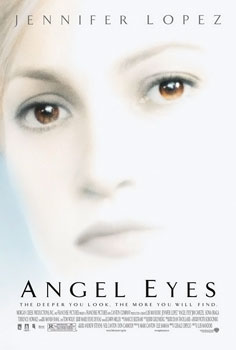
Film poster for Angel Eyes (Photo credit: Wikipedia)
Mark Holcomb of The Village Voice is right: Jennifer Lopez, in Angel Eyes (2001), is “winningly brassy/bashful.” In this Luis Mandoki film, written by Gerald DiPego, she plays a brassy/bashful policewoman, while handsome Jim Caviezel plays a shaken fellow on a moonbeam. The two fall in love.
For about an hour Angel Eyes sustained me because of J. Lo’s performance and pulchritude and the film’s considerable freshness. Indeed, it is not oblivious to the spiritual dimension of human life. But by and by DiPego throws all credibility and unsentimental honesty out the window, as witness the silliness about Caviezel’s newly received blessing of a pet dog named Bob. That spiritual dimension hardly means very much alongside material like this. Let it be lamented, too, that Hollywood folks do not care how sentimental their movies are so long as they’re unabashedly commercial; that’s all that matters. But I want to believe that Lopez and Caviezel rise above the money-mindedness enough to respect their craft of acting, for neither of them lets us down. And there’s still that worthwhile first hour.
by Dean | Aug 28, 2016 | General
After his divorce and a short time in prison, Andreas Winkleman (Max von Sydow) lives a solitary life until, first, he sleeps one time with a lovely neighbor (Bibi Andersson) and, second, he begins a romantic liaison with the damaged Anna (Liv Ullmann). A Passion, not The Passion of Anna, is the actual title of this 1969 Ingmar Bergman film when it is correctly translated, with passion as a synonym for suffering. Needless to say, this being a Bergman movie, Andreas and the other characters do suffer.
What is more, Bergman was impressed by the observation of a particular philosopher that people live strictly according to their needs, both positive and negative. He means for his people here to verify that. At the end of the film, the needs of Andreas conflict with each other and there is painful irresolution. A limited profundity is in this, but much more can be found in A Passion, which is also about isolation and the lies we tell to make it seem there is less isolation.
The film is brilliant, especially visually, but is yet another excessively talky Bergman piece. Predictably, the acting is magnificent. Max von Sydow was never more incisive, more soulful. As well, however, Bergman is the same old skeptic about religion (unlike me). He never—and I mean never—understood it. A Passion is easier to take than the Swedish artist’s other movies, excepting Winter Light, but I finally cannot accept it.
(In Swedish with English subtitles)
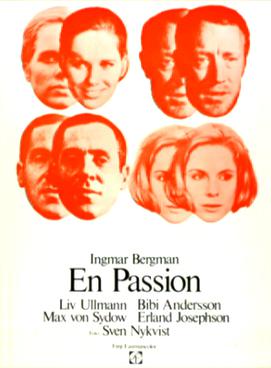
The Passion of Anna (Photo credit: Wikipedia)
by Dean | Aug 24, 2016 | General

Cover of Tadpole
There is fine acting from Bebe Neuwirth, John Ritter, Sigourney Weaver and the newcomer, Aaron Stanford. There is a fairly funny and unpredictable script by Heather McGowan and Niels Muller. Gary Winick‘s decision to shoot the film in DV is acceptable because Tadpole (2000) is, to use another critic’s proper adjective for it, unassuming.
Nevertheless, this Graduate-like film with a 15-year-old Benjamin and Neuwirth’s Mrs. Robinson would have been far better had the precocious boy (Stanford) not been in love, or “in love,” with his fiftyish stepmother (Weaver). With Neuwirth the boy is not smitten; with his father’s wife he is. It’s a sleazy and ill-fitting item. It knifes the otherwise successful confection right in the back.
by Dean | Aug 22, 2016 | General
The characters in the new Japanese picture, Our Little Sister (proper title: Umimachi Diary), hold our attention, but I find the story mediocre because certain things are laid on so thickly (a now dead woman became involved with Sachi’s married father; now Sachi is involved with a married pediatrician). In addition, the film is so humanistic—and finally so sentimental—that all the major characters are, or become, virtual saints. It is as though every fault has melted away. This is not the case with a great film like Ozu’s Tokyo Story, which I bring up since Sister resembles an Ozu production.
The movie is based on a comic-book novel which director Hirokazu Kore-da probably should have left alone.
by Dean | Aug 19, 2016 | General

Cover of Shopgirl
I’ve never read Steve Martin‘s novella Shopgirl, on which this 2008 film is based, but I mostly admire his script for the film—more than I do his wan acting.
Directed by Anand Tucker, Shopgirl stars Claire Danes as an L.A. sales clerk for Sak’s. Lonely and sans a beau, she takes up with a near loser (Jason Schwartzman) whom she can’t possibly love. By and by he changes for the better, but by then the Danes character, Mirabelle, has drifted into the arms of a friendly, fifty-something swell (Martin). The swell is not quite the man for her, though, albeit Mirabelle decisively wants him. But will she, can she, fall for Schwartzman too?
Martin’s little opus surveys the pleasure and heartache of love without mutual commitment, romance which is sexual but of limited potency. Note how falling in love spurs Mirabelle to give up antidepressants, only to eventually find she still needs them irrespective of whether she has a beau or not. . . A histrionic angel, Danes creates a tender Mirabelle, and Tucker makes sure she has presence. There are shortcomings in the film, such as Martin’s unnecessary voiceover and the fact that the last sentence he speaks will not do. But, too, it is feelingful and pleasantly Chekhovian. And, yes, not very comedic but it doesn’t have to be.
by Dean | Aug 18, 2016 | General

Cover of Sudden Fear
Revived this month in a New York City theatre, the 1952 thriller Sudden Fear, by David Miller (who?), presents love being replaced by self-preservation, both belonging to Joan Crawford‘s Myra Hudson. Myra adores, and marries, the unscrupulous actor Lester (Jack Palance) but he starts making out with an old flame (Gloria Grahame), who hatches the idea that the two of them should murder Myra for money.
It’s riveting stuff, nicely justifying its title. With an often sweat-drenched face—playing an armed self-defender who does not want to kill—Crawford deepens the film. And Palance and Grahame are not without their unique appeal.
by Dean | Aug 16, 2016 | General
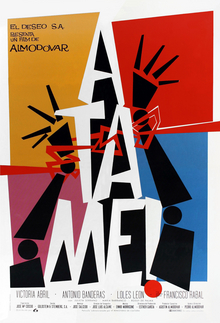
Tie Me Up! Tie Me Down! (Photo credit: Wikipedia)
There really isn’t much to Almodovar‘s Tie Me Up! Tie Me Down! (Atame! 1990) because it exists only to be daring or—if you will—transgressive, not to convey a shared vision of life. It is also decidedly politically incorrect, which is okay by me, since it deals with a woman (a porn star played by Victoria Abril) who falls in love with her unstable kidnapper (and would-be husband, played by Antonio Banderas).
Abril doesn’t quite convince me as a porn star and a drug addict, but it hardly matters: her acting is excellent. It isn’t her fault that her taking up with the kidnapper is a rather hard sell. Tie Me Up! may be rated NC17 for its sex and nudity, but it is utterly minor, if beguiling (or seductive). And, no, the Abril character does not really care about religion.
(In Spanish with English subtitles)
by Dean | Aug 15, 2016 | General

The Nun’s Story (film) (Photo credit: Wikipedia)
Catholic asceticism or self-deprivation, as in a convent, is not for everyone. It is not for every Christian, in fact. In the Fred Zinnemann film, The Nun’s Story (1959), strong-willed Sister Luke (Audrey Hepburn) becomes certain she is failing as a nun, certain she cannot adequately keep the Holy Rule she respects. Her good work as a nurse in the Congo cannot leave her with a sense of spiritual security, and so she renounces the convent life. Before leaving, Sister Luke (real name: Gabrielle) kneels to receive the sign of the cross from a fellow nun, who silently refuses to grant it. Subsequently our heroine looks at the crucifix on the wall and makes the sign herself. Communicated here is that Gabrielle no longer being a nun does not mean she is no longer a woman of God, a Christian.
How faithful the film is to Kathryn Hulme’s book I don’t know, but creditable work has been done by, among others, Zinnemann and screenwriter Robert Anderson. The movie peters out before its denouement, and reactions to the murder of a nun by a superstitious African ought to have been more affecting. All the same, Hepburn is beautifully serious and so is the film. To me it never gets boring; it gets memorable.
by Dean | Aug 9, 2016 | General

Bed and Board (Photo credit: Wikipedia)
Francois Truffaut made Bed and Board (Domicile Conjugal, 1970) to show us his autobiographical character, Antoine Doinel—a former juvenile delinquent—as a married man with a child. Casually he tosses in the revelation that Antoine (Jean-Pierre Leaud) is often selfish, and drama would be absent from the film had he not had Antoine cheat on his wife (Claude Jade) with a Japanese woman.
Less successful than Truffaut’s other Antoine Doinel pictures, Bed is nevertheless pleasurable with its slight goofiness and, well, essentially meaningless high spirits. It is usually the equivalent of a Paul McCartney love song, except that it’s pretty risqué. The Story of Adele H. it ain’t.
(In French with English subtitles)