by Dean | Aug 28, 2012 | General
His father’s anti-colonialism and pro-collectivism were instilled in Barak Obama when he was young, in all likelihood by his mother (Dad was gone). Later he learned from the likes of Communist member Frank Marshall Davis, and the rest is history as the same old laughable contempt for capitalism became, after 2008, almost palpable. We’ve learned nothing from Milton Friedman.
2016, the 2012 hit documentary by Dinesh d’Souza and John Sullivan, lets us know how essentially little it takes for leftism to grab a prosperous Western nation by the throat. Ours is a country which owes a $16 trillion debt and which funds offshore drilling in Brazil while oil exploration on its own terrain often receives short shrift. Madness!
by Dean | Aug 23, 2012 | General
For a book published in 1977, Lewis Patten’s The Trial at Apache Junction might seem like a pretty tired Western. But how tired, really, is such a novel when its story makes sense and its action passages are fairly imaginative? It concerns a sheriff who knows the scoundrel he’s supposed to execute did not get a proper trial, and it’s fun despite a few stale details. Throw in a perfidious deputy and a career-ending murder, and you just might end up with a notable entertainment.
Does the book have anything to say? Nope. It’s neither philosophical nor religious nor political. It’s the usual trinket. Have fun.

Sunset, 3/9/08, near Apache Junction, Arizona (Photo credit: gwilmore)
by Dean | Aug 20, 2012 | General
Spike Lee’s 25th Hour (2003), which concerns a drug dealer’s last day of freedom before his prison sentence begins, is a sluggish and offputting film which I didn’t bother watching to the end. Lee’s style is pushy and unreal, and there is too much of Terence Blanchard’s often gimcrack music.
“At its best,” wrote David Edelstein for Slate, “25th Hour is a melancholy tone poem,” but I wouldn’t expect a cinematic tone poem to be as talky as this. And that it is genuinely poetic is debatable.

Cover of 25th Hour
by Dean | Aug 14, 2012 | General
It was in 1979 that the late Donna Summer had a Top 40 hit with “Fujiyama Mama”. . . No, wait a minute! That was Wanda Jackson. Donna Summer had a hit with “Hot Love.” I get confused because both women were pleasure-seeking pop stars who eventually turned to Jesus Christ, albeit in Donna’s case it was only her public image that was pleasure-seeking (and sex-lovin’). From the porno song “Love to Love You Baby” to The Wanderer album (1980) with its “I Believe in Jesus” cut–this constituted Disco Gal’s journey. Summer did a duet with Streisand called “No More Tears.” With The Wanderer, it was No More Hedonism.
Technically not a Christian album, The Wanderer nonetheless offers “I Believe in Jesus” amid the optimistic “Looking Up” and songs about failed love (“Breakdown”). It has its spiritual dimension, in addition to being very entertaining. For all the no-account lyrics, almost every tune on it is catchy–and blessed with Summer’s powerful but unmannered vocals. Her voice is The Instrument here, that’s for sure.
I don’t know how meritorious Donna’s following albums were, but there have certainly been some strong individual songs, such as “Unconditional Love,” except for the line “Give me your unconditional love / The kind of love I deserve.” The kind of love I DESERVE?

The Donna Summer Anthology (Photo credit: Wikipedia)
by Dean | Aug 9, 2012 | General
Set in New York during the Twenties, Thomas Mallon’s comic novel Bandbox (2004) chronicles the doings of those who put out fictitious Bandbox magazine for men. Indeed, they struggle to keep the magazine afloat in the face of such realities as gangster involvement and the recalcitrance of film star Rosemary LaRoche, intended for a cover shoot.
A man who values animals (sometimes treated cruelly, to be sure), not people. The gangster activity of selling illegal narcotics. A strictly non-intellectual mag which may be considered the Maxim of its day. Bandbox presents all this–and what we understand, of course, is that much in America never changes (also true of other countries). And yet, simultaneously, there is that early 20th century innocence among Mallon’s people which many of us today apprehend and which will never exist again.
Great novels, it seems, are no longer being written, and it’s probably undeniable that this one isn’t great. Still, it’s bouncy and shrewd and enjoyable, the work of a talented writer.

Cover of Bandbox: A Novel
by Dean | Aug 6, 2012 | General
Pirates–i.e., evildoers–are sanitized and trivialized in the clay-animation feature, The Pirates! Band of Misfits (2012), and there is a conspicuously silly plot, but a lot of good jokes crop up as well. Even something weird will occur now and then, as witness the presence of Jane Austen and the Elephant Man (the year is 1837). Also, surprise, there is no love interest.
A product of Britain’s Aardman Animations, Pirates! is a rowdy family film proffering the voices of Hugh Grant, Imelda Staunton, and Salma Hayek. Miss Staunton “plays” a mean Queen Victoria, who looks like a fat Helena Bonham Carter.

Film poster for The Pirates! - Courtesy of Columbia Pictures (Photo credit: Wikipedia)
by Dean | Jul 30, 2012 | General
In Revanche (2009), from Austria, an ex-con named Alex (Johannes Krisch) works for a scurvy pimp and is secretly in love, and in a sexual relationship, with one of the pimp’s prostitutes, Tamara (Irina Potapenko). Both wish to get away from the pimp and raise enough money to pay the drug-addicted Tamara’s debts, so Alex devises a plan. He’ll rob a bank for some short-term cash, the two will flee Vienna for Ibiza where Alex has a chance of co-owning a bar. During the execution of the plan, however, Tamara gets killed by a policeman, Robert (Andreas Lust), who is thereafter obsessed with what he’s done. He doesn’t know exactly how the killing took place and his inner turmoil affects both his work and his marriage to Susanne (Ursula Strauss). To Alex the shooting was murder (he’s wrong) and he doesn’t want Robert to go on living. Early in the film, the pimp asserts that Alex believes he’s a tough guy but really isn’t. While living with his grandfather in a rural area, where coincidentally Robert and Susanne also live, will Alex turn into a tough guy and avenge himself by killing the policeman?
Even viewing it on DVD, I can see that Gotz Spielmann’s film, which never played in Tulsa, is a terrific work of art.
The effect of being deprived of a lover and thereafter alone is staggering. The scenes of city life in Vienna and then of doings in the countryside are equally compelling. Except for Alex’s grandfather, the people in Revanche are incomplete, stunted, because of the lure of ill-gotten gain, because of drug addiction, because of childlessness (in the case of Robert and Susanne). They face their own failure: Alex himself gets Tamara killed, Robert wishes he hadn’t killed her. Indeed, if the policeman did anything truly wrong, he eventually receives a comeuppance by being cuckolded. He is a pitiable man, and so, in a way, is Alex.
The film is Austrian, the title is French. “Revanche” is “revenge” in French. Spielmann may have given it this title because in France romantic notions about revenge, as about so many other things, were generated over the years. Even revenge against a policeman in the twentieth century–in French Algeria, perhaps?–could be considered as legitimate as revenge against the royal family during the Revolution. Yet Spielmann, I think, rejects such romanticism for his Austrian milieu. It never arises.
(This is a foreign film with English subtitles.)

Cover via Amazon
by Dean | Jul 26, 2012 | General
Anyone who’s a music lover should check out the Russian composer Sergei Prokofiev’s Violin Concerto No. 1 in D Major.
It’s an outstanding composition whose first movement gets feverish as well as lightheartedly lovely, whose second movement is strikingly jaunty, and whose third movement is poignant and highly melodic. It may be the best thing Prokofiev ever wrote.
For pared-down strings, I recommend Leos Janacek’s String Quartet No. 1 (inspired by the Tolstoy story, “The Kreutzer Sonata”)–just as rich and accessible as the Prokofiev piece.

English: Sergei Prokofiev playing his 3d Piano Concerto with the Orchestre Symphonique de Brussel under Désiré Defauw pencil on paper 22.8 x 16.9 cm signed l.l.: HW signed by performer l.r.: Serge Prokofieff February 1936 Palais de Beaux-Arts, Brussel (Photo credit: Wikipedia)
by Dean | Jul 23, 2012 | General
The first half of the new version of Spider-Man—The Amazing Spider-Man (2012)–is quite captivating and even disturbing as it tells of Peter Parker’s becoming the titular hero and his fighting the Big Mutant. But the second half is clunky and somewhat boring. Why, I have to ask, is Gwen Stacy’s policeman father such a fool? He obviously thinks he can take on the Big Mutant without Spider-Man’s help. (He can’t.)
Andrew Garfield is fine as Spider-Man. So is Emma Stone as Gwen, and although the role is underwritten, Gwen is plainly both a strong female and a romantic. In a pleasing scene, Peter Parker hesitantly begins to tell the girl about the astonishing spider bite he recently received. “I’ve been bitten,” he murmurs. “So have I,” Gwen replies, looking softly at Peter.
But a lot of not-so-pleasing stuff is here too. I actually consider Sam Raimi’s Spider-Man (2002), insipid as it occasionally is, a somewhat better entertainment.

The Amazing Spider-Man #121: "The Night Gwen Stacy Died". Cover art by John Romita Sr. (Photo credit: Wikipedia)
by Dean | Jul 16, 2012 | General
I have no use for Oliver Stone’s wrongheaded movies, and not surprisingly his latest, Savages (2012), is more interesting than truly good. It is very interesting, though, in my view; an intriguing drug-cartel drama. For the most part it is poorly written–forget the film’s dumb suggestion that there are “beautiful savages” here–but it’s dramatically sobering and visually seductive nonetheless. Or at least it’s visually seductive when it avoids Stone’s filmic pretentiousness; it is Don Mindel’s fine cinematography with its seaside colors that gives the movie its look.
Histrionically Benicio Del Toro (as a drug-trade bully), Salma Hayek (as the Baja cartel leader) and John Travolta (as a corrupt cop) carry the film. Taylor Kitsch and Blake Lively do not. Travolta gives it all he’s got, with acting that’s tough-fibered and unself-conscious. Hayek is pleasantly solemn.
David Thomson, on the Internet, is right: Savages is trashy, and not because Kitsch bares his bottom. It’s quite a sensationalistic stew. Even so, Thomson accepts the film and so do I. Reluctantly.
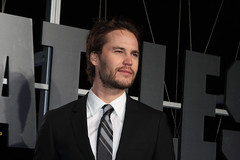
Taylor Kitsch (Photo credit: Eva Rinaldi Celebrity and Live Music Photographer)