by Dean | Sep 14, 2011 | General

Image by Getty Images via @daylife
Want to see a strong documentary? Kevin Knoblock’s Border War, from 2006, is it, for it skillfully presents its subject of the “border war” involving illegal immigrants from Mexico. It concentrates on a number of participants in this war, most of them opponents of illegal entry and of such measures as a guest-worker program–e.g. former Rep. J.D. Hayworth of Arizona.
Lupe Moreno, another participant, is a Latina activist against the illegals, she whose father, a migrant worker, helped Mexican family members and others emigrate to a “safe house” in California when Lupe was a little girl. Lupe lived in the safe house and had a very hard time of it. Her father’s doings drove Lupe’s mother to leave the man, and Lupe, unprotected, was sexually molested by the immigrants, all of whom were male. What’s more, a nephew of hers was murdered by an illegal immigrant.
So was Teri March’s husband, a policeman. A vicious, drug-dealing illegal shot Dave March to death and, at long last, was extradited to the U.S. (Brutal, this, and even more brutal was the 1994 murder of a 16-year-old girl in Texas at the hands of an illegal immigrant named Humberto Leal Garcia. After raping the girl, Garcia crushed her skull with a 35-pound piece of asphalt. He was FINALLY executed in 2011.) The film’s resident defender of the illegals, Enrique Morones, correctly notes that most border-crossers do not belong to the criminal class (they’re often excellent workers) and explains their desperation to escape poverty. Morones helps them with food and water, but, although he doesn’t want them to cross the border, he also glorifies them. “They’re heroes,” he says. Also featured is a U.S. Border Patrol agent, Jose Maheda, who rightly comments that the illegals ought to be treated with respect after they’re apprehended. He knows, however, they’re not actually heroic. They’ve broken the law and they leave garbage all over the desert. And they’re dependent on evil “coyotes,” i.e. men who smuggle immigrants into America for profit.
Knoblock isn’t on the side of the open-borders advocates. He lets Morones speak his mind, but he knows the man’s assertions about illegal entry are worthless compared with what Moreno, Hayworth and a few others have to say. I wish the film had spent a little time on the economic costs of massive immigration but it isn’t an analytical work and, withal, simply assumes the audience knows those costs are there. And we do know it, do we not? It is enough that Knoblock is alarmed by how many people are getting in. An Arizona rancher tells Rep. Hayworth that he once asked a coyote, “How many [immigrants] make it through?” The coyote answered, “They all make it through.” Sounds unsustainable to me.
Border War is a dark conservative film which wholeheartedly wishes to persuade liberals and conservatives alike that what’s going on is important. . .
It is still relevant.
by Dean | Sep 11, 2011 | General
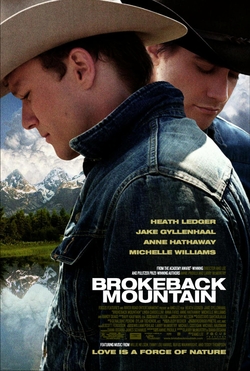
Image via Wikipedia
The famous picture about two “cowboys” working with livestock who initiate a homosexual love affair in 1963, Brokeback Mountain (2005) tells us that sexual and emotional self-denial is an unfortunate, even a tragic, thing. It’s wrong: What it should be telling us that such self-denial CAN BE an unfortunate thing, not simply that it is. Pretty simpleminded message.
by Dean | Sep 7, 2011 | General

Image via Wikipedia
It never came to a Tulsa theatre, but 2007’s Broken English, which I saw on DVD, is a small triumph for director-writer Zoe Cassavetes. Nora Wilder (Parker Posey) has no boyfriend. She does have a fling, however, in her native New York City with a Frenchman, Julien (Melvil Poupaud). It hurts her when he returns to Paris; indeed, Nora’s life is a vacuous mess. Ergo she decides to fly to Paris with her best friend to try to find Julien, that is, to find a man she does not actually love. She goes because she wants to love and to be loved. On another level, she goes not to find Julien but herself.
The film has to do with the drift and hope, not to mention the anxiety, of the lovelorn. I can’t resist declaring that this is one Nora who is not in anyone’s doll house–because she has no husband. Even so, there is no evidence that her best friend, a dissatisfied wife played by Drea de Matteo, is living in Ibsen’s doll house either. The adeptly directed Broken English is the work of the daughter of John Cassavetes and Gena Rowlands. It’s more deserving than daddy’s films.
by Dean | Sep 6, 2011 | General

Image via Wikipedia
Shark Night 3-D (2011) is meant to resemble grindhouse movies of the ’70s, which is to say it’s disgustingly low and stupid. Its PG-13 rating, though, is just about right: it features neither the F word nor bona fide nudity.
It must be that an American Idol culture sooner or later produces a flick like this, which co-stars an utterly hot but badly performing Katharine McPhee, an Idol alumna. Superior acting issues from Sara Paxton and Dustin Milligan, who are also utterly hot. The thing is, if Shark Night were a song routine, Simon Cowell would deservedly savage it.
Make a grindhouse movie if you will, but a useless mess is–probably–all you’ll end up with.
by Dean | Aug 29, 2011 | General

Cover via Amazon
Though somewhat plebeian, Mel Gibson’s The Passion of the Christ (2004) is a heartfelt and unusual religious, or Christian, film. The direction is sometimes heavy-handed, as when Jesus dissuades the Jewish men from stoning Mary Magdalene. But mainly it is absolutely solid, and several scenes make the movie memorable.
One of these is when Jesus stamps to death the strange snake which slithers out from under the androgynous Satan’s garment and which presumably represents evil. Another is the sequence in which at Golgotha the wind starts blowing and the sky becomes overcast to convey a sense of foreboding and yet hope. It precedes Jesus’ death and the tear-from-the-eye-of-God shot, and all of it is good directorial work from Gibson.
Even better is the resurrection scene. We see, from the Lord’s perspective, the stone roll away inside the dark tomb and a subsequent shot of thrown-off graveclothes. Then Gibson presents just the right images of Christ’s face in profile.
True, the violent cruelty of the Romans becomes tiresome, but the film succeeds at showing us utter mayhem along the Via Dolorosa after Simon of Cyrene is grabbed up and Jesus collapses. Too, thank goodness we get a respite from all the cruelty with an interlude, very Catholic, about Veronica and her handkerchief. Veronica, by the way, is both Jewish and sweet, but The Passion of the Christ does come down hard on the Jews because, as critic Stanley Kauffmann explained, the New Testament comes down hard on the Jews. Gibson’s film is a biblical one. Accordingly, however, it does not shy away from the truth of Jesus Christ having died for all humanity, for Jew and Gentile alike. That quiet resurrection confirms that “he was wounded for our transgressions” (Isaiah 53), those of all of us.
Jim Caviezel is fine as Jesus, though Maia Morgenstern, remarkable in The Oak (1991), has an easy part to play as Mary. Still her anguish is real. With his impeccable facial play, Hristo Shopov (Pontius Pilate) is magisterial.
Again, The Passion is a bit Hollywood-plebeian: I can do without the demon-baby Satan carries in his arms in one scene. But in its own way the film is riveting, a brutal work of orthodoxy about Evil and Redemption. It makes the unorthodox The Last Temptation of Christ (1988) look even sicker and stupider than it is.
by Dean | Aug 22, 2011 | General

Image by Getty Images via @daylife
The failure of America’s first black president to see the unsatisfactory directions in which he is taking the country (e.g., health-insurance premiums are rising and entrepreneurs decline to start businesses because of Obamacare) has driven the minds behind The Help (2011) to earnestly focus on the past and a relentlessly racist Mississippi. That’s Hollywood for you.
Based on a best-selling novel by Kathryn Stockett, Tate Taylor’s film presents wise and noble black maids of the early ’60s and, more often, white middle-class women too many of whom are flibbertigibbets and dopey conformists. I said “too many” of them, not “all” of them. Exceptions are Emma Stone’s Skeeter and the lady played by Sissy Spacek–that is, the mother of the outrageously racist Hilly (Bryce Dallas Howard).
Obama aside, it is doubtless true that Hollywood also wished to turn what I assume to be an entertaining book into an entertaining movie. The Help tells a juicy yarn, even as it gives the story of Skeeter and her new boyfriend short shrift.
Emma Stone is quite good in the film; I’d like to see perfection from her because I believe she’s capable of it. Octavia Spencer has real appeal as black maid Minnie; Viola Davis is authoritatively excellent as black maid Aibileen. Howard proffers a bit too much on-the-surface acting, but this is probably partly the fault of writer-director Taylor since he doesn’t quite know what he’s doing in his depiction of white women. His film is almost misogynistic.
by Dean | Aug 18, 2011 | General

Cover of Lamerica
The foreign-aid programs or projects of Western governments are there to help the poor. They are also there to be exploited by crooks, which is what happens in Gianni Amelio’s deeply humane Lamerica, from 1995.
The crooks in question are Fiore and Gino, two Italians who seek to set up in Albania a non-functioning shoe factory with the foreign-aid money of the Italian government. Only with the help of a dishonest Albanian official can they do this, for they need a native “chairman” for their phony company and a middle-aged suit finds them one among Albania’s wretched. This is Spiro, a senile old gent in a rotten, neglected prison from the days of Enver Hoxha. It is assumed that Spiro is an Albanian hero who fought against communism before Hoxha’s regime jailed him for fifty years, but that is not the case. He is Italian, a deserter from Mussolini’s army in the late Thirties.
Gino finds this out as his and Fiore’s scheme unexpectedly begins to unravel. Italy under Mussolini annexed Albania, then lost its rule when the communists took over in 1944. Such Italians as Spiro (real name: Michele) who stayed in the tiny country hid their nationality lest the new government imprison or execute them, notwithstanding Spiro/Michele got imprisoned anyway. For a while Gino finds the old man hard to handle, and the wheels of his jeep get stolen. Later he is detained by Albanian police and his passport is taken away. Forced to board a ship full of would-be immigrants to Italy, Gino sees Spiro/Michele there, dementedly believing he is sailing to America, or, as he pronounces L’America, “Lamerica.” Italy, it transpires, is the Albanians’ Land of Opportunity. Their America. They yearn to go there.
Gino the con man witnesses and even experiences the communist and post-communist misery and poverty of a broken country (which is not to say he reforms). There are characters in the film who wish they had communism back, but it so happens that Hoxha’s government left the Albanians no capital to live off of, to work with. A government once willing to execute Italians, it leaves behind what may be in fact a Putin-like authoritarianism; Lamerica gives us a glimpse of this. At the same time, the Italy that wishes to aid destitute Albanians cannot even help or rescue a fellow Italian–actually a Sicilian–like the old man. The tone of this film is gentle and uncynical; Amelio hates no one and is not angry at “welfare fraud” or communism or fascism. He is a moralist, however, one whose jaw has surely dropped at the scale of human want in a world of government failure and callousness.
by Dean | Aug 12, 2011 | General

Cover of My Summer of Love
Re My Summer of Love (2005):
A teenaged redhead called Mona (Natalie Press) lives in Yorkshire, England with her brother Phil (Paddy Considine), a former convict. They constitute the only family the pair have, the mother in fact having died of cancer, and their residence is a pub which Phil is turning into a Christian meeting place now that he claims to have found God. Not a whit happy over this religious conversion, Mona misses the man her brother used to be and childishly weeps because of it. After spontaneously calling Phil a fake, she goes on to eventually befriend a girl named Tamsin, played by Emily Blunt, who is a lovely mischief maker. Loss and dysfunction in the family drive both girls into a warm concord which soon waxes sexually intimate despite Mona’s and perhaps Tamsin’s heterosexuality (evidenced in Mona’s case by her doomed affair with a married man). In truth, what they are also driven to is role playing, fraudulence and–when you come down to brass tacks–sin. This, to be sure, is the designation one could slap on what Tamsin, as immature as Mona, does to her lover. The outcome is lamentable.
This British film by Pawel Pawlikowskyis flawed–the doings of Tamsin and Phil are a little less convincing than they ought to be–but, too, it is aesthetically pleasing with its potent closeups and Ryszard Lenczewski’s nicely rugose cinematography. And the actors know what they’re doing at every second.
Even so, there is this: in Christian circles there are people who are self-deceived, who are unwittingly faking it. The pre-“born again” Phil was a quite violent criminal, and it turns out that the “born again” Phil is violent as well. Indeed, he is a faker, hoping against hope that he has not remained the man he used to be. But in frustration Phil screams at the other religious believers in the ex-pub, “You’re all fakers!” and the film appears to accept this as woeful truth. Tsk, tsk. Phil and all his new friends: nothing but religious frauds. But why, I’d like to know, should this be so? It has to be nonsense. Another question, possibly unfair, comes to mind: Must Europeans such as Pawlikowski be so ignorant about Christianity?
A lot of talent can be observed in My Summer of Love, but the film is a nice-looking liar. And Emily Blunt’s nudity is wasted on it.
by Dean | Aug 9, 2011 | General
On the Robert Rauschenberg exhibition at Philbrook Museum in Tulsa, Oklahoma, which exhibition ends on Sept. 11, 2011:
Most of the Rauschenberg assemblages, lithographs, etc. here offer little in the way of an aesthetic experience. Storyline 1 (1968), for example, consists of lithograph images from the Arthur Penn movie Bonnie and Clyde and that’s it: it’s utterly trivial. On the other hand, exceptions to this no-aesthetic-impact tendency are found, I think, in Sling-shots Lit #2 and #7, especially the former. Both works feature fluorescent light and superimposition. #2 dazzles us with blocks and smudges of bright color, while #7 is a black and white assemblage-cum-lithograph replete with small pop culture images. Both held my eye for quite some time.
In an essay on Rauschenberg from the Brushes with History anthology (2000), Max Kozloff mentions “hints of disaster and dissolution” contained in the artist’s work and vision. Are there any such hints in the Philbrook exhibition? Yes, as in 1997’s successful Daze, with its empty green chairs and “ruptured” pond water. But, as it happens, the further Rauschenberg moves away from hints of disaster and dissolution, the weaker his creations become. They turn into pseudo-art; they fail to speak to me.
Not at all is this true of the older (permanent?) stuff at Philbrook. These are paintings and sculptures, including the realistic The Flax Spinner by Jules-Adolph Breton, the Fauvist Nice, le Baie des Anges by Raoul Dufy, and The Artist’s Wife in the Garden by Frederick Carl Frieseke. Beauties, these. They’re resonant.
More about the Philbrook collection in later posts.
by Dean | Aug 2, 2011 | General

Image via Wikipedia
It is never made clear just why Emily (Julianne Moore) no longer wants to be married to Cal (Steve Carell) in Crazy Stupid Love (2011), but that is the point at which the movie’s plot takes off. Early on, a splendid scene crops up in which Cal drives a 17-year-old girl home and all the while–knowing of Cal’s upcoming divorce, aware of current disaster–the girl nervously and silently longs to tell the man she adores him. Later, another well-done scene has a schoolteacher played by Marisa Tomei furiously rail at Cal at a parent-teacher conference for Cal’s romantic mistreatment of her, and this she does in front of Emily! Such footage is certainly to the credit of this contemporary screwball comedy directed by Glenn Ficarra and John Requa.
Unfortunately, the film is only sometimes funny. But its narrative is fun and curious and twisty. (And preposterous.) The pacing is as good as the editing, and the picture’s look is pleasingly unadorned.
This is the first time I’ve seen Emma Stone, who, although she is talented, mildly overacts in a long sequence with Ryan Gosling. Tomei does better with the schoolteacher; it’s a comparatively small role and she works memorably hard to create a character here.