by Dean | Dec 15, 2013 | General
People who have been long unemployed in America will not be hired for nascent jobs. Employers are not interested in them. This is the subject of a pretty good Slate.com article by Matthew Yglesias (Dec. 11).
Yet how many times can we provide these people with federal unemployment compensation? It’s unaffordable. To do nothing for them, however, “is cruel and insane,” says Yglesias. Indeed it is. Something should be done. Maybe one more year (2014) of unemployment comp, though at the same time I’d like to see President Obama and Congress do all they can to remove this infernal climate of uncertainty for entrepreneurs and corporations. (Alas, Obama can’t be trusted for this.) A proliferation of jobs—more jobs than we have workers for—is what is needed: THIS is what will benefit the long-term unemployed.
Obamacare, thou should’st not be living at this hour. Or any hour.
by Dean | Dec 12, 2013 | General
All the President’s Men, the Alan Pakula film, was a stand-out in 1976 largely because most other movies that year were so dismal.
Scripted by William Goldman, Men concerns the Bob Woodward-Carl Bernstein breaking of the ’72 Watergate story, and is as evenhanded about it as it needs to be, however skeptical I am about . . . this and that. In the final analysis, it’s not a very important film, merely a celluloid chronicle telling us a lot about the newspaper business but not much about anything else.
Even so, for a long time it’s very absorbing; all the time it’s wonderfully acted. It almost convinces me that the American media in the 1970s was not quite the joke it later became. Not THAT big a joke.
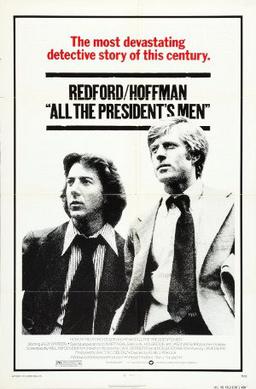
All the President’s Men (film) (Photo credit: Wikipedia)
by Dean | Dec 10, 2013 | General
It is well known that Robert Aldrich’s Kiss Me Deadly (1955) ends more or less apocalyptically—unique for film noir—but this isn’t so strange considering how many deaths precede the climax and that the movie’s hero, Mike Hammer, is capable of low-level sadism as well as other forms of naughtiness. We just wait and see what the world has to dish up after all the violence.
What Aldrich has dished up is a weird credit sequence, a tough-as-nails opening scene with Cloris Leachman running down the highway, interesting staging, and cool sex appeal. Looking both manly and unintimidating, Ralph Meeker is appropriately charmless yet not quite repelling as Hammer. How could a man who receives as many smooches from strange women as this guy does be repelling?

Cover of Kiss Me Deadly
by Dean | Dec 8, 2013 | General
For starters, I do believe the Palestinians have legitimate grievances. But in Hany Abu-Assad’s solemn film Paradise Now (2005), a new Arab terrorist, Said (Kais Nashef), after experiencing doubt and bewilderment, glumly sets off to do his dirty work in Tel Aviv. To Abu-Assad, however, the work is not dirty. He’s sympathetic to Said from beginning to end. He doesn’t care about the Israeli men, women and children his hero will murder. All are nonentities living in a country that was nevertheless willing to yield a lot of territory to the Palestinians in 1998 and to pull its Israeli citizens from Gaza several years later. Said is not impressed.

Cover of Paradise Now
by Dean | Dec 1, 2013 | General
Predictably, characterization means nothing in a movie as unspeakably raunchy as Maggie Carey’s The To Do List (2013). Not a trace of insight arises about why the valedictorian virgin here (Aubrey Plaza) decides to experiment with every form of erotic gratification known to man except for gay stuff. Indeed, none of the major characters is fully believable.
I did get a few laughs from this poorly plotted mess, but everything in it still blurs into one big dirty joke. In Tulsa, The To Do List lasted no more than two weeks and was never even shown in the second-run, dollar theatres. Somehow audiences knew to stay away.

English: Aubrey Plaza at the 2010 Comic Con in San Diego (Photo credit: Wikipedia)
by Dean | Nov 26, 2013 | General
“Black” cinema in America still has not reached a level of high merit, as evidenced by the content in Malcolm D. Lee’s The Best Man Holiday (2013).
That I never saw the 1999 flick The Best Man, to which this is a sequel, hardly prevents me from forming a proper opinion of the current film, which I see as superior to something like Lottery Ticket but not even as palatable as the Sanaa Lathan vehicle, Something New. Lathan is in the Lee film, too, and as usual she’s decidedly effective. She never blows it with facial play, timing, or restraint; but, moreover, she’s part of a mostly agreeable cast. Terrence Howard is okay in his role, but the comic character he plays is slimy and offensive. And here’s where the flaws come in.
Critic Stephanie Zacharek at The Village Voice appreciates the movie’s “joyousness” and doesn’t want to talk about the flaws (“flaws be damned”). I agree that a joyousness is there, but I’m not very impressed by it—because the flaws ruin the picture. For one thing, Holiday loses its edge and becomes maudlin. For another, its spirituality is nothing more than pseudo-spirituality. (The holiday in the title, by the way, is Christmas.) Along with utter bawdiness, there is in the film a superficial Christianity—Monica Calhoun’s “Christian” Mia mentions a woman with a “big booty” whom she hates—of which I want no part.

Sanaa Lathan at the 2009 Comic Con in San Diego. (Photo credit: Wikipedia)