by Dean | Nov 25, 2013 | General
Mark Robson’s ’67 film version of Valley of the Dolls (novel by Jacqueline Susann) is a very hokey show-biz drama, more interesting than good. As millions are aware, poor Sharon Tate is in the film, but hers is not the only unsatisfactory acting. Barbara Parkins (as the heroine) and several others are no better. Patty Duke, on the other hand, is disturbingly successful as big star Neely, the meanest Lindsay Lohan in American cinema.
To my mind Dolls is a guilty pleasure, whereas to someone else it would be simply trashy. So be it. It interests me that it’s pure mid-Sixties, with its coy sex, attention to American prosperity, Jack Jones-like singer, etc. What’s more, the film’s last few moments are pleasingly strong.

Cover of Valley of the Dolls (Special Edition)
by Dean | Nov 21, 2013 | General
One wishes Girl With A Pearl Earring (2004) were better.
The great Dutch painter Johannes Vermeer takes a shine to a new servant girl named Griet, but their relationship is chaste. He has her aid him in his work, instructs her somewhat about art, and makes her the model for his “Girl With A Pearl Earring” painting. Vermeer’s materialistic wife is scandalized, wild with jealousy. But this first film by Peter Webber induces to me to ask: Why, really, does the Dutch master befriend Griet? The story I have just described is absurd; how can we be expected to swallow it? Indeed, the Vermeer-Griet relationship is not even compellingly drawn. Screenwriter Olivia Hetreed, adapting the Tracy Chevalier novel, underwrites it, as it were, providing scant flavor. And how is Vermeer able to love a revolting wife who has no interest at all in his work?
The film is no masterpiece, although possibly Eduardo Serra’s cinematography is. Formally it is reminiscent of, and as sublime as, Vermeer’s art. Lighting evokes everything from placidity to menace, and Serra agreeably stays away from European melancholy. The dandy cast consists of Colin Firth, Scarlett Johansson and Essie Davis among others. Handsome Firth makes Vermeer as likable as he is imperfect and brilliant.
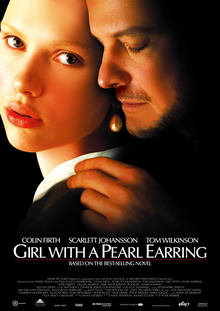
Girl with a Pearl Earring (film) (Photo credit: Wikipedia)
by Dean | Nov 17, 2013 | General
The Christmas Candle (2013) is a regrettably lame Christian movie in which thirty afflicted people, most of them born-again, in an English village receive exactly the miraculous gifts they were longing for, and then the movie ends. A man on his deathbed is thoroughly healed, a mute boy gets his voice back, a chap hopelessly in debt receives a job, a spinster who has long wanted a husband is provided with one, etc.—all at the same time. I, too, believe in God-given miracles but this is profoundly silly. Why does such a picture, an adaptation of a Max Lucado novel, get made? (There are other Christian films similar to it.) What is the thinking behind it?
It’s evangelical thinking, to be sure, and it may well be that today’s evangelicals believe that what occurs in this movie is indeed the reality that surrounds us. Never mind that constant miracles, or the greatest miracles (other than salvation), do not take place in their own lives. God is a miracle-working God, and this is what He does. But only up to a point is the truth being told, and yet this is how these people try to persuade the heathen that the Gospel is sound and right. It’s folly, especially since, in point of fact, it is God Himself Who does the persuading. Read your Bible carefully.
Such actors as Hans Matheson and Lesley Manville turn out fine performances in The Christmas Candle, but this is not how theological meaning should be conveyed.

A Christmas candle icon (Photo credit: Wikipedia)
by Dean | Nov 11, 2013 | General
In Cuba before the revolution, Batista’s men punish a Castro loyalist from a wealthy family by shoving him into a wooden cage and calling him a “rich bastard.” Makes me wonder: I thought Batista’s regime only snarled at the poor. In Andy Garcia’s film The Lost City (2005), however, the rich clan of Fico Fellove (Garcia), who owns an elegant cabaret, contains a couple of leftist radicals who deem Castro’s goals absolutely worthy. Then the truth hits. Castro’s regime snarls at democrats.
Romanticized Havana becomes a lost city. Fico, after all, loses his cabaret, and his radical brother commits suicide. Moreover Aurora (Ines Sastre), the woman Fico loves, wishes to stay in Cuba and try to “help” her country (through Fidel’s Marxist means!) instead of following Fico to America. The look that Fico gives a Communist security guard at the airport reflects his understanding of what bullies the reigning revolutionaries really are.
City is based on a screenplay by the Cuban novelist Guillermo Cabrero Infante, friend to Garcia and no fan of Castro. Although focusing on pre- and post-revolutionary Havana is a fine idea, the film is obvious and somewhat calculated. A lot of calculation, for instance, consists in the use of Aurora. Too, the dialogue is unimpressive, and in the cast of characters is a peculiar, nameless comedian (Bill Murray) identified as The Writer. I’m sorry it wasn’t a cameo. Still the movie is involving, and personal. Garcia not only directed and played the lead, he also composed The Lost City‘s music, some of which is dull but some of which sparkles.
Final word: the film makes me want to read Infante.

The Lost City (2005 film) (Photo credit: Wikipedia)
by Dean | Nov 10, 2013 | General
So: Orson Scott Card, the author of Ender’s Game, is hated and insulted either primarily or exclusively because he opposes gay marriage.
Woe and damnation to someone with a different point of view!
“But Card doesn’t think gay marriage is a civil-rights issue!” someone might complain. If that’s true, he’s right. But, ah, again, we just can’t tolerate a different point of view!

Orson Scott Card at Life, the Universe, & Everything at Brigham Young University in Provo, Utah. (Photo credit: Wikipedia)
by Dean | Nov 8, 2013 | General
The Internet can be a fairly good guide to which TV episodes of the Star Trek franchise are the worthiest to watch. Some that have been touted by web contributors I’ve seen on DVD and was glad I did.
Star Trek: Voyager‘s “The Omega Directive” (Season 4), for example, held up well on a second viewing and not just a first. Here, the starship’s crew are very much in the laboratory, with Captain Janeway (Kate Mulgrew) working to destroy a particular molecule and the female Borg character (Jeri Ryan) working to stabilize it. The latter is making an error, desiring that the dangerous particle stay intact since it represents Perfection for her. In fact it seemingly represents a spiritual experience for a nonbelieving alien. Although limited in drama, the episode is not at all boring—and not at all stale either, but gleamingly fresh.
Another real fan-pleaser from Season 4 of Voyager is “Hope and Fear,” which presents duplicity and vengefulness in addition to hope and fear. (Get this: the fear belongs to Ryan’s Borg.) A phrase like “sophisticated fun” was invented for this episode. It’s not quite as intelligent as “The Omega Directive,” but it’s just as engaging. And better acted.
I’d like to write about a couple of other Voyager episodes in the future. The Internet has inspired me.

Star Trek: Voyager (Photo credit: Wikipedia)