by Dean | Mar 26, 2013 | General
Peter Yates’s police drama Bullitt (1968) is poorly written in several ways but is engrossing nonetheless. It has to do with killers and witness protection, and it contains enjoyable action, but it’s a mostly quiet film. Proceedings are quiet, as they frequently are in life. Only now and then do people get noisy. Correlatively, the hero—Steve McQueen’s Frank Bullitt—is a loner.
Also, it’s a profoundly American film. The manly loner lives in a place of obvious, nonstop manufacturing, of urban construction and extensive roads. He has an English girlfriend, however, played by Jacqueline Bisset, whose celebrated beauty is another reason Bullitt is worth seeing.
It beats me why Frank Bullitt isn’t a better protector of his witness, but this movie is fun and interesting in spite of itself.
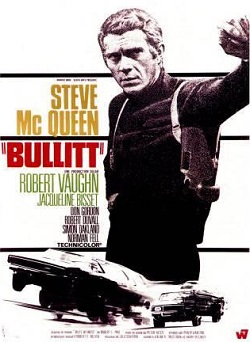
Bullitt (Photo credit: Wikipedia)
by Dean | Mar 16, 2013 | General
Woody Allen’s musical comedy, Everyone Says I Love You (1996), is a catastrophe. Frequently it is not very funny because comedy and undistinguished dialogue don’t exactly go together unless the comedy is physical. The movie features songs by Cole Porter, Rodgers and Hart, Bert Kalmar and Harry Ruby, among others; and they are butchered by the bad voices of Julia Roberts, Drew Barrymore and Allen himself. The only tolerable number is the first one, “Just You, Just Me,” because Edward Norton’s singing is more or less acceptable and the routine does not require much liveliness. Any time a routine does require liveliness, you can forget about Allen providing it. I can’t judge the choreography of Graciela Daniele, but it seems quite pleasant within this framework.
The film’s title derives from a Marx Brothers flick, and I wish Allen was as good a writer as those the Marx Brothers had. The musical’s “book” can be obnoxiously stupid, as witness the tomfoolery involving Barrymore and Tim Roth. Is it possible that when writing it Allen said to himself, “Oh well. The books for those old musicals weren’t very good either”? Damned if I know.

Cover of Woody Allen
by Dean | Mar 11, 2013 | General
However many improbabilities arise in Jack Reacher (2012), it’s a vigorous, reasonably intelligent, engaging crime thriller starring Tom Cruise. It works because I assume its source material, a Lee Child novel titled One Shot, is well-crafted. (Am I wrong?) Jack Reacher (Cruise) is a drifting ex-military cop who wishes to mete out justice to a sniper he knows, only to find out he needs to pursue a different offender, the true sniper. Cruise and Rosamund Pike, playing a defense attorney, make a good team; both have energy and project smarts. Christopher McQuarrie has directed and scripted the film with savvy, and nowhere is either the violence or the profanity excessive.
Jack Reacher is almost as good a crime drama as The LineUp and Bullitt. Check it out.
by Dean | Mar 8, 2013 | General

Cover of Red Eye
Both truthful and nonsensical, the Wes Craven thriller Red Eye (2005) is solid entertainment. Rachel McAdams is more than suitable as Lisa, a hotel manager needed by Jackson Rippner, acted by a nuanced Cillian Murphy, for a cruel assignment: assistance in murdering the deputy secretary of Homeland Security. If Lisa refuses the enlistment, Rippner will see to it that her father (Brian Cox) is killed. Not much personal vision comes through, but this is a fundamentally conservative movie, one which any liberal can enjoy. This despite the opinion in The Village Voice that, owing to the depiction of rude airline customers, “Red Eye could even be called anti-American.” Well, that’s one view.
Lisa becomes heroic but is not a superwoman, not a feminist heroine. She needs help from her dad. The deputy secretary is hardly a dunce or a bully. An assassination attempt by terrorists is quite silly, but at any rate it shows how murderous the fanatics are. I repeat: truthful. Fundamentally conservative, but actually more entertaining than conservative.
by Dean | Mar 4, 2013 | General
Adrian Lyne’s Unfaithful (2002) is loosely based on a good 1969 Claude Chabrol film, La Femme Infidele. There are many things wrong with it, but for the most part Lyne’s directing is not one of them. He and film editor Anne V. Coates understand pacing and suspense, while actress Diane Lane understands worry and guilt.
The movie’s two screenwriters convince me, without moralizing, that adultery and existential bleakness go together. According to Mark Steyn in The Spectator, the film communicates that “sex is not just a passing fancy, but profoundly disruptive, not life enhancing but life shattering, and what’s broken cannot be remade. The fling cannot be unflung.”

Unfaithful (2002 film) (Photo credit: Wikipedia)
by Dean | Feb 27, 2013 | General
The Robert Bresson picture, Mouchette (1967), is an adaptation of a short novel by Georges Bernanos.
The novel, a successful one, is about a preteen French girl living in harsh, awful surroundings. Dirt poor Mouchette is disliked by her peers and has an insensitive, criminal father and a dying mother. Worse, she is eventually raped by an epileptic poacher. It is easy to suspect she is en route to becoming a wicked young adult, but after hearing from an old woman, a layer-out of the dead, that the dead used to be worshipped as gods and that the woman herself “understands” the dead, Mouchette decides to drown herself. She escapes a hopeless world by dispatching herself to a realm where the dead are not merely dead, to God’s realm.
It is no surprise that the Catholic-born Bresson would be drawn to filming another Bernanos novel after directing Diary of a Country Priest many years earlier. However, what he does with his customarily nonprofessional actors seriously harms Mouchette. He insists on their being dry and undemonstrative, which of course means they’re histrionically sleepwalking. It doesn’t work. The film doesn’t work—it’s unconvincing—although certain shots and details are meaningful, even spiritually so. That is, they have a “religious” power, such as the shot of the pond, and the simultaneous Magnificat music (by Monteverdi), where Mouchette’s suicide occurs. We feel sure the Deity’s grace has reached this unsaved, terribly oppressed child. Bresson’s movie could have been a winner, but a few things for which we can be grateful do characterize it.
(In French with English subtitles.)

Mouchette stands at the gate of the rides of the fair, looking at the people in the rides. (Photo credit: Wikipedia)