by Dean | Feb 14, 2019 | General
It is after a talk with a psychoanalyst that Jill (Merle Oberon) develops an uncertain feeling about her marriage to Larry (Melvyn Douglas)—this in the film, That Uncertain Feeling (1941), by Ernst Lubitsch—and she starts pulling away from him. But Jill’s marriage is not a bad one. Soon, nevertheless, she takes up with a frowning pessimist (Burgess Meredith) who is not the man for her because he couldn’t possibly be the man for any woman. Still, a divorce is in the works.
Lubitsch’s movie, a comedy, is rather slight, and the subject of a couple’s desire for sensible reunion was funnier in 1939’s The Awful Truth. Also it could be asserted that Feeling is not entirely convincing except that Oberon and Douglas have a way somehow of making it convincing. Besides, it’s romantic comedy, as as such it is fantasy with the ring of hard truth. It isn’t one of Lubitsch’s best, but it is wry and skillfully acted.
by Dean | Feb 12, 2019 | General
Larry Peerce’s Goodbye Columbus (1969) is a Hollywood movie for adults since the Philip Roth story from which it derives is a novella for adults. It is well known that it has to do with the attitude of rich American Jews toward low-income Jews (and vice versa), but when Peerce isn’t proving what a romantic he is, he is imposing on us some ugly, very raffish, and insulting satire. Romantic? Yes, in the scenes where Neil and Brenda, falling in love, are together, and these can be pleasant. Richard Benjamin and Ali MacGraw enact the lovers with savvy and heart. But Goodbye Columbus is pushy and fails to adequately convey the ultimate meaning of Roth’s story (in the diaphragm sequence). It is, I think, worth seeing but just barely.
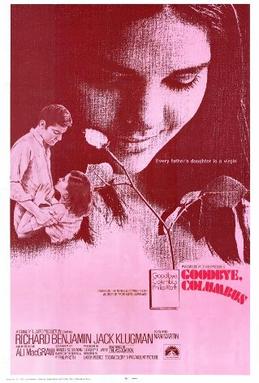
Goodbye, Columbus (film) (Photo credit: Wikipedia)
by Dean | Feb 10, 2019 | General
Thanks to YouTube I was able to see a film by the French director Claude Autant-Lara other than his mediocre Sylvie and the Phantom, the film being the 1958 Love is My Profession, or—a far preferable title—In Case of Adversity.
Bit by bit corruption gathers in a domain apparently created by Georges Simenon (whose novel is the source for this picture) as a lawbreaking party girl, Yvette, fights her own poverty through a spasm of violence and is defended by Andre Gobillot, a wily, now unethical lawyer. Gobillot, though married, falls in love with Yvette, and the fornication begins. Yvette, however, can be sensitive and affectionate but not loyal.
The film is a commercial piece with little to say, although its vision of life is tough (Simenon-like) and hardly divorced from quotidian cakes and ale. It’s engaging. The music is sheer Hollywood, but Autant-Lara directed intelligently, admirably. Jean Gabin, as Gobillot, does little to own the role; he gives too many expressionless looks. He is passable, though, but no more. Edwige Feuillere is first-rate as Gobillot’s wife, but Brigitte Bardot (Yvette) needs more subtlety in her energetic performance. All the same, of course, beautiful B.B. adds a lot to the picture.
by Dean | Feb 7, 2019 | General
Lady Gaga has said to Mike Pence, “You are the worst representation of what it means to be a Christian,” and, incensed over the government shutdown, has castigated “the f–king president of the United States.”
Hey, aren’t we supposed to be living in a time of nonjudgmentalism? That’s a laugh.
These narcissistic celebrities like to talk about politics, but something tells me they haven’t read much Irving Kristol or James Burnham. Correlatively, they are as boring as they are profane.
by Dean | Feb 5, 2019 | General
The silent flick, Safety Last! (1923), begins with a scene suggesting that Harold Lloyd (as The Boy) is in a prison cell waiting to be hanged for an unknown crime, but, no, it’s just a sight gag. Harold is simply at a railroad station. Yet an approaching hanging, if it were real, would be just one more scrape the amiable but aggressively fighting comic figure would have to survive.
All the nerd wants to do is raise enough money in the big city to marry The Girl (Mildred Davis), for there is prosperity in the big city. Yes, but there’s poverty as well—it exists for Harold and his roommate. The demands of money-making tasks keep Lloyd in mad tumult. Even a skyscraper must be conquered.
Comedic movies of the 1930s were good because they were interesting. Comedic movies of the 1920s were good because they were funny. (Those of the 1930s [e.g. Duck Soup] could be funny too.) And the physical comedians were delightfully talented. Safety Last! was written by Hal Roach and a couple of others, with Lloyd as an uncredited writer. Lloyd did not direct it. Mainly he was the great actor, a perfect linchpin performer. Incidentally, I now wish to see some 1930s Harold Lloyd films.
by Dean | Feb 1, 2019 | General
Audie Murphy was a war hero, but a charmless and very limited actor—too limited as a leading man. Still, the 1953 Gunsmoke, which stars Murphy, is another enticing Old Hollywood Western adapted from an obscure novel.
Here, Reb Kittredge, Murphy’s character, is hired to kill a man (Paul Kelly) but ends up buying his failing ranch instead. He becomes the instrument for protecting the rancher’s interests. However, he himself needs protection from Johnny, a coldly practical friend of his who might find it necessary to gun Kittredge down, and from big Curly, who resents Kittredge’s liking for Rita (Susan Cabot), the woman Curly is wooing.
I like that the film is in color, but Nathan Juran‘s directing is certainly unspectacular. There is extensive drama, though, and a handful of nifty performances (by Jack Kelly, Donald Randolph, Jesse White). Cabot’s Rita could have been an interesting character—as interesting as Susan Cabot herself, with her horrible life—but there is no development of her.