by Dean | Jan 13, 2019 | General
A horse falls on a boy called James in Larry Woiwode‘s 1993 story, “Silent Passengers,” and of course he is hospitalized with dreadful injuries. Where is God? Well, though He is never mentioned in the story, He is there. Woiwode, a Christian, writes in such a way as to intimate this.
The details here are very troubling, but the story ends with James’s survival and recovery. Hence we know God is there, but would we know it if James had died? We could have, sure, but it would have been harder for the author to work it out, to make it evident. Yet death is a reality, notwithstanding . . . so is recovery.
Another, longer literary gem, Woiwode’s “Firstborn” (1983), is a study in anger and guilt. Rough childbearing precedes a desire to utter, “Good God, forgive me,” for a husband has been unfaithful (as has his wife) and moderately, unfairly violent. Sad but hopeful, “Firstborn” is a religious story without Catholic or Protestant references. I do not quite think it has greatness, as “Silent Passengers” does, but it is exquisitely thoughtful and consistently powerful. The man of faith did it again.
by Dean | Jan 12, 2019 | General
The plot of Alias Betty (2001) is a bit too good for most screenwriters to have concocted, but not too good for the novelist Ruth Rendell, on whose novel–The Tree of Hands–it is based. A French film by Claude Miller, it concerns a mentally unbalanced woman who kidnaps a little boy in order to make a gift of him to her grieving, now childless grown daughter. What we have here is a person whose suffering drives her to become comfortable with an immoral situation. Several story strands are juggled perfectly; the novel is adroitly adapted. Nothing wrong with the acting either.
(In French with English subtitles)

Cover of Alias Betty
by Dean | Jan 5, 2019 | General
I would have enjoyed Elmer Kelton‘s novel, Shadow of a Star (1959)—“star” as in sheriff’s badge—a tad more had it been devoid of the hackneyed concept of townspeople demanding that a deputy turn over to them an appalling killer so that he might be lynched. The deputy, young Jim-Bob, is the sole person in charge of the killer now that the sheriff, Mont Naylor, has been badly wounded.
Ah, but for a short Western, the book is pretty rich and certainly exciting—not really tired. Hell is other people—Jim-Bob faces lawbreakers big and small—yet the tale is uncynical. Men can often be trusted, those can’t be are in genuine trouble. Further, there is much economy and little softness in Star. It can’t be much improved on.
by Dean | Jan 3, 2019 | General
The Ida Lupino film, The Bigamist (1953), turns Edmond O’Brien into a romantic. Director Lupino co-stars in the piece and, like scriptwriter Collier Young, is in a romantic mood; albeit, to be sure, O’Brien’s character is a bigamist. He is married to both Lupino and Joan Fontaine (unknown to each other), but is almost an angel in his liaisons with them. A true lover of both.
Lupino once remarked that as a director she was “the poor man’s Don Siegel.” (Remember The Hitchhiker?) Not exactly. Not with a film like The Bigamist, which is sober and character-driven. In the 1950s Europeans were making movies meant for adults not youngsters, but few Hollywood products had such an aim. Lupino’s film, although it’s no Le Amiche, is rather different. It won’t offend anybody but it will bore the kids. It has a grown-up gravity. I like it.
by Dean | Dec 29, 2018 | General
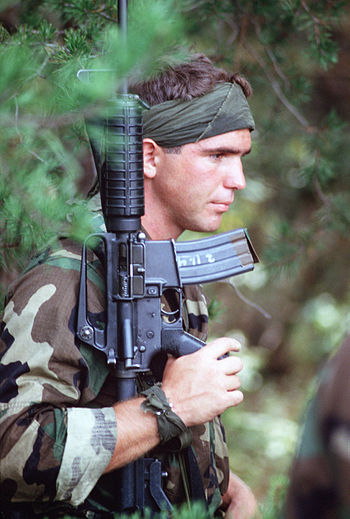
A Sea-Air-Land (SEAL) team member carries his Colt Commando assault rifle through the woods during a field training exercise. (Photo credit: Wikipedia)
Lone Survivor (2014) is an excellently wrought war movie that lets us know just how long a severely wounded human body can last. The wounds keep coming to the four Navy SEALs entrusted to a failed operation amid the forest trees of Afghanistan (and the SEALs give as good as they get). Another film based on a true story, though at long last it gets rather tiresome, it is incontestably powerful and has a mostly good momentum.
The dialogue is lousy—coarse—and apparently LS is not always journalistically accurate. But I agree with James Bowman that director Peter Berg’s “great achievement . . . is to take away the media’s political filter and show us war as men actually experience it, albeit at an unusually high level of intensity.” Too, it has a bigness about it that other contemporary war flicks lack.
by Dean | Dec 27, 2018 | General
William Wellman directed many serious films (The Ox-Bow Incident, The Story of G.I. Joe, Nothing Sacred) as well as superficial but pleasurable pop pictures like Yellow Sky, a 1948 Western wherein a band of thieves muscles in to take advantage of someone else’s gold claim. The someone else is Anne Baxter‘s “Mike” (a nickname for a very pretty tomboy) and her grandfather (James Barton), certainly not a match for six armed lawbreakers.
Wellman’s wild bunch, filmed in long shots on parched earth, snub and pound each other until real schisms develop. Gregory Peck is somewhat miscast as an outlaw, but at least his character grows in nobility. He gives the same dad-gum performance, though, that he gave in every movie. Lamar Trotti’s script is colorful and integrated. All the same, it is hardly edifying that the film implies that what will set a young woman on the right path is being tackled and smooched, yea, even by a thief. We’re grateful the smoocher is not a rapist.