by Dean | Nov 12, 2017 | General

Publicity photo of Loretta Young for Argentinean Magazine. (Printed in USA) (Photo credit: Wikipedia)
Love is News (1937), directed by Tay Garnett, is another old Hollywood comedy about newspaper reporters, shown here to be a shabby lot. They lie. Tyrone Power, as a reporter, intends to lie about a well-known heiress he interviews enacted by Loretta Young; but Young turns the tables on him. She lies about him to a batch of reporters.
Handsome Power has comic verve but no charisma. Beautiful Young is not a natural for farce but, happily, is never false. As a managing editor, Don Ameche is a gratifying exhibitor of range. The film is lively without being very funny (to me) until it turns slapstick, beginning with Power deliberately dropping Young into a mud puddle. The ending is romantically jaunty. Love is News is a more-than-okay lark.
by Dean | Nov 8, 2017 | General

Cover of Deliverance (Deluxe Edition)
I have read James Dickey’s novel, Deliverance, but I don’t much remember it. I remember enjoying it, though, and I also enjoy the John Boorman film version of it (1972), whose screenplay Dickey wrote.*
Four middle-aged men head to the forest and take a canoe ride on a treacherous river. The rapids are bad enough; the men also encounter bullying hillbillies, one of whom they kill after he sodomizes Bobbie (Ned Beatty), a member of their group. Without contacting the police, they bury the man and then try to high tail it out of the region. They gradually fear, however, that a vengeful hillbilly is attempting to waste them with a shotgun.
I am perfectly sure the movie is a lesser work than the novel. How I see Boorman’s concoction is as a nicely shot, mostly realistically made adventure story which conveys a message about moral uncertainty and compromise being involved in physical survival. The canoe riders do not trust lawful authorities who might help them, and the mountain man whom Jon Voight‘s Ed shoots with a crossbow may or may not be a murderer. Another thing the film tells us is that packs of violent cretins like the hillbillies are out there. They may lie low, they may be hidden, but they’re there.
Most, though not all, of the acting in Deliverance is impressive. A fine thespian, Jon Voight is nevertheless a bit unsteady here, maybe because the script “does not offer him sufficient motivation and opportunity for emotional shading” (John Simon). Agreed. Even so, the film is anything but dull. It’s exciting and, in its own way, trenchant. And it’s a nature lover’s film. I firmly disagree with the critics who dismiss it.
*Rewritten by Boorman, apparently.
by Dean | Nov 6, 2017 | General
Rick, an adolescent, is determined to see his girlfriend Sheryl, whose mother is vigorously keeping the two apart. This is because, unbeknown to Rick, Sheryl is pregnant and was sent out of state. The boyfriend and his unruly buddies drive to the girl’s house and, owing to their aggressiveness, get involved in a physical conflict with the men of the neighborhood. This early ’60s incident is the axis for everything that takes place in the novel, That Night (1987), by Alice McDermott.
Such a book might seem like a yawner—material so familiar—but it isn’t. For one thing, it is short; for another, the characterization is engagingly strong; for another, the structure is interesting. Style? It’s nothing exceptional but it’s eminently effective. Closer to Fitzgerald than to Hemingway or Faulkner, thank goodness.
Themes in That Night include the insufficiency of love (for Rick and Sheryl, for Rick’s mother and father) and when there is trauma for the young. It reveals for us a person’s “blind, insistent longing”—Sheryl, forever apart from Rick, “wants to love someone else”—whether love is insufficient or not.
by Dean | Nov 5, 2017 | General
The 2017 Broadway production of the Noel Coward play, Present Laughter, has been filmed and was presented last Friday on the the PBS program, Great Performances. A flavorous item, it stars Kevin Kline as a hopelessly vain theater actor and womanizer who gets his comeuppance at the hands of adulators (ones he doesn’t understand). The cast is vibrant and commanding, with Kline of course the stand-out. Bhavesh Patel is unrestrained as Roland, but it must be remembered that his character is a possible madman. Tedra Millan (Daphne) is a droll tornado.
by Dean | Nov 2, 2017 | General

Little Fugitive (Photo credit: Wikipedia)
The Morris Engle-Ruth Orkin picture, Little Fugitive (1953), probably influenced European cinema of the late Fifties and early Sixties, but I could never claim it has much to say. What I do claim is that it is a dandy representation of boyhood in America, and is refreshingly honest about young-male emotions and concerns.
With his tough-as-nails little voice (necessarily dubbed), Richie Andrusco plays the “little fugitive,” he who, because of a prank, believes he has killed his 12-year-old brother; but has not. Afraid, the boy takes off and—what do young New Yawkers like to do? Go to Coney Island, which is what the little fugitive does. For the most part, as the lad amuses himself at C.I., he is emotionally unaffected by the “killing” of a brother whose relentless teasing the boy hates. . . Little Fugitive is an urban, primitive-looking independent film with nonprofessional actors. It was released at a time when American movies, though usually inartistic, were very gradually taking chances (as witness Beat the Devil, Night of the Hunter, The 5000 Fingers of Dr. T., The Girl Can’t Help It). We’re fortunate the Engel-Orkin movie, not so inartistic, was made.
by Dean | Nov 1, 2017 | General
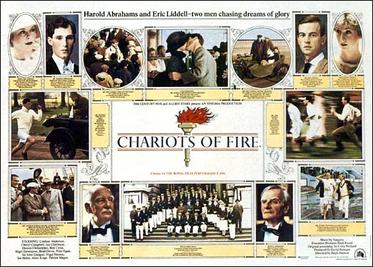
Chariots of Fire (Photo credit: Wikipedia)
Early in the film Chariots of Fire (1981), a working class chap comments apropos of two Cambridge students that British young men fought a hellish war (World War I) so that “shits like [the two students] could get a decent education.” But the wealthy need not be ashamed—here, they’re clearly not a bad lot—and the fought-for Great Britain is loved by its citizens, young men and the rest.
Of course Great Britain is imperfect, as is the twentieth century. If it is not banal to say so, where perfection exists is in commitment to something worthwhile, and so Cambridge student Harold Abrahams (Ben Cross), a Jew, is committed to a Jewish victory in competitive running. This in the midst of British anti-Semitism. There is also commitment in Eric Liddell (Ian Charleson), a Scottish Christian and another runner, and this is good. A modern Britain, after all, seems to pose a desultory threat to religion: it balks at Liddell’s refusal to run a heat on Sunday. It is a favor done by a particular Cambridge student which enables the young man to participate (in the 1924 Olympics). In Chariots of Fire, many moments of light, in England, follow the terrible war years. Granted, there is nothing redemptive in all the Olympic running, but what about the religious lives of people—religious dedication?