by Dean | Jul 7, 2016 | General

Cover of The Dreamlife of Angels
The main characters in Erick Zonca‘s The Dreamlife of Angels (1998) are cheerful Isa (Elodie Bouchez) and frowning, self-absorbed Marie (Natacha Reguier), who form a brief friendship.
Far more important to Marie than this friendship is her agonizing romance with well-to-do Chris (Gregoire Colin), a two-timing nightclub owner. In Marie and Chris, Zonca has characters an audience might feel superior to, but not in Isa, who, although not perfect, is friendly and generous. Marie and Chris, on the other hand, are callous. To the latter the former is, as Isa remarks, “just another girl”: the romance is doomed.
I do not understand the title of this French film; is it merely highly ironic? If so, that irony in itself is interesting. Whatever the case, La Vie Revee des Anges is easily one of the finest movies of the Nineties, a probing, dramatically strong artwork with an original, i.e. unadapted, screenplay. It eschews French talkiness and French pessimism (it is not merely dark). Moreover, it seems to be saying—albeit it’s something we all know—that there is no alternative to a life of self-control and some, or much, conventionality. Isa looks for and finds work; despite whatever odd jobs Marie has had in the past, she doesn’t really want to work (except, if she can, for Chris). Nothing good results from this. Also, for Marie friendship is a tenuous thing. She has little desire to maintain it. A stable sex life, admittedly not without love, is preferable.
I urge you to seek out Dreamlife.
(In French with English subtitles)
by Dean | Jul 6, 2016 | General

They Live by Night (Photo credit: Wikipedia)
There is an agreeable premise in Nicholas Ray‘s They Live by Night (1948): a young ex-con who robs a bank loves, and hits the road with, a saucy gal who knows better than to rob banks.
Bowie (Farley Granger) wants the straight-and-narrow while on the lam, but ordeals do arise. . . Keechie, Bowie’s wife, is a country girl whom the filmmakers glamorize a bit. She is played by Cathy O’Donnell with her semi-innocent, semi-sophisticated face.
Ray’s film is pretty naturalistic at first, but the romantic ooze it provides does nothing to spoil the story’s appeal. Bowie and Keechie live by night. Accent on the word “live,” for they do live—though they are also running. If you’ve heard the names Bowie and Keechie before, it may be from Robert Altman’s lousy remake of They Live by Night, titled Thieves Like Us, which is the title of the novel the two flicks are based on.
by Dean | Jun 30, 2016 | General

Jesus Camp (Photo credit: Wikipedia)
The 2006 documentary Jesus Camp should have been a movie called The Religious Lives of Children—whose subject is exactly that—since that’s partly what the film is, anyway. The religious lives of Christian children are in full swing here. Instead, what directors Heidi Ewing and Rachel Grady have engendered is a basically anti-right-wing scare-fest about an evangelical, pentecostalist camp for young kids, sent there by their born-again parents.
In all fairness, never do Ewing and Grady mock or sneer at the Christian people in Jesus Camp, and Pastor Ted Haggard, who became a sad case after a gay sex scandal, plays into the filmmakers’ hands by making a buffoon of himself before their cameras. That hardly keeps the film, however, from being tendentious secularist hogwash.
by Dean | Jun 28, 2016 | General

English: Richard Linklater at the 2007 premiere of The Hottest State in Austin, Texas. Español: Richard Linklater en la premier de The Hottest State, en Austin, Texas, durante 2007. (Photo credit: Wikipedia)
Tape (2001) is a filmed play, and filmed wisely with rapid cutting, flash pans, and DV technology. The director is Richard Linklater, the playwright-scenarist Stephen Belber.
All the action takes place in a single motel room in Lansing, Michigan, and there are only three characters. Vince (Ethan Hawke) is a shiftless drug dealer and volunteer fireman who wants his chum John (Robert Sean Leonard), a filmmaker, to admit that ten years ago he raped Vince’s ex-girlfriend, Amy (Uma Thurman). He craves the satisfaction of hearing such a confession from someone with whom Amy became involved, even sexually, after the failure of his own chaste relationship with the girl (Amy, not Vince, insisted on the chastity). When he eventually gets what he wants, he gleefully tapes it.
What is here thematically is the heinousness of human nature followed by the beating down a bit of that nature by (for whatever it’s worth) the desire to apologize. Violation in another’s life is another obvious theme, though that’s not all. In this present age of fornication, the concept of rape is sometimes hopelessly hazy. Did John injure Amy’s person the way Vince hopes to injure John’s? Or did something different happen? Vince is vindictive, but what does revenge mean when the truth is elusive?
Tape is a small-scale play, and as a film it is even smaller. This is too bad, but at least it is cinematic. It’s just utterly confined, though with Belber’s agon making it gripping. So do the first-rate actors.

Cover of Tape
by Dean | Jun 27, 2016 | General
These days there are more American films that are works of art than there used to be, though still not enough of them (especially good ones). One of them that is artistic—and good to boot—is Love & Mercy (2015), the humane biopic about Brian Wilson of the Beach Boys.
Not only do Paul Dano (as the young Wilson), John Cusack (as the older Wilson), Elizabeth Banks and Paul Giamatti give remarkable performances, but the film is inventive, unflinching and unpretentious. . . The young Brian is a patently blessed man, but has a broken mind, made worse by drug abuse. Even a soul with a broken mind, however, can be lied to and exploited by a . . . psychologist—here a fraud named Eugene Landy (Giamatti). Part of the picture’s drama consists in Brian’s love interest (Banks) deciding to vie with Landy. Director Bill Pohlad never lets down the material.
by Dean | Jun 24, 2016 | General
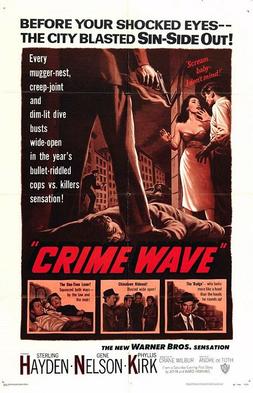
Crime Wave (1954 film) (Photo credit: Wikipedia)
Sterling Hayden does some deliciously authoritative acting in Andre de Toth‘s Crime Wave (1954). He plays a police detective, a man of some prejudice but mainly tough-mindedness and determination.
Three thieves rob a filling station, but a passing cop puts a slug in one of them. This paves the way for a mini-crime wave involving murder and the kidnapping of handsome Gene Nelson (soon to be in Oklahoma!) and lovely Phyllis Kirk (an unknown to me). . . Steely stuff, this, with a fitting pace and frequently a top-notch look. Sometimes it seems to have stepped out of the pages of Confidential magazine.