by Dean | Dec 13, 2015 | General
The fight with the lion and the final annihilation of the Philistines wrought by Samson between the pillars are dandy scenes in Cecile B. DeMille‘s Samson and Delilah (1949). And if you want sensuality, mostly that of Hedy Lamarr (Delilah), that’s there too.
But there are bad scenes to boot, such as the one where Delilah laughably vows to avenge herself on big Samson (Victor Mature) as the Philistine fields burn. In point of fact, the lady’s will to get even is unconvincing, unlikely. She so loves and moons over Samson this doesn’t make much sense. The screenplay here isn’t as well written as that of DeMille’s The Ten Commandments. Expectably, Delilah is given a much bigger part in the film than she is in the Old Testament account—a stranger and grittier story than this.
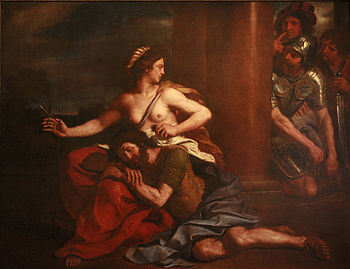
English: Samson and Delilah, Guercino, 1654, oil on canvas. Access number 316. (Photo credit: Wikipedia)
by Dean | Dec 10, 2015 | General
There are hillbilly men behaving badly in Seven Brides for Seven Brothers (1954), but no worries. It all ends happily. Stanley Donan directed with the same sure hand he displayed in Singin’ in the Rain, despite all the backlot shots (Ah, Wilderness?). Male dancing abounds, more so than female dancing, and the males sing too, though appropriately none of them can outsing Howard Keel, the lead. None of the gals can outsing Jane Powell, the female lead, either, who gets to deliver two splendid ballads in a row: “Wonderful Wonderful Day” and “One Man.” The music is consistently pleasant. Congrats to Michael Kidd for his choreography.

Seven Brides for Seven Brothers (Photo credit: Wikipedia)
by Dean | Dec 8, 2015 | General
The 1964 Jean-Luc Godard film, A Married Woman, held my attention for about an hour of its 94 minutes but then became dreadfully dull. The very pretty Macha Meril enacts Charlotte, who spends quality time with both husband and lover but lacks a veritable devotion to either.
The most interesting thing about the film is the Village Voice review it inspired after being re-released this month in New York. To Godard, asserts Calum Marsh, “A sort of mass delusion . . . had begun to seize the young [in Europe], manifesting itself in historical ignorance and prevailing trivialities like TV and fashion magazines”—and thematically this is what A Married Woman is about. I respect this, and I respect that Godard’s visual poetry, though sometimes too obvious in its meaning, frequently hits the mark. But a relatively short picture shouldn’t be this talky, shouldn’t be a slog.
(In French with English subtitles)

Cover of Une Femme Mariee
by Dean | Dec 6, 2015 | General
The movie adaptation of Colm Toibin’s novel, Brooklyn, is so good it is inevitable to think the book must be good as well.
With shining talent John Crowley directed and Nick Hornby scripted this absorbing love story about a newly emigrated Irish girl, now in Brooklyn, and an Italian-American young man living in the 1950s. The film is a vehicle for Saoirse Ronan, who is perfect as the Irish girl, the not-very-demonstrative but not unassertive Eilis. Among other things, it concerns the making of big decisions when Experience has not been big, as witness Eilis’s getting married to Tony, the young man in Brooklyn, when she is still youthfully naive.
Also, it concerns the magnetic attraction of one’s home country—to an immigrant—when life in that country becomes satisfactory. It is an attraction from which Eilis must break away.
Ronan is touching, as is the movie—which loves its characters. Such actors as Julie Waters, Emory Cohen and Jim Broadbent (who plays a priest) are beautifully natural. Brooklyn is not quite faultless, but I refuse to quibble and find it a sure thing: an acclaimed novel is now a rightly acclaimed film.
by Dean | Dec 3, 2015 | General
1994 saw the appearance of yet another phony and unprofound docudrama: Robert Redford‘s Quiz Show.
It deals with the deception scandal surrounding television’s “Twenty-One” program in the late Fifties; contestant Charles Van Doren even had to face a congressional committee. Redford and screenwriter Paul Attanasio achieve little of significance with this subject, especially since they inexcusably patronize quiz show-loving American suburbanites of that era (my, my, how could they not have known “Twenty-One” was rigged!). For some reason they also seem enamored of literary critic Mark Van Doren, Charles’s father, and moreover tend to inject their film with too much hyperbole. Or is this the fault of the actor John Turturro, who overacts Herb Stempel? Well, I don’t think it’s entirely his fault.
Despite all this, the story is well structured and the dialogue clever. Redford produced the film and saw to it that his direction for it was smooth and vigorous. Except for Turturro the cast is outstanding: as Charles Van Doren Ralph Fiennes is intelligent and self-controlled, and has a classy look. Paul Scofield as father Mark holds up well under Attanasio’s hero worship, though plenty of lesser actors could have handled the role. Rob Morrow is appealing as a government investigator. Quiz Show is a middlebrow worthy which I’m glad I saw but have never prized very highly.

Cover of Quiz Show
by Dean | Dec 1, 2015 | General
If you’ve never seen Carmen Miranda, you’ll be introduced to her almost immediately in Busby Berkeley‘s 1943 The Gang’s All Here. She takes her charisma beyond the movie’s beginning to the bananas-and-strawberries number and way beyond that to the movie’s finish, and is the best thing here. But it’s a picture replete with performers, indeed tending happily to give everyone a chance (as it were): to sing or dance or both.
A true success, Alice Faye sings (e.g., the lovely “Journey to a Star”). Sheila Ryan dances, stylishly. A fellow named Johnny Duncan jitterbugs. Benny Goodman is in the film and, notwithstanding he has an acceptable voice, is an indifferent crooner. His band sounds great, though.
With The Gang’s All Here, Berkeley’s 1930s escapism continued into the Forties during WWII, albeit certainly the flick did its pro-America wartime part. But it isn’t really this that gives the movie high respectability—this being a musical entertainment, why would it? It’s Miranda.

Cropped screenshot of Carmen Miranda from the trailer for the film The Gang’s All Here (Photo credit: Wikipedia)

Cover of The Gang’s All Here