by Dean | Dec 6, 2015 | General
The movie adaptation of Colm Toibin’s novel, Brooklyn, is so good it is inevitable to think the book must be good as well.
With shining talent John Crowley directed and Nick Hornby scripted this absorbing love story about a newly emigrated Irish girl, now in Brooklyn, and an Italian-American young man living in the 1950s. The film is a vehicle for Saoirse Ronan, who is perfect as the Irish girl, the not-very-demonstrative but not unassertive Eilis. Among other things, it concerns the making of big decisions when Experience has not been big, as witness Eilis’s getting married to Tony, the young man in Brooklyn, when she is still youthfully naive.
Also, it concerns the magnetic attraction of one’s home country—to an immigrant—when life in that country becomes satisfactory. It is an attraction from which Eilis must break away.
Ronan is touching, as is the movie—which loves its characters. Such actors as Julie Waters, Emory Cohen and Jim Broadbent (who plays a priest) are beautifully natural. Brooklyn is not quite faultless, but I refuse to quibble and find it a sure thing: an acclaimed novel is now a rightly acclaimed film.
by Dean | Dec 3, 2015 | General
1994 saw the appearance of yet another phony and unprofound docudrama: Robert Redford‘s Quiz Show.
It deals with the deception scandal surrounding television’s “Twenty-One” program in the late Fifties; contestant Charles Van Doren even had to face a congressional committee. Redford and screenwriter Paul Attanasio achieve little of significance with this subject, especially since they inexcusably patronize quiz show-loving American suburbanites of that era (my, my, how could they not have known “Twenty-One” was rigged!). For some reason they also seem enamored of literary critic Mark Van Doren, Charles’s father, and moreover tend to inject their film with too much hyperbole. Or is this the fault of the actor John Turturro, who overacts Herb Stempel? Well, I don’t think it’s entirely his fault.
Despite all this, the story is well structured and the dialogue clever. Redford produced the film and saw to it that his direction for it was smooth and vigorous. Except for Turturro the cast is outstanding: as Charles Van Doren Ralph Fiennes is intelligent and self-controlled, and has a classy look. Paul Scofield as father Mark holds up well under Attanasio’s hero worship, though plenty of lesser actors could have handled the role. Rob Morrow is appealing as a government investigator. Quiz Show is a middlebrow worthy which I’m glad I saw but have never prized very highly.

Cover of Quiz Show
by Dean | Dec 1, 2015 | General
If you’ve never seen Carmen Miranda, you’ll be introduced to her almost immediately in Busby Berkeley‘s 1943 The Gang’s All Here. She takes her charisma beyond the movie’s beginning to the bananas-and-strawberries number and way beyond that to the movie’s finish, and is the best thing here. But it’s a picture replete with performers, indeed tending happily to give everyone a chance (as it were): to sing or dance or both.
A true success, Alice Faye sings (e.g., the lovely “Journey to a Star”). Sheila Ryan dances, stylishly. A fellow named Johnny Duncan jitterbugs. Benny Goodman is in the film and, notwithstanding he has an acceptable voice, is an indifferent crooner. His band sounds great, though.
With The Gang’s All Here, Berkeley’s 1930s escapism continued into the Forties during WWII, albeit certainly the flick did its pro-America wartime part. But it isn’t really this that gives the movie high respectability—this being a musical entertainment, why would it? It’s Miranda.

Cropped screenshot of Carmen Miranda from the trailer for the film The Gang’s All Here (Photo credit: Wikipedia)

Cover of The Gang’s All Here
by Dean | Nov 29, 2015 | General
Frank Capra didn’t always have good ideas for his films, but doubtless he did when he chose to direct a movie version of a Damon Runyon story, the title of which movie is Lady for a Day (1933), with a screenplay by Robert Riskin.
There are no idealists or innocents in this Capra film. Instead we see the interesting phenomenon of small-time mobsters and a pool shark trying to help a financially poor woman—the apple-selling Apple Annie (May Robson)—fool the woman’s daughter into thinking her mother is a society lady. This is the fiction Apple Annie has maintained for years. At first the lowlifes treat their service to the old gal as something extraneous, beside the point, but later it doesn’t quite seem that way to them. Basically they are harmless lowlifes, never even roughing anyone up.
Yes, Lady for a Day has a couple of flaws, but it’s a work of a certain purity for which both Capra and Riskin are responsible. It’s one of Capra’s feel-gooders, energetic and droll but without moralism. The director worked well with his actors, the result being that May Robson is exemplary, Warren William amusingly assertive, and Guy Kibbee charming and commanding.
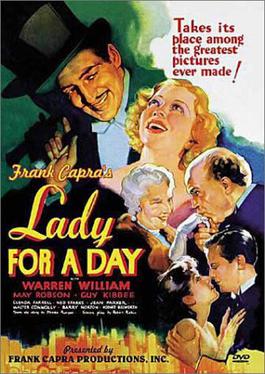
Lady for a Day (Photo credit: Wikipedia)
by Dean | Nov 24, 2015 | General
Among the stories in the 1962 volume of The Best American Short Stories, published by Houghton Mifflin, are two whose themes are related to religious faith. One of them, “The Model Chapel,” was written by Sister Mary Gilbert and has to do with the raising of money to build a new college chapel. It begins with the use of plastic pigs (from a savings and loan company) as receptacles for donated cash—the convent nuns like the idea—but it isn’t long before an examining priest mandates that the pigs be removed. This is one of the narrative details in a story focused, with mild comedy, on the dangers to spirituality: The assiduous work of chapel-financing undermines the nuns’ spiritual devotion. . . Sister Mary writes (or wrote) poetry, and although her prose here is not poetic, it is plainly admirable.
In John Updike’s remarkable “Pigeon Feathers,” 15-year-old David Kern is worried over the question of God and the boy’s future beyond the grave. His mother knows something is wrong, but at last all he gets from her are words of philosophical absurdity. She tells David she believes in God, only to subsequently state that God was made by Man! What’s more, what he hears from his minister is no better. Finally, David eyes the colors on the dead bodies of pigeons he has had to shoot, and there is an epiphany—a surprising, universalist epiphany about immortality and the Deity’s creation.
Published in 1961, these fine fictions are worth seeking out. Remember: The Best American Short Stories (1962).