by Dean | Nov 9, 2014 | General
Effervescent but never silly, convincing in her emotional range, Doris Day stars as a woman long believed to be dead—but not—in Michael Gordon’s Move Over, Darling (1963). James Garner co-stars as her well-to-do husband newly married to Polly Bergen. Day is not expected to carry the film by herself, as she so often does; Garner and others are sapidly talented, forcefully comic.
Though only mildly funny, Darling is a comedy of recognizable emotions. Cardboard characters, yes, but recognizable emotions. In addition, it is charming and involving—with a great woman-subjected-to-a-car-wash sequence.

Cover of Move Over Darling
by Dean | Nov 6, 2014 | General
Embed from Getty Images
The CW series Jane the Virgin keeps going strong.
Jane is a pretty complex character (some of the others need more complexity, and they may get it) played by an actress, Gina Rodriguez, who keeps proving just how able she is.
To no one’s surprise, the Village Voice reports that the show began with a “seeming social conservatism” but is now displaying “a rather nuanced, if not strictly progressive, sexual politics.” Are you sure it’s not a seeming sexual politics? To my mind, all the show wants to do is entertain. It cares about its characters, but has nothing to say. (Note to myself: There are plenty of more episodes to come, though.)
by Dean | Nov 3, 2014 | General
There is a lot of acquisitiveness in the Flannery O’Connor short story, “The Life You Save May Be Your Own”: Old woman Crater longs to acquire a husband for her simpleminded daughter, Mr. Shiftlet aims to acquire the old woman’s car without paying for it. Mrs. Crater lets Mr. Shiftlet stay and earn his bread on her property, intending to play matchmaker for the moneyless man and Lucynell, the daughter; and, indeed, there is a marriage. But the marriage means nothing to Mr. Shiftlet. He wishes to abandon the daughter (who has a child’s mind).
Though a miscreant, Mr. Shiftlet is not below feeling regret or even remorse. The “tramp” who shan’t be starting a family begins to sentimentalize family (motherhood, anyway) to assuage a bitterness he experiences. But bitterness all too easily gives way to despair. After a hitchhiking boy—Mr. Shiftlet gives him a ride in the car he stole—insults the man’s mother, he feels “the rottenness of the world . . . about to engulf him.” It is a rottenness with which Mr. Shiftlet knows he is united, and it triggers in him a thought about the indignation of God. It is worth asking whether Mr. Shiftlet is on his way to salvation in this Christian story. Perhaps so, but what is conveyed beyond a doubt is that, as Hebrews 10 tells us, “it is a fearful thing to fall into the hands of the living God.”

English: Portrait of American writer Flannery-O’Connor from 1947. Picture is cropped and edited from bigger picture: Robie with Flannery 1947.jpg (Photo credit: Wikipedia)
by Dean | Nov 2, 2014 | Movies
 Russian criminals in America beat the excrement out of John Wick, a former hit man, kill his beagle puppy, and steal his car. But Wick is formidable; he arms himself (after all these years) and goes out to settle the score.
To me, an action movie nowadays needs to be fluid, non-arty and halfway-sensible or it will be no blasted good—and this is the kind John Wick (2014) is. Tidy, not at all sloppy are the direction of Chad Staheslki and the film editing of Elisabet Ronaldsdottier. . . As John Wick, though, Keanu Reeves moves well but is flat, while surprisingly Ian McShane seems out of kilter. But it matters little since this commercial flick, as John Nolte says on the Big Hollywood site, “knows exactly what it is and what it promises.”
(The photo is of actors in John Wick.)
by Dean | Oct 31, 2014 | General
Tom is a college boy who is not very virile, and because of the ridicule and suspicion he elicits, the college headmaster’s wife, Laura, is kind and helpful to him. Laura herself could use some kindness, though, since she is married to a man who, though manly, resists her and is a repressed homosexual. He is seemingly jealous of Tom—a heterosexual, by the way—who knows how to receive and appreciate Laura’s sympathetic care.
The agony associated with what the human heart demands and needs is what Tea and Sympathy (1956)—film by Vincent Minnelli, play and screenplay by Robert Anderson—is about. Properly and knowingly, Minnelli put the play on the screen, and the top-notch cast from the Broadway production (Deborah Kerr, et al.) was used. The result is a truly adult film, i.e. one for an adult sensibility, presented with appreciable power. Kenneth Tynan rightly thought the play a good middlebrow work; no less so is the movie.
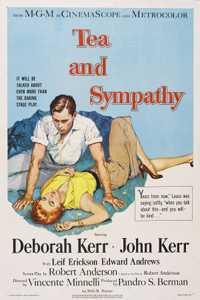
Tea and Sympathy (film) (Photo credit: Wikipedia)