by Dean | Dec 10, 2017 | General
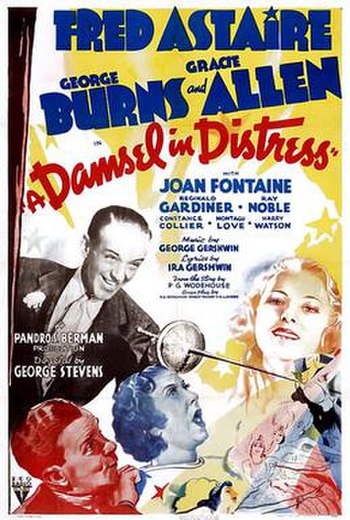
A Damsel in Distress (film) (Photo credit: Wikipedia)
Gracie Allen‘s comedy in the 1937 A Damsel in Distress is easy to take only in small doses, which is what we get (for his part, George Burns is a zero). Allen, at any rate, is not the movie’s leading lady; Joan Fontaine is, and Fred Astaire the leading man. Fontaine’s acting, however, is lukewarm, but she has far less to do than Astaire, who is his usual buoyant self. With his engaging dancing.
The George Stevens-directed Damsel has its shortcomings, but it’s a splendid musical-comedy with Gershwin songs. Its more or less fun book is mostly a P.G. Wodehouse creation, and its cast (largely American, playing Brits [with accent deficiency]) is winsome. Stevens does well in maneuvering the dancing Astaire and Fontaine outdoors around multiple trees to the tune of the very pretty “Things Are Looking Up.” And there is much to like in the wild, comic dance number set in a carnival. Other Gershwin songs, such as “I Can’t Be Bothered Now” and “A Foggy Day,” are musically and lyrically good.
The best thing about Damsel is that it’s enchanting.
by Dean | Dec 10, 2017 | General

Cover of Marathon Man
John Schlesinger‘s Marathon Man (1976) is a mediocre thriller—paranoid, rambling, even silly. Thus it is devoid of the economy and sensible content of the American crime movies of the Forties and Fifties. Yes, those movies were usually based on novels, but so is Marathon Man.
Dustin Hoffman and Roy Scheider are wholly remarkable here. They don’t belong in a wholly unremarkable film.
by Dean | Dec 7, 2017 | General
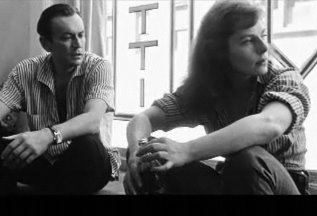
Weddings and Babies (Photo credit: Wikipedia)
Weddings and Babies (1958) is, like Little Fugitive, an American independent film by Morris Engle; and, again, the setting is New York City. A Swedish-born young woman, Bea (Viveca Lindfors), desires to be married to her photographer boyfriend, Al (John Myhers); but Al lacks the confidence that marriage is for him and even that he loves Bea. He goes through a quite miserable day on which he in fact announces upcoming nuptials with Bea and later sees her pulling away. Plus his new camera gets broken.
Only now and then does the film limp along; the rest of the time it is pretty agreeable. Resembling a short novel, it is properly a short movie, not lacking in interesting characters. Except for the coda, its conclusion focuses exclusively on Al, who is asked by a priest to photograph a concurrent wedding (Al wants a future in which he does not take pictures of weddings and babies), and he agrees. The flashbulb on the broken camera fails to work, though, and this is apparently a sign to Al that he must move on in life and both marry and love the woman who has pulled away from him. Engle, who wrote the script originally for the screen, did not mean for the ending to be moving, but only authentic. Which it is. In fact it’s a more artistic ending than the one supplied for Little Fugitive. Bravo!

by Dean | Dec 5, 2017 | General

Cover of White Dog – Criterion Collection
I wonder whether they’ll ever make a movie about today’s black-on-white violent crime, of which there is a lot. What was made instead, though it was decades ago, was Sam Fuller‘s White Dog (1982), about a dog trained by a sick racist to attack black people.
TV actress Kristy McNichol plays an aspiring thespian who finds the dog, initially lost, and then discovers what he was intended to be. A white dog. Like other Fuller films, this one is moderately unusual but, in addition, it shows that Fuller soundly possessed a mind.
At a training spot for animals used in movies, a black man acted by Paul Winfield painstakingly tries to cure the dog of its ugly instinct. Progress is so frustratingly slow that the dog has time to escape and, yes, actually kills a man. The film shows us the ease with which evil becomes real, becomes evident, and how lost we often are when trying to eliminate it. Fuller’s directing is far from ideal with its camera zooms and clunkiness, but the story’s power to disturb remains. McNichol and Winfield turn out decent, if unspectacular, performances. As always, Burl Ives is agreeably authoritative.
by Dean | Dec 3, 2017 | General
Harry Kleiner‘s screenplay for the Samuel Fuller film, House of Bamboo (1955), consists of too many coincidences for the plot to hold up well, but it’s interesting to see American gangsters in Tokyo (post-WWII). What they’re doing is robbing U.S. ammunition trains, and since the trains are guarded by American soldiers and Japanese policemen, I don’t know why the crooks are so successful. But they are, and so it’s time for military law enforcement to get really active. They send a man’s man named Eddie (Robert Stack) to infiltrate the gang, and Eddie’s Japanese lady friend, Mariko (Shirley Yamaguchi), ends up helping in a big way. At one point we fully expect Mariko to be killed or at least beaten to a pulp, but it doesn’t happen. . . Now that Americans are done fighting the Japanese, they’re having to fight other Americans—hoodlums.
The main hoodlum, Sandy, is enacted with smooth potency by Robert Ryan. He adds to the high entertainment value of this unique thriller.