by Dean | Mar 11, 2018 | General
True to Hollywood’s mixed genre tendency, Game Night (2018) is an arrant comedy-adventure starring Jason Bateman and Rachel MacAdams. Although the action of the adventure is stronger than the zippy comedy, some of the jokes are quite amusing. Others, though, are desperate or boringly vulgar (stuff about penis size) or not as witty or intelligent as the filmmakers think, as when Bateman wants his unborn child to eventually learn Mandarin because “China is the future.” This last one, in fact, isn’t even funny.
Game Night is solidly, sometimes scintillatingly (Kyle Chandler, Jesse Plemons) acted. I consider it a bit too playful and cheeky for its own good, but it is a fun piece of harmlessness. And how can the directorial work miss? The flick has two of them—directors, that is.
by Dean | Mar 7, 2018 | General
Though overlong, the French film Populaire (2013) is an entertaining homage to American movie comedies of the Fifties, taking place in 1959. Deborah Francois plays an appallingly incompetent secretary who nevertheless has an amazing knack for typing, while Romain Duris enacts her boss, an insurance man, intent on coaching her in ten-finger (instead of two-finger) typing for several lauded speed-typing contests. Eventually romance blooms, for, after all, the boss is a young man essentially deprived of love and the secretary is a small-town girl in Lisieux who has no beau and is probably a virgin.
Populaire is a seriocomic Doris & Rock-like movie with brief mild nudity thrown in. It understands that an item like Pillow Talk contains strong hints of sexual desire while it readily respects the mores of the time. The same respect exists in this current film directed by Regis Roinsard even as sexual desire is realistically more than hinted at. Really, the movie is in love with pop culture, nostalgically so. Even the pink typewriter necessarily becomes a pop culture element. The film is not as funny as the Fifties’ American comedies (even Hawks’s Monkey Business) but it is rich and buoyant. It has a fine cast too, although Duris does not even come close to declaring his love for the typist convincingly.
No bete noire is Populaire.


English: Screenshot from Linux software KTouch. An image of the Home Row keys for touch typing. Suomi: Kymmensormijärjestelmän sormien paikat. ???????: ??????????????? ?????? ????? ?????? ????????????? ????????? KTouch (Photo credit: Wikipedia)
by Dean | Feb 28, 2018 | General
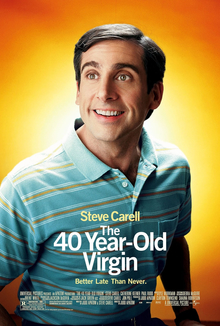
The 40-Year-Old Virgin (Photo credit: Wikipedia)
After seeing Judd Apatow‘s The 40 Year Old Virgin (2005) again, I was surprised to discover how frequently boring it actually is (e.g., the nightclub sequence). It tries to be engaging through highly sexual talk and very daring sight gags. With the latter it sometimes succeeds, as in the speed-dating footage. The successes that are there manage to be funny, but to me the movie in toto is not funny enough, and is overlong. Worse, it is insanely and relentlessly adolescent. Er. . . boredom, anyone?
by Dean | Feb 22, 2018 | General
The Siege of Trencher’s Farm, a 1969 novel by Gordon M. Williams, is about the cold and violent impulses of the plebes in rural England. It inspired the making of the Peckinpah film, Straw Dogs, a good picture but not very faithful to Williams’s novel. As in the film, even so, an American man married to an English wife is forced to violate his humanitarian conscience when some Brit bullies besiege his home. They demand that the “Yank” turn over to them a man even more morally repulsive—he murders little girls—than they are. But the man is puny and not in his right mind, and George, the Yank, refuses to yield to the chaps, whose scorn is decidedly for a child-killer and an American.
The novel is also about what being a man means apropos of having a wife—specifically, a very flawed one.
Close to being a mere potboiler, Siege is nevertheless splendidly exciting and sharply uncompromising. With its palatable plot, it itself would make a good movie.
by Dean | Feb 14, 2018 | General

Cover of Dark Passage (Keepcase)
A 1947 Delmer Daves picture, Dark Passage, has Humphrey Bogart (character name: Vincent Parry) as an alleged wife killer running from the law. “Alleged” is as far as it goes: a woman called Irene (Lauren Bacall) knows he is innocent, hides him and supplies him with money. Wanting a new face, Parry uses the money for makeover plastic surgery, but what happens later? For one thing, someone aims to blackmail Irene for concealing a fugitive.
What happens, therefore, is that even the plastic surgery fails to prevent life’s contingencies from arising. Parry’s identity is known regardless, by people who, unlike Parry, are up to no good. Enemies keep filing in. There is craziness in the plot here, but it’s also one to make you think a bit. And the hard-working cast enables you to admire the acting. In its late 40s way, furthermore, DP entertains not with sex but, unabashedly, with violence A rowdy ride.
by Dean | Feb 4, 2018 | General
In the French novel The Loved and the Unloved (1952), or Galigai, by Francois Mauriac, Madame Agathe (or Galigai) hopes that by exerting her will she will cause a young man, Nicholas Plassac, to enter a romantic liaison with her. But Agathe is physically repelling and the efforts do not work. Mauriac has written that, for his part, Nicholas has an “idol” he must be separated from, this being not Agathe but Gilles Salone, a fellow with whom Nicholas maintains a strong friendship.
Themes in the book include the limited power of amatory love and friendship, and when sacrifice is less than moral. It is shown that idols go, like life itself, and there is the idea of divine love at dead ends. About a particular character in the book, Mauriac writes, “It was as though he had agreed with somebody to meet him there,” the “somebody” being God.
Though not perfect, The Loved and the Unloved is a probing novel which certainly should be read more than once, as I have done. In its translation by Gerard Hopkins, it was penned with lovely and clever clarity: “that living silence of the night which is the very peace of God”. . . “She could feel in her flesh what such a night must mean to two young creatures pressing together under the tulip-tree, two creatures whose happiness she was about to sully.” Mauriac was a writer, all right.
by Dean | Feb 4, 2018 | General
Books and stories.
by Dean | Jan 28, 2018 | General
Robert Louis Stevenson wanted Treasure Island to be a fun book. Victor Fleming‘s adaptation (1934) is a fun movie. Without mugging, Wallace Beery carries the production as Long John Silver. The love of loftiness and the wise shots prove that Fleming was the right man chosen to direct Gone with the Wind, and yet Treasure Island is free of GWTW‘s deepest artifice. It’s a robust pic, although I agree with Otis Ferguson about “the extended sentimentality”—goodbye, just desserts—at the end.
by Dean | Jan 26, 2018 | General

Nader and Simin, A Separation (Photo credit: Wikipedia)
The chief character in Asghar Farhadi‘s A Separation (2011), Nader (Peyman Maadi) refuses to admit to his wrongdoing. Frustrated, he will not pay a disappointing caretaker of his sick father her proper wage and pushes her out the door of his apartment to get her to leave. The caretaker, Razieh (Sareh Bayat), who is pregnant, takes a minor fall and subsequently miscarries. She and her angry husband blame Nader’s push for the miscarriage, thus an accusation of murder is made. But, regardless of everyone’s suspicions, the evidence for this is not there. (Does it matter to Iranian society?) What’s more, Razieh herself refuses to admit to wrongdoing. Yet I agree with David Edelstein that “What makes [A Separation] so good is that no one is bad.” They’re just put-upon and fearful.
There is nothing genuinely good about familial separation in Farhadi’s vision. Nader’s wife Simin (Leila Hatami) tries to divorce Nader because he will not leave Iran to go with her to a country more beneficial to their daughter. Rightly the man declines to leave his Alzheimer’s-stricken father. Simin’s desire to separate, and Nader’s willingness to let it happen, opens the door to a painful labyrinth. A grand hiding of the truth emerges. All the not-bad souls suffer, but they resemble most of those Chekhov characters who, rather than shoot themselves, respectably go on living. Fortunately, Farhadi is not hiding the truth.
(In Farsi with English subtitles)
by Dean | Jan 23, 2018 | General
A German film from 1988, The Actress (Die Schauspielerin), directed by Siegfried Kuhn, is about an emotionally vulnerable but also strong-minded theatre actress (Corinna Harfouche) who discards her career in Nazi Germany in order to be with her relocated Jewish beau (Andre Hennicke). Strange times, with their ludicrous (anti-Jewish) propaganda, drive the actress to do some strange things. A major theme in the film is that political injustice, political evil, works on the mind. Indeed, a person may even embrace what is fatal.
An East German production, Kuhn’s opus is subtle, unpretentious and lovely-looking. Harfouche is extraordinary: talk about power, incisiveness and personality!
(In German with English subtitles)