by Dean | Dec 22, 2017 | General

Cover of Romeo & Juliet
The famous 1968 Romeo and Juliet, by Franco Zeffirelli, tries too hard in its cinematic realization. Much is overdone, such as the loathsome performance of John McEnery as Mercutio; and, withal, too much of the text is cut. The killing of Paris, for example.
I agree with Philip T. Hartung about “the terrific fight between Romeo and Tybalt,” and—except for Juliet’s distracting cleavage in the balcony scene— the film’s sensuality works quite well. Leonard Whiting and Olivia Hussey play the classic lovers and they’re not bad, but they’re defeated by something: the film lacks tragic anguish, true tragic darkness. We don’t feel the wound. The movie is too noisy, too busy, and too commercial for tragedy to force its way through. I said it tries too hard, but with tragic anguish it doesn’t try hard enough.
by Dean | Dec 19, 2017 | General
There is excellent work from actors Laurie Metcalf, Lois Smith (as a nun) and Saoirse Ronan in Greta Gerwig‘s movie, Lady Bird (2017), and pretty appealing work from Gerwig as well. Ronan enacts “Lady Bird,” or Christine, McPherson, an adolescent girl who attends a Catholic high school and who frequently fights with her intolerant if concerned mother (Metcalf).
Director Gerwig wrote the intelligent screenplay, never lapsing, unlike other small-film scenarists, into smug pseudo-intellectualism. Up to a point, even so, her writing is schematic: Lady Bird drifts away from her best buddy and befriends a cool beauty, who disappoints her. Chastened, she then returns to her best buddy with customary sentimentality resulting. A letdown, this. Also, the film could use more psychological believability, as when the defensive Lady Bird literally pleads with her mother to be reasonable about her going to an Eastern college.
But many jewels are glittering in Lady Bird. It presents interesting characters and dialogue, and it boasts a lovely ending involving a church and a phone call. It is, I think, a film that believes in God, along with being respectful of its few devoutly Catholic figures.
by Dean | Dec 18, 2017 | General
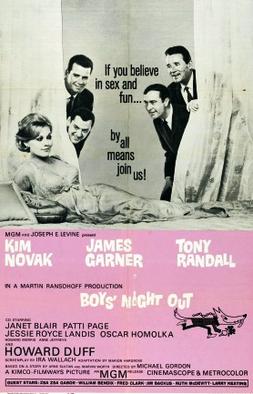
Boys’ Night Out (film) (Photo credit: Wikipedia)
A top-notch comedy, Boys’ Night Out (1962) proffers three corrupt married men who want an out-of-town pad where they can be serviced by a willing girl. Under protest, a bachelor friend played by James Garner finds for the men both the pad and the girl (Kim Novak), who is not what she seems. Instead of a floozy, Novak is a sociology student intending to study the suburban gents. Falling for her and pitching his woo, Garner is confused, for he doesn’t understand the masquerading girl’s personality. Naturally, after the wives of the corrupt men learn of their husbands’ adultery, there is zany pandemonium.
The film was deftly directed by Michael Gordon, who fashioned Pillow Talk. Scripted by Ira Wallach (adapting it from a story), it’s mildly charming and moderately funny, which means it’s funnier than most of the old black-and-white screwball comedies, good as they are. The restrained farcical acting of the cast is proper, although none of it is too restrained. Kim Novak is more feminine than Doris Day but has less personality, and yet she is credible. Tony Randall and Fred Clark make a splash.
Boys’ Night Out tells us that the sex drive, though men obey it, is not all that strong, really. It says this while being decent enough to maintain a respectable attitude toward Novak’s lovely non-sexpot and, more or less, the other women in the film as well.
A sapid romp. –
by Dean | Dec 14, 2017 | General

Film poster for The Brown Bunny – Copyright 2004, Wellspring Media (Photo credit: Wikipedia)
In The Brown Bunny (2005), a film he wrote, directed, edited, etc., Vincent Gallo stars as a motorcycle racer whose amatory attachment is to Chloe Sevigny‘s Daisy. The pair being separated, the racer tracks Daisy down in Los Angeles after purposefully abandoning three female strangers with whom he might have gotten intimate. The two lovers are messed-up people, one more messed-up than the other. This is Daisy, a doper and possible tramp. . . The film is evocatively directed—it evokes human isolation—and there are certainly people who do not find it monotonous. But I do. And that’s not all.
Gallo considers himself a conservative and, for sure, no sexual liberalism exists in this movie. And yet it was made, finally, in a pornographic spirit. A scene of fellatio goes on forever. It’s distasteful. Is Gallo trying to say that love and tramp-y, non-marital sex do not go together? I rather doubt it, but there is no way to know.
by Dean | Dec 12, 2017 | General
1968: a public high school in Philadelphia.
This is what Frederick Wiseman, America’s most famous documentary maker, trained his camera on 50 years ago, in High School. A dandy film, it reveals perfectly the unkillable regimentation in modern schools, although the classrooms in this particular, predominately white school do not drive us to the kind of despair that dysfunctional schools in 2017 do. Still, there are problems, regimentation or no. Bad behavior runs its course, albeit we don’t see any violence or cussing out of teachers. There is some fluff in the instruction: one teacher guides her students to appreciate the “poetry” of Paul Simon. She reads aloud the lyrics to “The Dangling Conversation,” then plays a tape of the song. And clinical lectures about sex just might have run counter to the moral values of many of the kids’ 1968 parents.
On the other hand, a Spanish-language teacher inculcates what seems to be the Spanish for “existentialist philosopher.” Nope: this is not a 2017 public school.
by Dean | Dec 10, 2017 | General
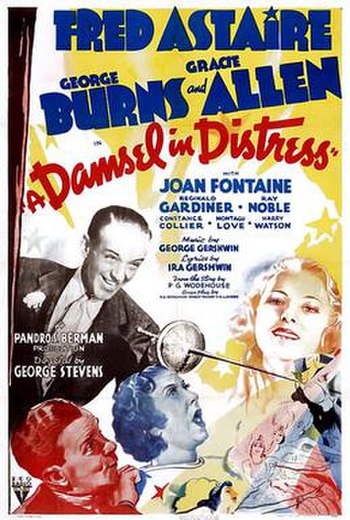
A Damsel in Distress (film) (Photo credit: Wikipedia)
Gracie Allen‘s comedy in the 1937 A Damsel in Distress is easy to take only in small doses, which is what we get (for his part, George Burns is a zero). Allen, at any rate, is not the movie’s leading lady; Joan Fontaine is, and Fred Astaire the leading man. Fontaine’s acting, however, is lukewarm, but she has far less to do than Astaire, who is his usual buoyant self. With his engaging dancing.
The George Stevens-directed Damsel has its shortcomings, but it’s a splendid musical-comedy with Gershwin songs. Its more or less fun book is mostly a P.G. Wodehouse creation, and its cast (largely American, playing Brits [with accent deficiency]) is winsome. Stevens does well in maneuvering the dancing Astaire and Fontaine outdoors around multiple trees to the tune of the very pretty “Things Are Looking Up.” And there is much to like in the wild, comic dance number set in a carnival. Other Gershwin songs, such as “I Can’t Be Bothered Now” and “A Foggy Day,” are musically and lyrically good.
The best thing about Damsel is that it’s enchanting.
by Dean | Dec 10, 2017 | General

Cover of Marathon Man
John Schlesinger‘s Marathon Man (1976) is a mediocre thriller—paranoid, rambling, even silly. Thus it is devoid of the economy and sensible content of the American crime movies of the Forties and Fifties. Yes, those movies were usually based on novels, but so is Marathon Man.
Dustin Hoffman and Roy Scheider are wholly remarkable here. They don’t belong in a wholly unremarkable film.
by Dean | Dec 7, 2017 | General
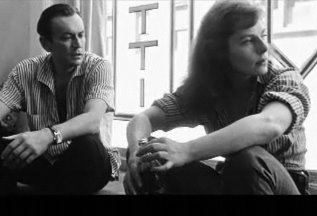
Weddings and Babies (Photo credit: Wikipedia)
Weddings and Babies (1958) is, like Little Fugitive, an American independent film by Morris Engle; and, again, the setting is New York City. A Swedish-born young woman, Bea (Viveca Lindfors), desires to be married to her photographer boyfriend, Al (John Myhers); but Al lacks the confidence that marriage is for him and even that he loves Bea. He goes through a quite miserable day on which he in fact announces upcoming nuptials with Bea and later sees her pulling away. Plus his new camera gets broken.
Only now and then does the film limp along; the rest of the time it is pretty agreeable. Resembling a short novel, it is properly a short movie, not lacking in interesting characters. Except for the coda, its conclusion focuses exclusively on Al, who is asked by a priest to photograph a concurrent wedding (Al wants a future in which he does not take pictures of weddings and babies), and he agrees. The flashbulb on the broken camera fails to work, though, and this is apparently a sign to Al that he must move on in life and both marry and love the woman who has pulled away from him. Engle, who wrote the script originally for the screen, did not mean for the ending to be moving, but only authentic. Which it is. In fact it’s a more artistic ending than the one supplied for Little Fugitive. Bravo!

by Dean | Dec 5, 2017 | General

Cover of White Dog – Criterion Collection
I wonder whether they’ll ever make a movie about today’s black-on-white violent crime, of which there is a lot. What was made instead, though it was decades ago, was Sam Fuller‘s White Dog (1982), about a dog trained by a sick racist to attack black people.
TV actress Kristy McNichol plays an aspiring thespian who finds the dog, initially lost, and then discovers what he was intended to be. A white dog. Like other Fuller films, this one is moderately unusual but, in addition, it shows that Fuller soundly possessed a mind.
At a training spot for animals used in movies, a black man acted by Paul Winfield painstakingly tries to cure the dog of its ugly instinct. Progress is so frustratingly slow that the dog has time to escape and, yes, actually kills a man. The film shows us the ease with which evil becomes real, becomes evident, and how lost we often are when trying to eliminate it. Fuller’s directing is far from ideal with its camera zooms and clunkiness, but the story’s power to disturb remains. McNichol and Winfield turn out decent, if unspectacular, performances. As always, Burl Ives is agreeably authoritative.
by Dean | Dec 3, 2017 | General
Harry Kleiner‘s screenplay for the Samuel Fuller film, House of Bamboo (1955), consists of too many coincidences for the plot to hold up well, but it’s interesting to see American gangsters in Tokyo (post-WWII). What they’re doing is robbing U.S. ammunition trains, and since the trains are guarded by American soldiers and Japanese policemen, I don’t know why the crooks are so successful. But they are, and so it’s time for military law enforcement to get really active. They send a man’s man named Eddie (Robert Stack) to infiltrate the gang, and Eddie’s Japanese lady friend, Mariko (Shirley Yamaguchi), ends up helping in a big way. At one point we fully expect Mariko to be killed or at least beaten to a pulp, but it doesn’t happen. . . Now that Americans are done fighting the Japanese, they’re having to fight other Americans—hoodlums.
The main hoodlum, Sandy, is enacted with smooth potency by Robert Ryan. He adds to the high entertainment value of this unique thriller.