by Dean | Nov 17, 2015 | General
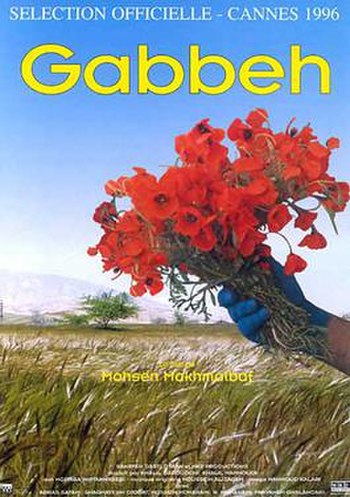
I don’t understand the meaning of the strange Iranian film, Gabbeh (1996).
Its protagonist is a girl who yearns to wed a man who howls exactly like a wolf but doesn’t seem to be one. He’s a man. A lot happens, even so—a mystifying lot—before the couple elope on horseback. Love, resentment, birth, old age, death—the film poetically touches on all these matters. I haven’t seen any of director Mohsen Makhmalbaf‘s other pictures, but they’re supposed to be political. This one isn’t. It appears to have something to do with existential truth, but is as figurative as it is visually entrancing. I take Makhmalbaf to be an ambitious artist.
Postscript: I have seen the director’s 2001 film, Kandahar, and was much impressed by it.
Gabbeh (film) (Photo credit: Wikipedia)
by Dean | Nov 15, 2015 | General
Brian Moore‘s novel, The Colour of Blood, was published in 1987, before the fall of Communism in the Soviet bloc. Its engaging action occurs in an unnamed Eastern European country, and the leader of the Catholic church there, Cardinal Bem, is a man honorable and peaceable and not at all fanatically anti-government.
However, as in his novel Black Robe, Moore, clearly lapsed, attempts to present the Catholic church as morally unworthy—unworthy in a way Cardinal Bem is not. For there exists in this church a politically extremist faction which manages to kidnap Bem with the aim of blaming it on the Communist government. False blame, then, will fall upon the Reds, but honest blame belongs to the Catholics.
Moore understands the far-reaching complexity in countries where there is tension between totalitarians and religious institutions, but he refuses to side with Catholic institutions. Indeed, he tacitly deems the Church philosophically suspect since even the silence-of-God idea springs up before the novel’s last sentence—“The silence of God: would it change at the moment of his death?” To tell the truth, it is no wonder Moore was Graham Greene‘s favorite living novelist. Both men are unsuitable intellectual guides.
by Dean | Nov 13, 2015 | General
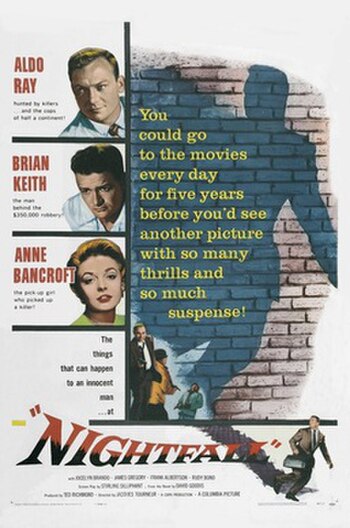
Aldo Ray is a mere marionette of an actor in Jacques Tourneur‘s Nightfall (1957) and Anne Bancroft provides little personality in her role. But the film itself is a knockout, finely directed and savvily adapted from a novel by screenwriter Stirling Silliphant. It tells of a free-lance artist (Ray) erroneously believed by murderers—and a possible policeman—to have made off with the evildoers’ loot.
There is nothing of a marionette in Brian Keith; he is disturbingly human, engrossingly true as John, one of the killer-crooks. His character leaves the impression that he should have been a good man. Thanks to Tourneur, there is a nifty scene inside and outside a shack which emphasizes John’s estrangement, all firearms raised, from his fellow murderer (slimy and played by Rudy Bond).
Nightfall (1957 film) (Photo credit: Wikipedia)
by Dean | Nov 10, 2015 | General
Matthew Weiner, the creator of the series Mad Men, is probably more politically liberal than conservative, and yet a final-season episode of his show acknowledges that Nixon, in 1969, was trying to end the Vietnam War, something leftists all over the country strongly doubted. It is the Republican politician Henry Francis (Christopher Stanley), not Nixon, who receives a jab for mendaciously saying he supports the President’s objective instead of the war effort, but such dishonesty emanates from pols on both the Right and the Left. And it emanates from the basically liberal but oversensitive and scurvy Pete Campbell (Vincent Kartheiser), involved with a new girlfriend in the final season after his nice wife spurned him for his adultery.
The Mad Ave master, Don Draper (Jon Hamm), makes no political pronouncements but merely adheres to his religion of Coming Out On Top. What he quietly realizes, however, is that without family he is too often on the bottom. His physical separation from wife Megan (Jessica Pare), whom he can love (but does he?), parallels his separation from his children and, to be sure, his first wife. Don cannot afford to let HIS religion trump family love, and an episode persuading us to believe this ends with daughter Sally (Kiernan Shipka) flatly but sincerely telling Don, “Happy Valentine’s Day. I love you.” It is one of the many scenes that demonstrate how much Mad Men concentrates on the human heart.
Mad Men (Photo credit: Wikipedia)
by Dean | Nov 8, 2015 | General
Needless to say, the computer-animated The Peanuts Movie (2015) contains a lot of humor. What it lacks is the excellent wit of Charles Schulz‘s A Charlie Brown Christmas and, of course, the comic strip, although this is not to say it completely lacks wit. No, sir.
Scriptwriters Craig Schulz (Charles’s son) and Bryan Schulz (grandson) purvey a Charlie Brown who causes problems for others as much as for himself, albeit one who is assuredly spared is the sad sack’s love interest. The movie’s central element is C.B.’s hope of impressing The Little Red-Haired Girl, a newcomer to the neighborhood and, here, a lass whose face is very slowly revealed in full. Amid all the slapstick, Chuck keeps his distance from her—but, withal, he does make progress and so a certain sunny vision arises in the flick.
No, it isn’t quite what Charles Schulz gave us, but I agree with the critic who said the movie feels like “the return of an old friend.”
by Dean | Nov 3, 2015 | General
I wish the creators of Jane the Virgin hadn’t made Luisa a lesbian because, as far as I’m concerned, Yara Martinez, who plays her, is too lovely to be one. (Lipstick lesbians are too lovely to be lesbians.) But, well, make her one they did; and so what we have is some curious comic action involving a lively beauty who’s uninterested in men. What a drag. At any rate, the comic action is there: While Jane fusses with the baby, poor Luisa gets kidnapped by men who handle her with kid gloves until they unfeelingly whack her in the leg. (What’s up with that?) Luisa is a SOMEWHAT engaging character—she’d be more engaging in the arms of a man—and Martinez portrays her skillfully. I fear the actress might be boring in serious moments, but in comic ones she can do funny desperation. Counts for a lot.
by Dean | Nov 1, 2015 | General
Rambling Rose (1991), starring Laura Dern, pretends to be consequential but isn’t. It’s as trivial as that 1984 flick with Sally Field, Places in the Heart, which at least features a nice slice of Christianity. Rose has no real interest at all in Christianity and no good reason to exist. If its nonexistence were a fact, we would be spared Elmer Bernstein‘s saccharine music and a slight adolescent vulgarity.

Cover of Rambling Rose
by Dean | Oct 29, 2015 | General
Preston Sturges based his script for The Lady Eve (1941) on a story by one Monckton Hoffe and then directed what was one of the best screwball comedies of the Hollywood-studio years. In it, a father-and-daughter con artist team attempts to bamboozle a wealthy young snake expert (Henry Fonda) but, as it happens, a cynic, the daughter (Barbara Stanwyck), falls for a non-cynic, the young man. She never misses a beat. Imperturbably she aimed to cheat him at cards, now she imperturbably likes the fellow and says no to cheating him—except that he soon breaks up with her.
The old charmer, Sturges, is at it again—teasing us with hard reality before proving once more that he’s in a romantic mood. The hard reality is Stanwyck’s elaborate plot to—get even?—with Fonda, who does need to learn a little lesson.
Even more fun than The Great McGinty, Eve is a farce of manners, an unfrothy romp. Stanwyck is fine in her juicy role, but I like Sturges’s The Palm Beach Story a bit more because Claudette Colbert looks more feminine than Stanwyck.

The Lady Eve (Photo credit: Wikipedia)
by Dean | Oct 27, 2015 | General
The “girls of slender means” in Muriel Spark‘s 1963 novel of the same name live in a London hostel during the virtual end of the Second World War. Economically poor, they are also morally unformed—wayward. But among them the Catholic Spark has fashioned a Christian character, Joanna, and a character who will become a Christian, Nicholas Farraday, a future martyr.
The two of them are self-abnegators who remove themselves, sooner or later, from the world of sex, Joanna doing so with a mild quirkiness. The young woman teaches elocution of poetry, and as Ruth Whittaker has pointed out, “poetry for Joanna . . . takes the place of sex.” For his part, Nicholas becomes acquainted with the hostel and moves from intermittently sleeping with the most beautiful of the girls of slender means—Selina—to Christian service in Haiti. Both persons end up dying: they die with sacred faith.
The girls at the hostel are superficial, except that Joanna is not a girl of slender spiritual means. Superficiality here essentially means self-seeking, seeking to satisfy the appetites for sex (Selina) and money (Jane). . . The Girls of Slender Means is another well-written, humorous success for Spark—and another short Spark novel, which is good since most of its sentences call for careful attention to determine the overtones. And hooray for the overtones.

Cover of The Girls of Slender Means
by Dean | Oct 25, 2015 | General, Movies
 So far I’m indifferent to My Crazy Ex-Girlfriend. Jane the Virgin is crazy enough, for all its soapy conventionality. In the most recent episode, a Jane doppelganger called Bachelorette Jane shows up, pleading for our heroine to hurry up and choose which man to marry. She isn’t a shadowy doppelganger, though; she’s a lively reality-show doppelganger, and the gag is extended far enough to show Jane’s suitors, Michael and Rafael, being interviewed re the virgin miss’s response to them.
The gimmicks continue. At any rate it was a decent episode, better than the one two weeks ago. Poor Petra has to put up with men again, the caricatures Scott and Lachlan, but, well, she’s also culpable for throwing a major scare into Rafael. My crazy ex-wife!