by Dean | Oct 18, 2015 | General
The new movie, Sicario (2015), is about the labor of U.S. operatives in trying to wreck a horrifying Mexican drug cartel. I don’t entirely believe the film any more than I entirely disbelieve it: for example, is it not true that Kate Macer (Emily Blunt), an FBI agent, is a little slow in catching on to certain things the more mysterious federal operatives are doing?
The film propounds the idea that the only way the U.S. government can bring down those intractable drug lords is to use a vengeful Mexican sicario (hit man) who has personal reasons for killing Mr. Big. Nothing very sophisticated about this, yet I cannot deny that Sicario offers a certain sophisticated naturalism. It’s powerful. One wishes it were better, but it is not the “dismal thriller” I called Denis Villeneuve’s previous movie, Prisoners.

English: The Merida Initiative, a U.S. Counter-Narcotics Assistance to Mexico. (Photo credit: Wikipedia)
by Dean | Oct 15, 2015 | General, Movies

Amateur (film) (Photo credit: Wikipedia)
Hal Hartley’s Amateur (1995) stars Isabelle Huppert, who wanted to work with Hartley after seeing his good film Trust, as a former nun who helps and is attracted to a man with amnesia and a very ugly criminal past which he naturally can’t remember. This ex-nun, a ridiculous character, now writes pornography (!) but at least this establishes her resemblance to another woman who, instead of writing the stuff, acts in it, in porno movies. She does this unhappily; she wants a changed life. It transpires that she is married to the man with amnesia (!), who has treated her abominably and is the cause of her becoming a porno star in the first place. Why this parallel between the actress and Huppert?
First let me comment that I do believe Hartley’s film, despite its childish and inept comedy, has something to say—namely, that outside any kind of religious milieu, redemption is very difficult, slippery, something to grope for. We’re just amateurs at it. Huppert believes she is a nymphomaniac who nevertheless sensed it was God’s will that she enter a convent. Now she thinks God’s will is that she fulfill some sort of mission apart from the convent, which mission just may be her saving the porn actress, Sofia by name, from her amnesic but formerly brutal husband. But this is amateur thinking. It is true that Sofia and her spouse do not get back together, but Huppert has nothing to do with this. Neither does she herself get together with the amnesiac even though she has fallen for him: the film, you see, ends in tragedy. God’s will is often known only imperfectly and often not at all, which is something else the movie says. Sofia, too, does some amateur thinking with respect to redemption, and she ends up getting a man tortured and herself shot! No will of God in this, is there?
Then again, perhaps we should ask whether cosmic retribution figures here. A number of characters besides Sofia get shot or fall out of high windows; could it be they all deserve it? Does Sofia get plugged (though not killed) because she is not only a porn star but also a blackmailer? True, the amnesiac, who also gets shot, is not now brutal and he tells the ex-nun, “I don’t know what I’m sorry for, but I am sorry. That’s got to mean something, right?” But it may mean nothing at all if the fellow’s memory returns and, seeing what he’s missing, he returns to a life of crime, which is surely what would happen. Hartley teases us with possibilities—doing so, I’m afraid, in a flimsy film. Trust and Surviving Desire are the successful Hartley pictures (of those I’ve seen).
by Dean | Oct 13, 2015 | General
That tour de force of commercialism, Jane the Virgin, is back for a second season. Gina Rodriguez is older (31) and looks it. Andrea Navedo, the woman who plays her mother, is only 38 (!) though she could pass for 44. Which doesn’t mean Navedo isn’t pretty; she certifiably is. Yael Grobglas (Petra) is the same age as Rodriguez but seems older, and is still lovely. Past their twenties, these women have had a lot of time to develop their acting chops, and develop them they did.
At the end of Season One, Jane’s newborn baby was kidnapped, but it’s okay. He’s back. And Jane is naturally shaken and nervous over motherhood, and given to frank talk (in last night’s show) about breastfeeding. It’s just too bad it was a rather uninteresting episode. It wasn’t scintillating or adventurous. But I believe the writers tried—-and that tour-de-force commercialism, the naked drive to entertain, won’t let us down. Hope not, anyway.
by Dean | Oct 11, 2015 | General
Future technology permits five elderly people to go back to age 20 and thus elude death, but the supervisor of the project, Dana, has difficulty making these people happy about it and even keeping them in line. This constitutes part of the action in Lee Blessing’s splendid play, The Hourglass Project (2015), mounted for a very short time, as college theatre is, at the University of Tulsa.
What happens as well is that Dana fights to prevent her parents, who paid for the creation of the rejuvenating technology, from wholly erasing the subjects’ memories. Mom and Pop are cruel—just like the society in Never Let Me Go, another work which warns about the uses of technology. With the looming erasure, though, the play disappoints a little, but not much. It is still fresh and incisive enough, not to mention tragicomically sad. The same shattering effects that life brings to people near the end of their earthly time (Alzheimer’s, for example) emerge for these people after this particular scientific intervention.
TU’s production is the premiere of The Hourglass Project for regional theatre. The talented Blessing himself helped with the staging, and indeed it was—last night, October 10th—a fine production.
by Dean | Oct 8, 2015 | General
2008 saw the publication of the Marilynne Robinson novel, Home, which explores such common themes as religious faith, old age, personal failure, and forgiveness. But, as it relates what occurs between Christian believer Glory Boughton and her prodigal brother Jack, it yields a boatload of meaning which is not terribly common at all in world literature.
It affirms that for spiritual and unspiritual persons alike, life happens, as when Glory and Jack’s elderly father, a Presbyterian minister, develops severe dementia. Glory’s ex-fiance declined to tell her he was already married, and here the book paves the way for a message about how difficult it is for even a Christian to forgive. Alas, more than once Glory proves she is, to an extent, an unforgiving believer.
In addition, Home is about the mystery of the salvation of the soul. Glory says she is not certain what a soul is, but what is also evinced is that the salvation the minister father has long had is to Robinson so important that Jack wishes to convince the old gent that he now sees theological belief as valid. Nothing less than validity would cause the author to wrap up the novel with the sentence, “The Lord is wonderful.”

Cover of Home: A Novel
by Dean | Oct 5, 2015 | General
The first time I read Milan Kundera’s novel, The Unbearable Lightness of Being, I enjoyed it; when I started it a second time I was bored—an effect I don’t think any of the great classic novels of earlier decades would ever have on me with further readings. In some measure this may be because I don’t accept that an “unbearable lightness of being” exists, or might exist, as Kundera does. As a Christian I believe that being has decisive weight, which is another way of saying it means something.
However, even if it didn’t, Philip Kaufman’s 1989 adaptation of the book is not the film to convince us of it, of anything philosophically dark and enigmatic. The novel is suffused with thought; the film is only superficially thoughtful. For example, only once or twice is the titular lightness mentioned, which is hardly enough for the concept to be dramatically emphasized. Like the book, the film gets boring, though only after the first hour and a half, and the mitigation of this boredom, I must admit, comes with the occasional nudity and sex.
But via these elements Kaufman says virtually nothing; he just thinks he says something. A nexus between sex and thematic meaning seems as wispy here as the shots of the 1968 Soviet takeover of Czechoslovakia are fancy and cloying—wretched, in fact. The movie was a mistake.

Cover via Amazon
by Dean | Oct 4, 2015 | General
In The Intern (2015), director-writer Nancy Meyers creates a female character, Jules, who has it all. Or she nearly does. At the same time, Meyers has fashioned two of the kind of male characters she will value and cherish for the rest of her life: i.e., men who are enlightened about women and their jobs. One of the problems with the film is that one of these men, Ben (Robert De Niro—Jules’s intern), is a paragon of righteousness, having no faults to speak of. This is not quite the case with the other man, a stay-at-home dad to whom Jules is married. And yet . . .
The Intern is not the most realistic feminist pic you could see, and, what’s more, it’s pretty bumpy—“clumsy” (Joe Morgenstern). Truth to tell, it’s a failure, but an interesting one in which we get to see a well-grounded and sensitive performance by Anne Hathaway as Jules, in addition to Meyers’s curious imagination. Alas, there is an immature, unfunny shlub too (Zack Pearlman’s Davis)—here because every American comedy-drama has to have one.
by Dean | Oct 2, 2015 | General
Nothing spoils contest goods, such as those won by Jimmy Stewart’s Bill Lawrence in The Jackpot (1950), like Uncle Sam via the IRS. Bill gives the right answer to a radio-show question and receives the loot the federal government becomes so eager to tax, understandably prompting Bill to loudly inquire whether the “STATE [government]” will be just as grasping. You got that right, boy.
But it isn’t merely the IRS that is setting traps for Bill. The winnings eventually shake up his marriage to Amy (Barbara Hale), who sees good reason for jealous suspicion. . . Walter Lang’s playful conservative flick is, like innumerable other Old Hollywood comedies, not very funny but still entertaining. It is also forgotten—except by YouTube—but why should we forget something that has Jimmy Stewart and two very good-looking women: Barbara Hale and Patricia Medina (as a Frenchie)? More, it provides the right amount of sentiment for its unmawkish romance.
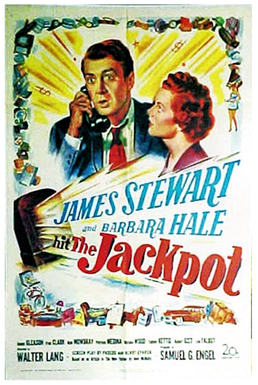
The Jackpot (Photo credit: Wikipedia)
by Dean | Sep 30, 2015 | General
Re Taylor Swift‘s Red CD (2012), which I recently heard for the first time. (I’m not much interested in her current CD, 1989.)
1) Predictably, there are too many love songs on this 16-track recording. 2) When Taylor isn’t boring me with “I Almost Do,” “Sad Beautiful Tragic,” “Everything Has Changed” and a couple of others, she’s delighting me with . . . the following:
With Liz Rose, Swift wrote the remarkable, nicely worded ballad “All Too Well,” which presents our girl as a country-pop Carly Simon, and by herself Swift wrote the calm, melodically fine “Begin Again.” “22” sounds a bit like Rebecca Black’s “Friday”: it’s optimistic catchiness. The song’s college-girl boyfriend stuff continues in “We Are Never Ever Getting Back Together,” a fun song of exasperation. By herself Swift also wrote “State of Grace,” which could use some better lyrics but is musically vivid and exciting.
Terrific as she is, Taylor Swift is not a great songwriter, but Red is an almost great CD. There is more artistry than art in her many decent-sounding songs.

Change (Taylor Swift song) (Photo credit: Wikipedia)
by Dean | Sep 28, 2015 | General
The director of Ju Dou, To Live, and Not One Less, China’s Zhang Yimou is a brilliant master. Small, amusing and sad, his Happy Times (2002) concentrates on a shortchanged person, a pared-down life—that of Wu Ying, a girl made blind by a brain tumor and treated ignobly by her husband-less stepmother. The man who wishes to marry the stepmother is Zhao, a fiftyish loser of sorts so tired of bachelorhood that he lies to the stepmother about owning a big hotel. Stirred by this, the woman asks Zhao to hire Wu Ying as a hotel masseuse; she wants the girl out of the way. Hence Zhao rigs up a phony massage room and leads Wu to believe she is servicing customers who are in reality Zhao’s helpful friends. The unseeing girl enjoys the “work” and considers these brief days the happiest of her life.
In this film one deprived soul immorally uses another deprived soul. The lying little man is luckless, but the blind Wu Ying is more so, and yet Zhao does do something for the girl. Indeed he can even be very kind to her; such paradoxes! Largely, though, he is merely kind to himself, and things go into a tailspin. For Wu, is it only through deception that happy times can be had? What’s more, self-deception appears to plague both characters.
Zhao Benshan is capital as Zhao with lower-class ordinariness and ingenuous appeal, believable as a puritanical bachelor. Dong Jie is absolutely winning with Wu Ting’s guilelessness and forbearance, but is not a cardboard saint. Zhang’s direction is standard but careful and felt, perhaps reflecting an admiration for contemporary Iranian filmmakers. Happy Times has heart; it has the heart of Not One Less, quite different from Zhang’s earlier great, nigh depressing pictures, although some might find Happy Times depressing too.
(In Mandarin with English subtitles)
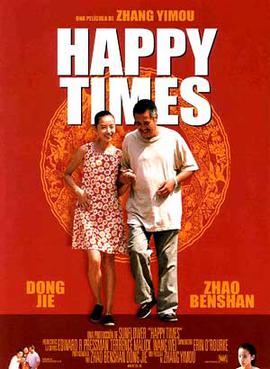
Happy Times (Photo credit: Wikipedia)