by Dean | Jan 13, 2014 | General
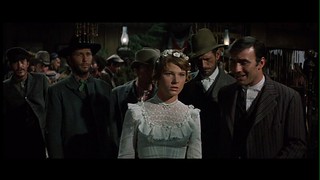
Director Sam Peckinpah had better material to work with in the days when censorship was still noticeably strong in American film, as witness his Ride the High Country (1962), an engaging Western starring Randolph Scott and Joel McCrea. Originally written for the screen, the good (though not great) script by N.B. Stone, Jr. has two aging gents transporting a bank’s gold to a mining camp in addition to helping a hapless young woman (Mariette Hartley) escape her deeply foolish, tyrannical Christian—or “Christian”—father. As a follower of Christ I might have been greatly put off by this depiction but, well, such people as this guy have been a part of human history.
The Hartley character wishes to marry a good-looking but squalid miner (James Drury) from a repulsive family. After the knot is tied, she immediately sees what a ghastly mistake she has made, and the bank guards execute a rescue which precipitates violence. At one point Joel McCrea’s old-timer declares that all he wants in life is “to enter my house [i.e., death] justified,” which is more than the other characters want, including, it seems, the other old-timer (Scott). Human behavior is quite shabby here. The film is about that which bombards, or prevents, self-respect, the knowledge that one is justified in one’s actions. It is in fact conveyed that one always feels justified in working for his bread and butter.
NTF104 hint1 (Photo credit: a75)
by Dean | Jan 10, 2014 | General
Written and directed by John Singleton in his twenties, Boyz n the Hood (1991) is no two-bit feat. It’s explosive. Even so, Singleton’s youth hamstrung him into a great naivete, and a certain decadence develops in this film about South Central L.A.
Hood‘s political significance goes no further than to show an African-American boy giving a picture of Ronald Reagan the finger, which is meant to express Singleton’s own anti-Reaganism, anti-rightism. Or to put into the mouth of a decent man acted by Laurence Fishburne words about how drugs, guns, and even liquor are being transported to the inner cities so that whites can see to it that blacks are gradually polished off. Absolutely nothing belies our suspicion that this is Singleton’s view too.
The film’s early scenes include some lame, idiotic material about an arrogant black boy (sympathetically viewed by our director) who disturbs a white teacher’s (unsympathetically viewed by our director) grade-school class. In the religion department, there is some trite philosophical talk about God, uttered by the South Central “boyz n the hood” themselves, and a Roman Catholic girl named Brandi who, despite her moral beliefs, opts to comfort Cuba Gooding Jr. by losing her virginity to him—a decision Singleton finds touching. After all this, how could I not pronounce Hood decadent?
![Cover of "Boyz N the Hood [UMD for PSP]"](http://ecx.images-amazon.com/images/I/514CX1V1WCL._SL350_.jpg "Cover of \"Boyz N the Hood [UMD for PSP]\"")
Cover of Boyz N the Hood [UMD for PSP]
by Dean | Jan 8, 2014 | General
Here we go. Two gay men take a Colorado baker, Jack Phillips, to court because he declined to bake them a wedding cake. The judge rules that Phillips either prepares the cake or pays a fine, his religious beliefs be damned.
This is hardly the first time something like this has happened. Advocates for same-sex marriage demand that people violate their consciences in the interest of something the State has legalized. They are coerced into “recognizing” its “legitimacy” (the quotation marks are necessary), but nothing but the impulse to deny religious freedom is at work here.
Such advocates say to all of us, “I want you to be a Follower.” Not a Follower of God, to be sure, but a Follower of today’s ultra-egalitarianism. I say: LET’S GO TO WAR AGAINST THIS MADNESS!
by Dean | Jan 6, 2014 | General
The French director who left me disgusted with Murmur of the Heart left me satisfied with The Fire Within (the French title is Le Feu follet—“Will-o’-the-wisp”), a 1963 gem. Louis Malle, the director, outdid himself with what is an adaptation of a novel I haven’t read about a man’s unstoppable suicide.
Life seems mainly worth living in the film, but perhaps not for Alain (Maurice Ronet), a former (?) alcoholic with no money of his own and a dissatisfying marriage to an American wife living in New York. Confidently Malle delivers a world—in 1960s Versailles and Paris—of socially undamaging psychological pathology. Quiet neurosis is almost everywhere, but Alain is the only suicidal character. Yet the film induces us to ask questions. Is Alain’s situation actually hopeless? At the beginning of the movie we see him with a mistress. Maybe for a damaged man who cheats on his wife it is hopeless. Then again, does Alain’s suicide merely emanate from what seems to be an unyielding self-absorption?
The Fire Within is challenging. For me it is a trifle hard to get through since incidents in the film are scarce, but it’s an utterly mature, smartly made artwork with enjoyable Satie music on the soundtrack.
(In French with English subtitles)

Cover of The Fire Within – Criterion Collection
by Dean | Jan 3, 2014 | General
Of all the 2013 movies I saw (there are a good number I didn’t see), the best are American Hustle, The Spectacular Now, Gravity, Blue Jasmine, Populaire and probably Renoir.
Honorable mention goes to The Place Beyond the Pines, Enough Said, The Hobbit: The Desolation of Smaug, Kick-Ass 2, and World War Z.
by Dean | Jan 2, 2014 | General
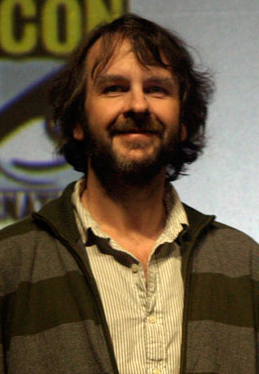
English: Peter Jackson promoting the 2009 film District 9 at San Diego Comic-Con. (Photo credit: Wikipedia)
If there are any people—I mean creatures—who have problems and struggles galore, it is the hobbit (Martin Freeman) and the dwarves inhabiting the world of The Hobbit: The Desolation of Smaug (2013). They strive and fight and run all the way to the cliffhanger ending, and the Peter Jackson serial goes on.
Granted, I couldn’t keep up with everything that happens here, but at least I knew the stakes were very high. Orcs, giant spiders and especially, a stupendous talking dragon called Smaug kept them that way. Jackson has had a very uneven career, but Smaug is an eminently watchable pop movie with Lord of the Rings visual poetry and properly built excitement.
A cramped, old-world town on a cold lake, thin blankets of spider webs in a forest, lovely vistas beyond numerous treetops—-these images and more splendidly enrich a not-so-important enterprise.
by Dean | Dec 27, 2013 | General
Inspired by the FBI’s Abscam operation of the late ’70s, American Hustle (2013), according to its own announcement after the credits, “is a work of fiction.” It is unconcerned with historical re-creation. Too, for all the focus on corruption, it is not a work of moral import, but it does do a good job of demonstrating that in life there is comedy even where there is crime: specifically, fraud. And even where there is a painful love triangle. This triangle involves two con artists (Christian Bale and Amy Adams) and the FBI agent (Bradley Cooper) who offers them impunity if they will help engineer four big-time arrests.
The characters are fun—and, better, fascinating—in this mercurial David O. Russell film as gratifyingly commercial as Russell’s previous pic, Silver Linings Playbook. Direction and editing here make for an outstandingly constructed product, and the main actors are either commandingly “natural” (Adams and Bale, in that order) or passionately credible (e.g. Jennifer Lawrence).
It may be Russell’s best movie to date. It ain’t perfect, it ain’t profound, but . . . it’s riveting. And it’s eccentric in that the women look sexy and the men, by virtue of the ’70s, look laughable.

Cover of Amy Adams
by Dean | Dec 26, 2013 | General
I have no interest in seeing the 2013 remake of Carrie, starring Chloe Grace Moretz, but the Village Voice review of it (from October) does interest me. In particular the following two sentences grabbed my attention:
“When De Palma shot the original [Carrie] in 1976, the sexual revolution had trickled down to the suburbs. Today, a new puritanism is trickling back up, with politicians and religious leaders trying to keep a new generation of young women from learning how their bodies work.”
Of course this is preposterous. Carrie in the movie was never taught about menstruation. So there are politicians and religious leaders fighting the practice of teaching menstruation to today’s real-life Carries? Are they “trying to keep” them from learning about intercourse and contraceptives too? Don’t look now, but somehow they’re finding out.
It is hardly worth bringing it up, but there is NO new puritanism going on today. This is not what Hobby Lobby, worried about insurance coverage of abortion pills and not just of contraceptives, represents.
Dream on.
by Dean | Dec 19, 2013 | General
Francois Truffaut’s French film The 400 Blows (1959) still impresses, and always will. We respond favorably to its autobiography, it holds us with its detail and moves at a nice clip. For a narrative work of art it has little to say, but the frozen-frame face of the juvenile delinquent after he has sweatily dashed to the seashore bespeaks much about being on the brink of maturity, of resignation, of personal change.
(In French with English subtitles)

Cover via Amazon
by Dean | Dec 17, 2013 | General
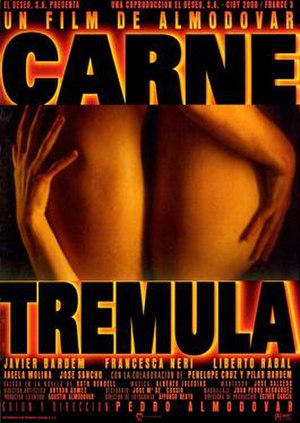
Two women, both married, are gaga over a young ne’er-do-well—and commit adultery with him. But, well, nobody’s all bad: so does Pedro Almodovar’s Live Flesh (1997)—it should have been translated “Trembling Flesh”—remind us.
The mode is that of a serious but crazy thriller, with no shortage of intriguing or droll details (e.g., TV will frequently grab a character’s attention, even in the course of a physical fight). Almodovar will do anything to keep our eyes glued to his footage, which is why he is a sensationalist. Naked body time: The big intimacy scene may well have been the most vividly sexy segment in ’97 cinema. Some of this stark stuff doesn’t work (Angela Molina shooting Jose Sancho), but on the whole Carne Tremula is a carefree, pleasurable oddity.
(In Spanish with English subtitles)
Live Flesh (film) (Photo credit: Wikipedia)