by Dean | Oct 12, 2014 | General
 Unpleasant as it is, Gone Girl (2014) is the misanthropic David Fincher movie I’ve been waiting for. I have no use for Seven and The Social Network, but this film, not merely unpleasant, is riveting and pulpy-good.
Does polished Amy Dunne (Rosamund Pike) deserve to have her skull shattered, as her hubby Nick (Ben Affleck) sort of intimates? Well, clearly their marriage has become unstable, but then Amy turns up missing and suspicion understandably falls on put-upon Nick. See the movie and you’ll know why I say “understandably.”
Astutely directed by Fincher, Gone Girl was admirably screenwritten by the woman on whose novel the film is based—viz., Gillian Flynn—and offers nicely eccentric music by Trent Razor and Atticus Ross. The acting ranges from competent (Affleck) to superlative (Pike and probably the magnetic Carrie Coon). Sex and unclothed female bazooms are there and are shot un-vulgarly.

English: Rosamund Pike at the 2010 Toronto International Film Festival. (Photo credit: Wikipedia)
by Dean | Oct 8, 2014 | General
So far we’re waiting for the maturation of such villains as the Penguin and Catwoman and of Bruce Wayne’s Batman (if indeed it takes place) in the new Fox TV series, Gotham (on Monday nights), but in the meantime there is no mere modicum of criminal activity in depraved Gotham City. All the perniciousness gives police detective Jim Gordon (Ben McKenzie) a run for his money, forcing him to consort with future costumed personages. He makes a promise to young Wayne, for example, that he will find his parents’ killer.
The sleaziness of the police force, etc. is a stale element in Gotham, and yet the show tries hard not to be boring. It can be hard-nosed fun if also a bit raffish, and there is first-rate acting from Donal Logue and Robin Lord Taylor (as the future Penguin). Some of the female thespians could be stronger.
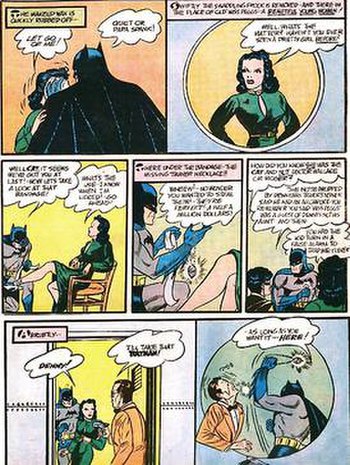
Selina Kyle’s first appearance as The Cat in Batman #1 (Spring 1940). (Photo credit: Wikipedia)
by Dean | Oct 5, 2014 | General
Who says there will be a pre-Tribulation Rapture? It doesn’t seem quite compatible with what the Bible says about the suffering of the saints, but maybe the Christians who believe in it are right; I don’t know. The 2014 Left Behind movie has a way of making the concept slightly dubious, even though this is not the apocalyptic picture’s problem. The early footage is promising, but afterwards Vic Armstrong proves he doesn’t know how to direct the film, which is why it is rhythmless, clumsy and pseudo-clever.
Left Behind is a more successful Christian action film than the very bad Trinity Broadcasting Left Behind of 2000, but this isn’t saying much. Nicolas Cage’s commanding performance as Rayford Steele, however, is enjoyable, and the not-bad Nicky Whalen (as Hattie) is a beautiful woman. You might want to try out the movie, after all.
by Dean | Oct 2, 2014 | General
In Wild Strawberries (1959), an old man and esteemed professor gets, in a way, bludgeoned for being less virtuous than others would suspect. (He’s expressionistically bludgeoned.)
Is there anything that saves this famous Ingmar Bergman film? NO. It’s tiresome glop. When it isn’t fatuous (the despairing husband who also serves as figurative judge) it’s sentimental (the old man’s gentle eyes fixed on a remembered Bibi Andersson). Plus the protag’s selfishness, etc. is usually revealed through exposition, not drama. . . In truth, art should not be as unentertaining as this.

Wild Strawberries (film) (Photo credit: Wikipedia)
by Dean | Sep 30, 2014 | General

English: Sir Alan Ayckbourn was lunching with Critics’ Circle members at the National Theatre on 22 April 2010, on the occasion of the presentation of the Critics’ Circle annual award (Photo credit: Wikipedia)
The Alan Ayckbourn play, The Norman Conquests, and its televised performance (in 1977 and available on DVD) make for a magnificent experience.
This is actually a triptych of plays featuring six British characters, all but one of them related. Many a fault, or sin, is manifest among them; many a sad moment arises. Norman is an assistant librarian and a great, rather promiscuous, lover unhappily married to a woman he nevertheless yearns for. He conducts an affair with Annie, who inwardly recoils from such a feckless man but is subtly resisted by the naïve chap, Tom, of whom she is fond. Matronly Sarah nags her husband Reg mercilessly, but is disappointed enough with her marriage to enjoy the odd attentions of the Norman she deplores.
A serious play, then, but, as everyone knows, Ayckbourn writes comedies—which is why his plays get mounted—so there is no depressing content. The cast is superlative. Tom Conti (Norman), for example, is nearly startling in his nuances. Penelope Wilton was as good an actress in her thirties as she is now, and had better material in Norman than she does in Downton Abbey. As Annie, she can be fiery but yearningly sensitive as well.
Also, I’d like to say this: Again, it is a 1977 production, and it’s refreshing to see a show which never questions whether a character who is less than a he-man, e.g. Norman, is genuinely heterosexual (instead of, say, bisexual). Behind such questioning is the wish to see homosexuality as more pervasive than it really is. No, The Norman Conquests is a strictly heterosexual comedy.
by Dean | Sep 25, 2014 | General
Federico Fellini’s 1954 film I Vitelloni (“Overgrown Calves”) proves just how satisfying an original screenplay can be. Three heads, one of them Fellini’s, produced it, and the result is a sure artistic success about life as lived by five young men in a provincial Italian town. Unambitious about traditional living—traditional living, to be sure, in an arid town—the callow “overgrown calves” are indifferent to the social values their elders know must exist.
Fellini’s direction is careful and winningly imaginative, serving a film as buoyant as it is sad. Precisely the sympathy for freakish people we want, but don’t always get, from a Fellini movie exists in spades here. Better, everything is made engaging, from characters to details.
(In Italian with English subtitles)
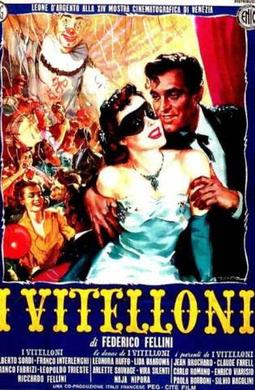
I Vitelloni (Photo credit: Wikipedia)

 Unpleasant as it is, Gone Girl (2014) is the misanthropic David Fincher movie I’ve been waiting for. I have no use for Seven and The Social Network, but this film, not merely unpleasant, is riveting and pulpy-good.