by Dean | May 7, 2012 | General
His first picture in 14 years, Whit Stillman’s Damsels in Distress (2012) revolves around three college girls who recruit a new student for their suicide-prevention center (at fictitious Seven Oaks College) and for their larger idealistic purpose of gently freeing the college from male “barbarism.” In other words, they want their milieu to be more refined, albeit the leader of the pack is the strikingly eccentric Violet (Greta Gerwig), who aspires both to help the depressed–the suicidal–and to start a new dance craze. The new recruit is reasonable Lily (Analeigh Tipton) and the other two coeds are Rose (Megalyn Echikunwoke) and Heather (Carrie MacLemore). Yes, they all bear the names of either flowers or flowery plant life.
I mentioned male barbarism, but Damsels is not a feminist film. It is, in fact, philosophically conservative. Violet says of her quartet, “We are all Christians. Or, well, Judeo-Christians”–an important line.
What Stillman, writer and director, constructs here is a world which doesn’t really exist, but through which we receive messages and implications about the world which does exist: our world. One of the implications seems to be that “God’s in his heaven” and the human condition is not so bad. (Unfortunately, after Violet loses her boyfriend and sinks into a depression, what gets her over it is not at all credible.)
Too, there’s a message that eccentricity, Salvador Dali-like “madness”, has little worth in our culture, that, according to Lily, “what the world needs is a large mass of normal people.” And it may also be that Stillman is telling us that unless we generate what we genuinely value–everything from good hygiene to sensible religious belief–naught but absurdity will prevail.
Damsels in Distress is seriocomic and intelligent. Only intermittently is it funny, but altogether it is very droll and very charming. Stillman is still not examining his characters, although this time around it is rather unimportant since he’s letting go of verisimilitude anyway. Like his Last Days of Disco, the current film ends with delightful dancing–in one sequence, to the tune of a Fred Astaire song. This is how Stillman expresses his optimism but, well, since Violet considers dancing therapeutic, maybe in addition the folks here are giving a bit of therapy a try. Who knows? It would sort of justify Violet’s nutty idea of starting a new dance craze.

Greta Gerwig (Photo credit: Wikipedia)
by Dean | Apr 29, 2012 | General
About Lust, Caution (2007):
Mr. Yee (Tony Leung), frankly, is a man who deserves to die.
Along with being a traitor to his country in the Japanese-occupied Shanghai of the 1940s, he murders and tortures resistant Chinese countrymen. Patriotic activists want to kill him; specifically, six university students do. One of them, the inexperienced and romantic Wong (Tang Wei), agrees to infiltrate Mr. Yee’s circle by befriending his wife and then becoming his mistress. By and by she will lure the evildoer to her fellow students’ gunfire. But Yee is hard to assassinate. For one thing, the sex between him and Wong, though it resembles agony, means something to Wong. She is moved by Mr. Yee’s emotion, by what appears to be love. At the same time, she does not doubt that he must die.
This is not all that’s going on. “Would you believe me,” Wong says to Mr. Yee, “if I told you I hate you?” Yee answers that, yes, he does believe her. These words are spoken because instinctively Yee knows that Wong is a member of the resistance, that she is his enemy. Maybe he suspects he is a doomed man. But he never admits this and probably hopes he can win Wong over. Critic James Bowman, in his website review, is right that Lust, Caution “transcends ideology . . . by making us see its irrelevance to the real well-springs of human action and feeling.”
This is one of Ang Lee’s best films. The man who made Eat Drink Man Woman (1994) hasn’t lost his touch, for LC is adeptly directed and acted. Its necessary eroticism earned it an NC-17 rating. . . Wong is a woman who barely conceals her passion. Her breasts are small but, when she sleeps with Mr. Yee, her nipples are powerfully erect. Copulation here proceeds in such a way that it belongs to a sphere of its own, a separate world. Fascinating and honest–this is what Lee’s superlative film, based on a story by Eileen Chang, is.
(In Mandarin Chinese with English subtitles.)

Cover of Lust, Caution (Widescreen Edition)
by Dean | Apr 17, 2012 | General
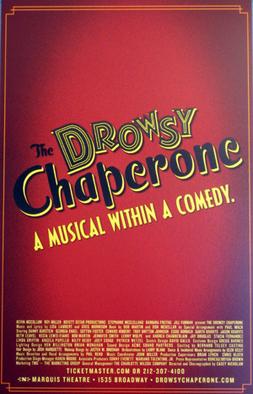
Anyone who likes musicals should experience the very charming The Drowsy Chaperone if he or she gets a chance to see it. The book by Bob Martin and Don McKellar salutes American musicals of the Jazz Age and, although it starts to sag after a while, is effectively mirthful and casually smart. The music–by Lisa Lambert and Greg Morrison–seldom disappoints. True, “Cold Feets” doesn’t cut it, but such songs as “Show Off” and “Love is Always Lovely in the End” are pleasant and exciting items. As long as the singing and dancing are acceptable (they usually were in the local production I saw), it’s a heck of a show.
The Drowsy Chaperone (Photo credit: Wikipedia)
by Dean | Apr 15, 2012 | General
Gore Verbinski’s The Ring (2002) is a Hollywood remake of a 1999 Japanese film, and I could hardly figure out what was happening in it. A horror concoction, it is strikingly creepy (aren’t they all?), but for me creepy isn’t scary.
Even so, congrats to Verbinski for his directing and to Charles Gibson for his supervision of visual effects. They make it palpable that evil exists. The sequence with the freaked-out horse is wildly, weirdly effectual, and the image of Naomi Watts holding a small, clothed skeleton while standing waist-deep in well water is sobering. I wish The Ring had been better. It has its virtues, but confusingly complex writing in a freakfest is not for me. More simplicity, please.

The Ring (2002 film) (Photo credit: Wikipedia)
by Dean | Apr 8, 2012 | General
Re El Crimea del Padre Amaro (2002):
No matter how pervasive Catholicism is, or how much headway Protestantism makes, in a country like Mexico, there will still be Latino directors and other artists who reflexively declare that Christ-followers are hypocrites.
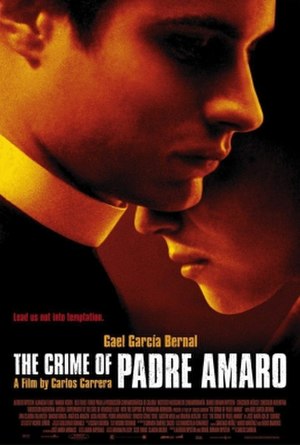
A novel written by Eca de Queiros in the 1870s, the basis for this film, afforded Carlos Carrera the opportunity to communicate this wonderful insight. He’s the director of this enterprise involving a corrupt fool of a senior priest, a girl-chasing fool of a junior priest, and the pious but sensual girl he chases. All three live decidedly worldly lives, and they’re not the only ones who do. The film is both sexy and dark, and the sexiness, I have to concede, is beautifully done. Not at all uninteresting, El Crimea (The Crime of Father Amaro) is nevertheless basically pedestrian. And ignorant–ignorant enough, by the way, to shed a measure of sympathy on “liberationist” Christianity, but not on any other form.
(In Spanish with English subtitles.)
El crimen del Padre Amaro (Photo credit: Wikipedia)
by Dean | Apr 1, 2012 | General
Ralph Fiennes has directed for the screen Shakespeare’s Coriolanus (2012). Placed by Fiennes in a modern setting, it tells of Caius Martius, a Roman general given the title-surname of “Coriolanus,” who has valiantly defeated the current enemies of Rome. Extolled for this, the general is meant to receive the political position of consul, but there are tribunes who bitterly oppose him for his pride and his lack of love for the common people. The dirt-poor mob that begins to support him is prodded by the tribunes into rejecting him, and at last it is decided that Coriolanus will be banished from Rome. The general then seeks to betray the ungrateful country by joining the very enemies he bested: the Volscians.
As James Bowman has asserted, the film is about honor and loyalty, but it also contains a sea of implications that makes it wonderfully relevant to our times. For one thing, it shows us that the electronic media does not, cannot, present honor (owing to its “radical leveling” of people–Bowman). It is clear, nevertheless, during the first 40 minutes of the movie that the world needs honor, even if, unfortunately, the honor here emanates from a tragic hero.
Further, the scandalized tribunes remind us of men of the Left who deplore all things “conservative”: They undervalue Coriolanus’s military prowess and, as I indicated, hate his non-love for the common people. And they do not win our sympathy. On the other hand, what is to be done for the Roman mob when it demands bread? (More relevance to our times.) It seems Rome is a place of neither scarcity nor economic strength.
Predictably, in its contemporary setting the film is not wholly convincing; not by a long shot. But it mainly succeeds, and is lively and engagingly performed. As both actor (he plays Coriolanus) and director Fiennes is effective.

Cover of William Shakespeare