by Dean | Nov 19, 2014 | General
The 1951 Billy Wilder film, Ace in the Hole, is one of those wherein Wilder expresses his anger over deception and skulduggery, the bilking of the innocent or vulnerable for the sake of money or prestige or sex. A newspaper reporter (Kirk Douglas) “befriends” a man trapped under rocks during a mountain cave-in, but cruelly arranges for a third-rate rescue operation in order to prolong the man’s predicament. This, the reporter believes, will make for a more important scoop, one that will possibly guarantee for the gent a New York City position.
That the lousy rescue plan is devised is not quite credible, and, unlike other Wilder films, Ace is disturbingly gray, chilly. Even so, it is one of his best. The whole of Wilder’s personality is evident in it; it’s intelligently cynical and morally meaningful. Neither Wilder nor Douglas makes the reporter a caricature; the former aims for too much unHollywood-like honesty to commit such an error.

Cover of Ace in the Hole – Criterion Collection
by Dean | Nov 16, 2014 | General
Too fancy but still fascinatingly shot, Birdman (2014) is a notable film but not a great one. Though awash in coarse language, its serious and personal nature is potent, and it can be funny. It asks how an individual’s sense of worth is to be had in the present world, especially with moral and emotional failure so pervasive. It’s a great question, notwithstanding the movie’s ending is meaningless.
Michael Keaton is extraordinary in Birdman, while Edward Norton, Emma Stone, Naomi Watts and many others are thrilling strong.
Directed by Alejandro Gonzalez Inarritu.
by Dean | Nov 11, 2014 | General
In Marc Lawrence’s Music and Lyrics (2007), Alex (Hugh Grant), a forgotten singer once a part of the raved-about PoP! band, gets a chance to write a song for, and record with, a currently famous pop queen called Cora Corman (Haley Bennett). Lacking any talent for lyrics, Alex begs a stranger—Drew Barrymore‘s Sophie—with a certain poetic sensibility to churn out some words for him. Not only do they naturally fall in love, they also struggle with the song and face the threat of severe artistic compromise, thanks to someone who represents “Buddhism in a thong,”: namely, Cora. That phrase in quotes belongs to one of the flick’s many one-liners, that which makes Music and Lyrics a funny treat until it starts limping with no hope of recovery. Dramatically crippled by Sophie’s character and, finally, some weak acting, the film proves it was made by a man who doesn’t know what he’s doing.

Cover via Amazon
by Dean | Nov 9, 2014 | General
Effervescent but never silly, convincing in her emotional range, Doris Day stars as a woman long believed to be dead—but not—in Michael Gordon’s Move Over, Darling (1963). James Garner co-stars as her well-to-do husband newly married to Polly Bergen. Day is not expected to carry the film by herself, as she so often does; Garner and others are sapidly talented, forcefully comic.
Though only mildly funny, Darling is a comedy of recognizable emotions. Cardboard characters, yes, but recognizable emotions. In addition, it is charming and involving—with a great woman-subjected-to-a-car-wash sequence.

Cover of Move Over Darling
by Dean | Nov 6, 2014 | General
Embed from Getty Images
The CW series Jane the Virgin keeps going strong.
Jane is a pretty complex character (some of the others need more complexity, and they may get it) played by an actress, Gina Rodriguez, who keeps proving just how able she is.
To no one’s surprise, the Village Voice reports that the show began with a “seeming social conservatism” but is now displaying “a rather nuanced, if not strictly progressive, sexual politics.” Are you sure it’s not a seeming sexual politics? To my mind, all the show wants to do is entertain. It cares about its characters, but has nothing to say. (Note to myself: There are plenty of more episodes to come, though.)
by DaveStuff | Nov 4, 2014 | Music
 My good friend Neal Hutto passed away around this time of year back in 2010, My thoughts often go back to memories that we shared hanging out… Talking about music and the state of the universe and all that…
He used to MC the open mic nights at the Eclipse club back in the 90’s. He made the entertainment! He would introduce me and I’d stumble drunk up on the stage and sing about abusive youth church camp leaders and such… It was fun!
Yeah… Neal was kool… I was a thug.. There were other artists and punks heckling other losers. What can I say? It was some of the best times of my crazy youth… Well I was pushing 30… But ya know
Dang I miss that guy.
I didn’t make it to his funeral but I found a copy the full eulogy of Neal on Facebook. His friend Will knew him much better than I did and said all the right things. He mentions Neal’s Riverside Drive Tape that he recorded back in 1990. He talks about some of it being digitized but I have never found it on the net..
Well here ya go… Riverside Drive (download it)
Neal was sleeping at my pad one summer and we were checking it out and I told him “lemme get a copy of that” So I simply dubbed one over….And I still have it…
I hadn’t heard that stuff in a long time… Wow! I don’t know the names of the songs but it’s quite a good little musical journey that record. Some really trippy ambient music there…
Simple and effective lyrics
“love is here to stay..I ain’t bullshitting…. Love is here to stay”
Thats the Neal I remember.
by Dean | Nov 3, 2014 | General
There is a lot of acquisitiveness in the Flannery O’Connor short story, “The Life You Save May Be Your Own”: Old woman Crater longs to acquire a husband for her simpleminded daughter, Mr. Shiftlet aims to acquire the old woman’s car without paying for it. Mrs. Crater lets Mr. Shiftlet stay and earn his bread on her property, intending to play matchmaker for the moneyless man and Lucynell, the daughter; and, indeed, there is a marriage. But the marriage means nothing to Mr. Shiftlet. He wishes to abandon the daughter (who has a child’s mind).
Though a miscreant, Mr. Shiftlet is not below feeling regret or even remorse. The “tramp” who shan’t be starting a family begins to sentimentalize family (motherhood, anyway) to assuage a bitterness he experiences. But bitterness all too easily gives way to despair. After a hitchhiking boy—Mr. Shiftlet gives him a ride in the car he stole—insults the man’s mother, he feels “the rottenness of the world . . . about to engulf him.” It is a rottenness with which Mr. Shiftlet knows he is united, and it triggers in him a thought about the indignation of God. It is worth asking whether Mr. Shiftlet is on his way to salvation in this Christian story. Perhaps so, but what is conveyed beyond a doubt is that, as Hebrews 10 tells us, “it is a fearful thing to fall into the hands of the living God.”

English: Portrait of American writer Flannery-O’Connor from 1947. Picture is cropped and edited from bigger picture: Robie with Flannery 1947.jpg (Photo credit: Wikipedia)
by Dean | Nov 2, 2014 | Movies
 Russian criminals in America beat the excrement out of John Wick, a former hit man, kill his beagle puppy, and steal his car. But Wick is formidable; he arms himself (after all these years) and goes out to settle the score.
To me, an action movie nowadays needs to be fluid, non-arty and halfway-sensible or it will be no blasted good—and this is the kind John Wick (2014) is. Tidy, not at all sloppy are the direction of Chad Staheslki and the film editing of Elisabet Ronaldsdottier. . . As John Wick, though, Keanu Reeves moves well but is flat, while surprisingly Ian McShane seems out of kilter. But it matters little since this commercial flick, as John Nolte says on the Big Hollywood site, “knows exactly what it is and what it promises.”
(The photo is of actors in John Wick.)
by Dean | Oct 31, 2014 | General
Tom is a college boy who is not very virile, and because of the ridicule and suspicion he elicits, the college headmaster’s wife, Laura, is kind and helpful to him. Laura herself could use some kindness, though, since she is married to a man who, though manly, resists her and is a repressed homosexual. He is seemingly jealous of Tom—a heterosexual, by the way—who knows how to receive and appreciate Laura’s sympathetic care.
The agony associated with what the human heart demands and needs is what Tea and Sympathy (1956)—film by Vincent Minnelli, play and screenplay by Robert Anderson—is about. Properly and knowingly, Minnelli put the play on the screen, and the top-notch cast from the Broadway production (Deborah Kerr, et al.) was used. The result is a truly adult film, i.e. one for an adult sensibility, presented with appreciable power. Kenneth Tynan rightly thought the play a good middlebrow work; no less so is the movie.
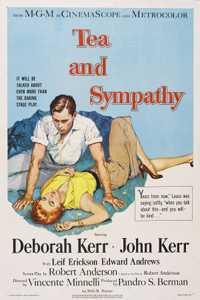
Tea and Sympathy (film) (Photo credit: Wikipedia)
by Dean | Oct 29, 2014 | General
The 1972 film Dirty Little Billy tries to be honest about the Old West and about life. Here, Billy the Kid (Michael J. Pollard) is mistreated by certain people, such as his tyrannical stepfather, before he ever becomes a violent ne’er-do-well. Several wastrels, primarily a prostitute (Lee Purcell) and her beau (Richard Evans), accept him, however, and force him to engage in gunfire against scurvy adversaries. No small amount of loss and debacle breaks out for the drifting boy.
The movie was made by two ad men, Stan Dragoti (who directed) and Charles Moss, and although it is plainly a fledgling’s achievement, it can be gripping and even fascinating. The writing is sometimes a letdown, but very little of the drama is predictable: the violent reactions, for example. And there is a nice touch whereby an American flag waving over Billy and the dingy new town he walks through bespeaks something about the country’s future: that many ignorant young ne’er-do-wells will be a fixture in the U.S. population.
(Available on YouTube)

Dirty Little Billy (Photo credit: Wikipedia)