by Dean | Aug 26, 2014 | General
Declaring it was “inspired” by the true story of a supremely successful high school football team (that of De La Salle High), When the Game Stands Tall (2014) simply does not make its material believable. Example #1: Christian coach Bob Ladouceur, played by Jim Caviezel, teaches his players that a winning streak is not the most important thing in the world, etc.; but when he feels that the boys have failed to get the message (gosh darn it!), the coach disappointedly hangs his head. The film strongly implies, however, that almost all these players are bona fide Christians, so why doesn’t Ladouceur simply let the Bible tell them what’s right and wrong?
Example #2: The coach arranges for the boys to take a field trip to a VA hospital, but exactly what this does for them is not made clear. Comic relief occurs, even so, when a wounded veteran’s urine bag bursts open in the hands of a haughty black kid (how does it happen?) who then exclaims, “Aw, heck no!”
On the subject of football Game is good, but, unfortunately, it is yet another “religious” movie with nothing significant to say theologically or Christologically. In no way does it avoid the disagreeableness of human nature, especially that of high school football players, but neither does it avoid clichés. The bullying father of a running back is one of them. The movie has so many flaws it deserves the equivalent of a 15 yard penalty.

Delasalleconcord (Photo credit: Wikipedia)
by Dean | Aug 25, 2014 | General
Larry Stevens (Dick Powell), the main character in It Happened Tomorrow (1944), is a newspaper reporter who miraculously receives, for several successive days, tomorrow’s newspaper with tomorrow’s news—i.e., the future is revealed—and he begins to exploit this marvelous knowledge.
The story is set in America in the late 1800s, and it is interesting to see such a setting without the presence of cowboys and cattle ranches. But like the Western stuff, It Happened Tomorrow is a fantasy. It was directed by Rene Clair of France, active in Hollywood for a while, and everything Clair touched turned to pixie dust. He kept his movies nicely fey: this one is an enchanting comic Twilight Zone, and a soothing love story. Tain’t original: the film derives from a play and a novel, but Clair makes it his own.

Cover of It Happened Tomorrow
by Dean | Aug 20, 2014 | General
Alice Munro’s “The Bear Came Over the Mountain” is a clever if almost dull short story about a married woman with Alzheimer’s who, while in a nursing home, grows emotionally attached to another woman’s husband, also with Alzheimer’s. It makes for a truly impressive film adaptation written and directed by actress Sarah Polley, who gives adequate attention to the sorrow and strain delivered to the sick patient’s once unfaithful husband (Gordon Pinsent). Almost dull? No. It’s absorbing. Though often with eyes too bright for an Alzheimer’s patient, Julie Christie acts with more savvy and affecting skill than she ever did in the past. Polley’s nursing-home shots are engagingly true, and her closeups make Away From Her (2006), the picture’s title, an exquisite drama of faces, especially when the camera is on Christie.
The film deals with the fallen-world madness of advanced age. The dying of a mind and the toll it takes, the senior citizen’s (ugh, that term!) longing for human consolation and companionship—this is the film’s thematic content. Culpability is another theme.
I’d like to make one more observation: Away From Her ends with Fiona, the lady with Alzheimer’s, struggling with her words as she expresses her gratitude to her husband. “You could have just driven away,” she says. “Just driven away and forsook me. Forsooken me. Forsaken.” “Not a chance,” the husband replies. It’s a tender scene but, ah, he did forsake her, really, by sleeping with Olympia Dukakis. (One more act of adultery for Pinsent’s character.) Such a thing never takes place in Munro’s story, a wise move on her part. It renders the husband a more sympathetic, a nobler, protagonist. Polley certainly appears to be an artist; Munro certifiably is.

Cover of Away from Her
by Dean | Aug 17, 2014 | General
Co-starring the late Lauren Bacall and starring Rock Hudson, Written on the Wind (1956) is about a wealthy young alcoholic, Kyle (Robert Stack), who is in most ways inferior to his best friend Mitch (Hudson), but ends up marrying the pleasant secretary (Bacall) for whom Mitch has a strong yen. Eventually Kyle, believing himself sterile, grows powerfully self-destructive and feels threatened by Mitch—who, to be sure, has no amorous liking for Kyle’s sexually promiscuous sister (Dorothy Malone) who loves Mitch.
Is this a soap opera? Oh, yes. I don’t know what the novel by Robert Wilder is like, but in the film’s first few moments, director Douglas Sirk demonstrates that we’re in for soap-opera fun. This is passionate drama usually identified as melodrama, and it’s melodrama with a theme: the dead ends encountered by love.
It isn’t art, and there is clearly a cornball use of music, but it is a handsome-looking production. Since Bacall was gorgeous but not big in the chest, the moviemakers do all they can to make Malone utterly sexy, which isn’t hard. Malone also turns out the best performance. Hudson is just Hudson—uninteresting. Unlike Written on the Wind.

Cover via Amazon
by Dean | Aug 10, 2014 | General
A Francois Truffaut film, Small Change (1976) is small potatoes.
Full of vignettes, most of them mediocre, about young boys (and one girl), the flick is vapid, intermittently sentimental, even stupid. The old Truffaut charm registers much weaker than it does in The 400 Blows, Jules and Jim, Two English Girls, etc.
(In French with English subtitles)

Small Change (film) (Photo credit: Wikipedia)
by Dean | Aug 4, 2014 | General
Hercules (Dwayne Johnson) in this new Brett Ratner movie is a trifle too naïve for my taste, and assuredly the dialogue isn’t brainy. But the battle scenes, involving Hercules and the Thracian army, are fun and sweatily compelling. Also, it was savvily photographed (by Dante Spinotti) and costumed—the actors, I mean—(by Jany Temime). Rebecca Ferguson looks like a million bucks in hers, for she’s a classical beauty—and has acting ability to boot.
Nothing great, this Hercules, but it is watchable.
Image from page 289 of “The illustrated companion to the Latin dictionary and Greek lexicon; forming a glossary of all the words representing visible objects connected with the arts, manufactures, and every-day life of the Greeks and Romans, with represen (Photo credit: Internet Archive Book Images)
by Dean | Aug 1, 2014 | General
The tale of an aging gunman in 1901 bound to die of cancer, Don Siegel’s The Shootist (1976) is not what a Western ought to be.
John Wayne performs memorably as John Bernard Books, but far more pleasure is to be had from such energetic Wayne Westerns as Stagecoach, True Grit and even the messy Red River. In contrast, The Shootist needs a pacemaker. What it does not need is decent period-piece production design, for Robert Boyle has provided it. But Siegel—he who directed Invasion of the Body Snatchers and The Line-Up—can only disappoint us with a derivative oater like this.

Cover of The Shootist
by Dean | Jul 30, 2014 | General
We’ve certainly lived with electricity a long, long time. Now, in The Amazing Spider-Man 2 (2014), it’s being used by Jamie Foxx as one of the most destructive weapons imaginable. The power was forcibly harnessed in Foxx’s character, Max Dillon, via electric eels! Oh, well.
For a superhero movie, this one is quite rich. It’s long but not overstuffed with action (stuffed, not overstuffed). Its look is wonderfully urban, varied, and pretty: kudos to cinematographer Dan Mindel. It’s an appealing love story, wherein a sensitive Peter Parker (Andrew Garfield) is frequently distraught in his relationship with Gwen Stacy (Emma Stone)—and what charismatic actors Garfield and Stone are here! Others, too, do very well.
A family pic (no sex between the principals), TAS2 is, I think, better than the first (reboot) film. Too, it beats the pillow feathers out of most of the Tobey Maguire Spider-Man movies.

The Average Spider-Man | The Amazing Spider-Man 2 Review (Photo credit: BagoGames)
by Dean | Jul 27, 2014 | General
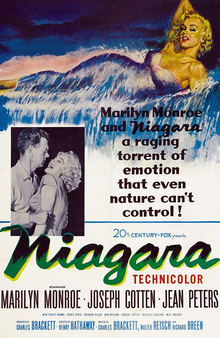
In Niagara (1953), Marilyn Monroe plays a tramp of a wife and Joseph Cotton her neurotic, harried husband. Sojourning in Niagara Falls, Ontario, the two wish to murder each other, the husband for revenge. . . Naturally, Marilyn’s beauty (in Technicolor) is luminous, but her mechanical acting mars the movie. By and by, however, it primarily becomes Jean Peters’s film, at least in the female department: She enacts a honeymooner who is the one person aware that the Joseph Cotton character is still alive after everyone else believes he is dead.
Savory touches abound in Niagara, directed by Henry Hathaway, who wanted a bit of artistic exploration. Hence there is a gripping pursuit on a staircase and a poignant discovery of a lipstick holder. There is the hazy nudity of femme fatale Rose (Monroe) behind a shower door contrasted with the wet but clothed body of innocent Polly (Peters) awaiting rescue from the river. There are even some shots anticipatory of something like L’Avventura (1960).
True, Hathaway seems pretty distant from his material, but it doesn’t matter. Its virtues keep Niagara from falling.
Niagara (1953 film) (Photo credit: Wikipedia)
by Dean | Jul 24, 2014 | General
Sergeant York (1941) is a coming-of-age and coming-to-faith story. There is much that is wrong with it, but Alvin York’s biography is interesting, even with the limited treatment it receives here. A hellion as a young man, he became a Christian and resisted fighting—resisted killing—in World War I until he discovered such Bible verses as “Give unto Caesar that which is Caesar’s . . .” It is well known that during an offensive in France York killed and captured a large number of German soldiers.
Religion is handled in a rather callow way in the film, but at least it’s treated seriously. Howard Hawks’s direction succeeds splendidly in what is a not-bad flick.

Cover via Amazon