by DaveStuff | Mar 18, 2016 | Money, Technology
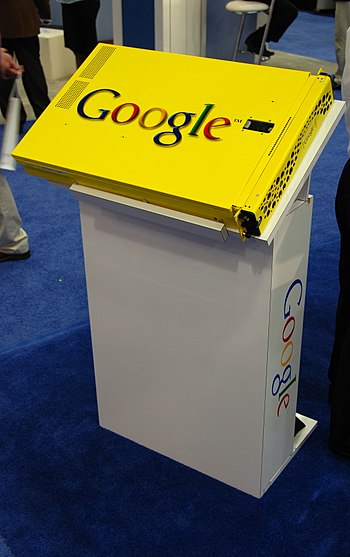
Google Appliance as shown at RSA Expo 2008 in San Francisco. It was only a computer case with no parts inside.-Daniel A (Photo credit: Wikipedia)
I got a notice from Google about my Adsense account. You can see the ad’s there on the right..(maybe) I have owned this site for several years.. I don’t blog on it much anymore. My brother uses it a lot – he is a film buff and enjoys reviewing movies .
So anyway Google sends me an email…
One or more of your sites has been in violation of AdSense policies.
Huh? What the heck are they talking about? I go over and look! Here it is! Yes.. My old blog… Violating Google Rules… What is it?
Well….The Email says:
AD MISLABELING: Publishers may not implement Google ads in a manner that disguises the ads in any way.
How am I doin that? OH…. It said ‘KEWL’ above one ad. And ‘Stuff” above another.. It can’t say that. It has to say – Advertisements’ Or ‘sponsored links’ 😉
OK… I’m glad we got that cleared up. I have had this site up since like 2008. Hmmm 8 years. Sorry I didn’t wanna break any rules…Good they got around to telling me.
I took a quick look at my balance while I was fixing the problems.. A grand total of $76.66
It’s money in the bank……
by Dean | Mar 15, 2016 | General, Movies
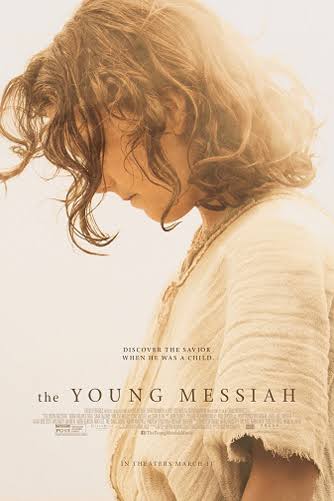 In The Young Messiah (2016) Jesus, as a young boy, does not yet know that God the Father has predestined him to be . . . everything. Alpha and Omega. The Savior of the world. Cyrus Nowrasteh crafted the film in such a way as to suggest that the earthly existence of the child is relevant to all humanity, as when he shows Jesus looking intently at various individuals. And when he shows him intermittently doing what his parents generally oppose him doing: performing a healing. How could he not be the Anointed One?
Based on an Anne Rice novel, Christ the Lord Out of Egypt, the movie explores not only the theme of destiny but also the themes of family love and loyalty, the Fatherhood of God, and the actually inescapable nature of the invisible world. . . There is weakness in The Young Messiah, and the film can get confusing. But Adam Greaves-Neal is the right fit for Jesus, along with some fine acting emanating from Christian McKay as the boy’s uncle, Sean Bean as the Roman Severus, and Sara Lazzaro as Mary. It is an interesting work with many sapid touches, e.g. several Herod-sent Roman soldiers clearly disinclined to seize the young Jesus before whom they stand.
by Dean | Mar 14, 2016 | General

Cover of Shenandoah
The Virginia farmer acted by James Stewart in Shenandoah (1965) has every intention of keeping himself and his family neutral in the War Between The States, but abundant gloom descends after Yankee soldiers make a costly mistake, etc. It is impossible to buy much of what James Lee Barrett‘s script proffers us, such as a group of Johnny Rebs escaping from Yanks on a wharf (ineptly directed by Andrew V. McLaglen.) There are some gripping and pleasurable moments, though, just not enough of them.
by Dean | Mar 9, 2016 | Movies

Cover of Late Spring – Criterion Collection
Another great, or at least very good, Yasujiro Ozu film, Late Spring (1949) concerns a young Japanese woman, Noriko (Setsuko Hara), whose 56-year-old father (Chisu Ryu) wants her to marry despite the daughter’s insistence that she is happy simply to live with and take care of the middle-aged gent. Indeed, it is a matter not only of happiness but also of obligation—in Noriko’s eyes, not the eyes of others. Sadly, Noriko feels despondent over the upcoming matrimony she has agreed to.
This Ozu (director-scenarist)-Kogo Noda (scenarist) adaptation of a novel is excellent on the theme of painful transitions, and as open-eyed about loneliness as other Ozu films. There are longueurs here and rather too much music, but certainly the film is far more interesting than the boring Noh play several of the characters serenely watch. Hara is superlative and Ozu’s style a gentle wonder ready to undergo a nice extension for such later movies as Tokyo Story.
(In Japanese with English subtitles)
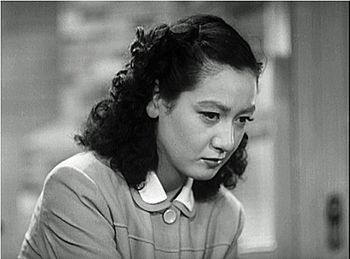
Setsuko Hara in the Japanese motion picture Late Spring (1949). (Photo credit: Wikipedia)
by Dean | Mar 8, 2016 | General
 Human relations can get so loathsome. In last night’s Jane the Virgin, a very pregnant Petra treated Jane condescendingly, bitchily, before the unexpected childbearing, and Paolo (Ana De la Reguera), who seemed so sane at first, continued to keep Rogelio captive in a non-dingy locked apartment. And then we hear that Xiomara has invited into the family’s lives a man who represents “bad luck.” The telenovela problems and antics were strong—the episode was teeming with them. Here’s one of the antics: Petra named her two newborn daughters Elsa and Anna, which names are from the animated movie, Frozen, though Petra didn’t know that.
I’ve been waiting for something meaningful to happen on Jane, as it has before, and last night something somewhat meaningful did. Jane imagined, with images on the screen, what it would have been like had she never broken up with Michael. She sees that human relations in this case would have been quite nice.
by Dean | Mar 6, 2016 | General
Directed by Marielle Heller, The Diary of a Teenage Girl (2015) is morally detached from its depiction of sexual indulgence, and, in the end, mildly stupid. An unconvincing paean to self-esteem, in fact.
No sale.
by Dean | Mar 3, 2016 | General
I like the fact that, as at least one critic has indicated, it is not the ordinary things people do in Muriel Spark‘s fiction that ultimately matter. Rather it is their sins and, implicitly, their standing in the cosmos that matter, although this is never examined gravely or angrily. Spark uses wit: she does so in 2004’s The Finishing School as she concentrates on Rowland, a would-be novelist, and Chris, the 17-year-old libertine whose seeming writing ability Rowland is madly jealous of.
Rowland is married to Nina, but there is no bona fide love between them. He may be homosexual, but this is unclear in a way his “envy of another’s spiritual good”—a catechism phrase—is not. That’s right: Chris’s artistic writing talent, if it actually exists, is seen as a spiritual good. And, as seen by the Catholic Muriel Spark, Rowland’s “obsessive jealousy” is “his greatest affliction.” Without spiritual truth, both Rowland and Chris have little or nothing going for them.
The Finishing School is clever and meaningful and probably wittier than such Spark novels as The Prime of Miss Jean Brodie and The Girls of Slender Means. It lacks, however, the viable drama of those works, and yet an irresistible intelligence saves it from any kind of hard judgment I might give it. You did it again, Muriel.

Cover of The Finishing School
by Dean | Mar 2, 2016 | General
I just barely know what the FX network is, but I know The Americans is on it, and now because it’s come out on DVD I can contentedly watch Season 3. Last night I saw the first two episodes, and learned how to stuff a naked corpse into a suitcase. (Ugh!) Further, it was surprising to see Richard Thomas—the Field Agent (?)—get whacked in the face by the well-trained Commie, Elizabeth.
by Dean | Feb 29, 2016 | General
Re The Insider (1999):
First, it is too long. Second, a large number of closeups in a movie lasting 158 minutes gets enervating. Third, it is somewhat pretentious. Fourth, Lowell Bergman, the Al Pacino character, is two-dimensional. Fifth . . . oh, never mind. Despite all its problems I’m glad this turkey was made owing to a few choice items, such as the acting of Russell Crowe, Pacino, Diane Venora, et al.
Michael Mann‘s film is a ho-hum journalistic chronicle regarding the 60 Minutes TV series and the cigarette industry. What satisfies is the way it exposes the ability of a powerful business to devastate an individual, and although here the business is Big Tobacco, Big Media can be just as culpable for such a thing. Add to this some of Mann’s directorial choices and the sublime cinematography of Dante Spinotti, “one of those rare cinematographers who know how to highlight with shadows” (Stanley Kauffmann), and you have a couple of other Insider assets. You have a movie which is artistically inviting in spite of itself.

Cover of The Insider
by Dean | Feb 28, 2016 | General
To a child, a favorite toy acquires a life of its own, with the child as its master. In the 34-minute French movie, Albert Lamorisse‘s The Red Balloon (1956), it is for a child (Pascal Lamorisse) that a balloon acquires a life of its own, magically.
This simple short became famous, and has endured, because it is beautifully and enticingly put together, inevitably in color and with several excellent set pieces. Alas, it is not very moving, but it has the kind of unfailing charm of which a director like Truffaut in his films made such a contribution. Lamorisse proved the worth of his instincts.
(In French with English subtitles)

The Red Balloon (Photo credit: Wikipedia)