by Dean | Dec 19, 2014 | General
The writer Larry Woiwode knows America to be a land that will never truly renounce Christianity both Catholic and Protestant, and this is glowingly reflected in his fiction about the Neumiller family of North Dakota.
Much of this fiction is in the form of short stories like “The Suitor”, whose protagonist, Martin Neumiller, proposes marriage to Alpha Jones. Martin is a Catholic Christian who receives bad vibes from Alpha’s feisty, drunken father and shortsighted Protestant mother; but the standard attachment to a major institution—i.e. marriage—brings resolution. The parents are happy their daughter was proposed to.
The incidents in “Marie” take place many years later, after Alpha has passed on and Martin intends to remarry. Marie is the youngest child of the couple: she has grown up without a mother and knows she cannot possibly fill the woman’s shoes for the family (“I can’t do anything right”). Yet, as Marie points out, she is the one who’s alive, she is here, albeit Woiwode demonstrates his firm belief in God by making it seem that Alpha Neumiller is not really a person of the past. Somehow she lives too, her death not looked at through a nihilistic lens.
Woiwode is a man of faith whose prose is soothingly subtle and gently penetrating.
“The Suitor” and “Marie” can be found in his book The Neumiller Stories.
http://gty.im/159463818
by Dean | Dec 14, 2014 | General
Suspend disbelief here and there, and you’ll enjoy the Francois Truffaut flick The Woman Next Door (1981) which, though it isn’t saying much, was seen by more Americans than any other foreign film in ’81.
Again, as in other Truffaut movies, there is amatory passion. Adele H. never quite committed adultery, however; Gerard Depardieu and Fanny Ardant do. Woman is about the monstrousness of temptation. Depardieu’s first mistake is not informing his nice wife that before he married he once had a love affair with new neighbor Ardant; he keeps it a secret. Naturally he soon learns that he and Ardant can’t be just friends. The tragedy which ensues is especially jarring in a movie this typically lyrical and basically simple, plainly lacking in gravity. Film buff Truffaut insisted on his achievements being serious but not grave, which is why there is something of Hitchcock in this tragedy. But whereas I am not convinced the estimable Hitchcock was an artist, I believe Truffaut was.
(In French with English subtitles)

Cover of Fanny Ardant
by Dean | Dec 11, 2014 | General
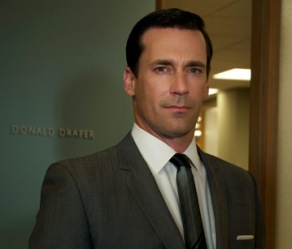
Don Draper of Mad Men works on Madison Avenue (Photo credit: Wikipedia)
Since there’s a dearth of serious, intelligent movies right now (a common event), I’ll cast an eye on the serious, intelligent TV series Mad Men.
There is nothing mad about these men of Madison Avenue: they’re perfectly sane, and usually efficient. But they can be self-defeating. I’ve been re-watching the fourth season, in which Don Draper (Jon Hamm) loses to cancer the only friend who has ever truly known him and consequently feels defeated. In following episodes, though, we see the proclivity to be self-defeating that in Draper we are used to seeing.
Probably Don wins our sympathy in this season more than in the first three, but it is unfortunate that his religion is Coming Out On Top. This leads him to some puzzling behavior, as when he expresses a preference for charming Megan (Jessica Pare) over the woman with whom he is already in a relationship: the affable, highly supportive Faye (Cara Buono). Then again, Faye might deserve better than the two-timing Don, but what about Megan? ‘Tis hard for a woman to come out on top when Draper strives to do so, for all the blessed privilege that comes her way. (Ah, the unprecedented wealth of America!) Mad Men looks at privilege warily. After all, Don’s ex-wife Betty (January Jones) is very privileged, and she unjustly fires the black nanny and won’t even give her a good recommendation.
That’s almost mad!
by Dean | Dec 9, 2014 | General
Jane the virgin in Jane the Virgin, the new CW series, is still waiting till marriage to have sex, and it would be nice to see the show’s writers respect and satisfy that aim. Curiously, she is involved with a former playboy named Rafael (Justin Baldoni). (She’s no longer engaged to the police officer, who retains his taste for the interracial.)
It was good to see the talented Yara Martinez again on the Dec. 8th episode, but not quite believable that her character, the put-upon lesbian Luisa Alver, is hauled off to a mental hospital. Martinez, for good measure, has a conventional beauty and Yael Grobglas, as Petra, an unconventional beauty. Sleek and wispy-looking, Grobglas is beguilingly adept as a conniving but not wholly self-assured future divorcee.
Good acting and good looks prevail in Jane the Virgin: the show might be a milestone in commercial effort. And a funny one at that.
by Dean | Dec 7, 2014 | General
1993’s In the Name of the Father begins with almost risible melodrama about British vs. Northern Ireland confrontation before concentrating on the 1974 bombing of a Guildford, England pub and the arrest of the Irish foursome—the Guildford Four—accused of the bombing. This included Gerry Conlon, here played by Daniel Day-Lewis, on whose book (Conlon’s, that is) the movie is based. After the melodrama, the film nicely aspires to tell the truth about young people, hippies included, just as it reveals a stoic IRA leader to be coldly inhuman.
Woe is me, though: I have read that in its anti-British tendentiousness Father is a historical fraud, yet another phony docudrama. The Guildford Four may have been guilty, and in fact some of what we see does not have the ring of truth. The IRA leader in prison with Conlon is fictitious, but that’s okay, undamaging to the film. The rub is that one wants more truth than lies in a film which is assuredly partisan. We don’t want ambiguity all but rejected because director Jim Sheridan hates the British presence in Belfast. Only this, I believe, keeps Father from being recommendable.

In the Name of the Father (film) (Photo credit: Wikipedia)
by Dean | Dec 4, 2014 | General, Movies
Re the 1937 film musical, On the Avenue:
 On the avenue, there is savory Irving Berlin music and some pleasurable singing and dancing.
Alice Faye is somewhat miscast as a jealous meanie, but as a performer she is a heartening jewel. Musically Dick Powell holds his own, and the unfunny Ritz Brothers do some pretty good hoofing. The hookiest song is probably “I’ve Got My Love To Keep Me Warm,” but “You’re Laughing at Me” and “This Year’s Kisses” also boast eminently likable and not too predictable melodies.
As romantic as it is mirthful, this vivacious flick was well directed by Roy Del Ruth.
by Dean | Nov 30, 2014 | General, Movies

Cover of Say Anything
A love story, Say Anything (1989) has the distinction of focusing on a teenaged boyfriend (John Cusack’s Lloyd Dobler) who is a Great Guy, however unambitious. The main proof that he’s a Great Guy is his romantic—or chivalrous—prowess—not aimed at just anyone but at the very pretty class valedictorian, Diane Court (Ione Skye). “I’m good at it,” Lloyd says of his companionship with Diane, but the girl’s father (John Mahoney) deems Lloyd a nice mediocrity and dislikes the relationship. Ironically, this is despite the detractor’s being in prison for accruing ill-gotten gain off a nursing home. (How naughty some of these middle-agers are!)
The girls in the film are close to being paragons of virtue, but . . . there’s also Lloyd. Over and above, SA is a good-hearted picture with inventive story elements and a fun, discerning cast. A middlebrow worthy.
Written and directed by Cameron Crowe.
by Dean | Nov 28, 2014 | General
In Joel Schumacher’s Falling Down (1993), Michael Douglas plays divorced, jobless, bespectacled Bill, who snaps under modern day pressure and starts doing deleterious things en route to his ex-wife’s house. Its first half hour is wrenchingly honest, but then it gets very wobbly. It politicizes itself by showing how terrified it is of seeming more essentially conservative than essentially liberal, when only political neutrality would have saved the day. Here and there the film is highly imaginative, and the acting of Douglas, Barbara Hershey and Robert Duvall is un-hammily not to be improved on. James Newton Howard’s score is sleek and fervid. The script, however, turns into a p.c. debacle, hoping, really, to be more ideological than artistic; and the film’s visceral power doesn’t stand a chance against that. It deflates.

Cover of Falling Down
by Dean | Nov 26, 2014 | General
Because the Flannery O’Connor novel Wise Blood is utterly fascinating (on the second reading, that is; on the first reading it meanders), the faithful film version by John Huston is utterly fascinating.
It tells of a Southern oddball who rebels against his fundamentalist Christian upbringing by preaching atheism until he discovers that, well, he cannot escape the Jesus he verbally denies. He wants Him. He has Christianity in his blood, therefore to O’Connor—and to me—he has wise blood. The film, from 1979, is deeply and idiosyncratically religious as well as ably made. It sorely lacks O’Connor’s sense of terror but not her humor. Most of the performers, e.g. Brad Dourif in the main role, do well. (Ned Beatty is immensely enjoyable.) The film’s last few minutes, though, do not compare with the poetic final paragraph in the novel, wherein the Southern rebel dies in a state of grace and, distant now from earthly existence, is perceived to be a faraway light.
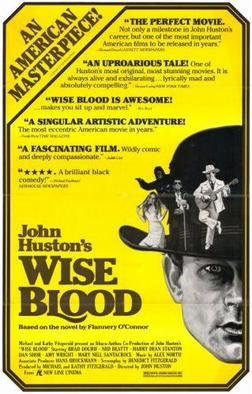
Wise Blood (film) (Photo credit: Wikipedia)
by Dean | Nov 24, 2014 | General
In Blue Ruin (2014), a recent film by Jeremy Saulnier, a loner who lives as a bum learns that the murderer of his parents is being released from prison. Hungry for vengeance, wide-eyed Dwight, the loner (played by Macon Blair), tracks down the ex-con and kills him, thus precipitating a chain of vigilante attempts as well as harrowing violence. It is clear that the film deals with what makes revenge problematic, but it also centers on the shattering messiness of life as lived by lost souls who make dark, bad decisions.
Individuals scenes in Blue Ruin are better than Saulnier’s okay writing: disbelief must be suspended a little too often. But his direction is fine and the movie is a potent nail-biter.